
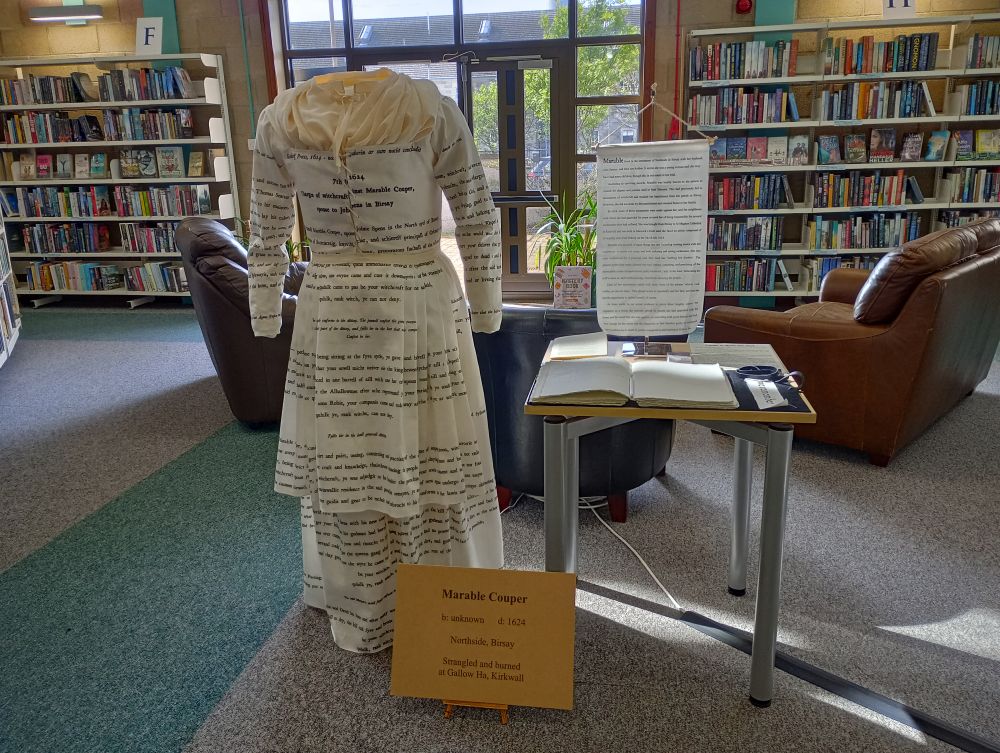

On display in Kirkwall Library, Junction Road, is a specially created linen dress by Carolyn Sutton which catalogues the accusations brought against, and sentencing of, Marable Couper, a Birsay woman, executed in 1624, charged with witchcraft.
Marable Couper lived in Northside, Birsay with her husband, John Spence, and their son Robbie. She was locally known as the person to consult for charms and potions used to treat illnesses. This had previously led to accusations of witchcraft and resulted in her banishment from her parish in Birsay. However, Marable did not abide by this punishment and returned home to her family.
In 1624, more of these accusations were made against her, and the neighbours with whom she had quarreled for years accused her of being responsible for several misfortunes they had suffered. She was brought from Birsay to St Magnus Cathedral in Kirkwall and was held in Marwick’s Hole until she faced an assize composed of 15 wealthy men from Orkney.
Marable was accused of many things that day including causing issues with her neighbours’ livestock and crops, and both inducing and curing sicknesses. She was even condemned for a practical joke they said was ‘nothing bot divelrie’. The general points they made claimed she was ‘useing, comitting, and practising of the abominable cryme of superstitioun [and] witchcraft,’ and ‘at the least, behaveing hir selff to haue sic skill and knawledge, thairthrow abuseing the people…’.
Each of her accusations ended with some form of the phrase ‘which, rank witche, ye can not deny’. This phrase seems to repeatedly seal her fate; not that she had the opportunity to defend herself, of course.
As there could be no actual evidence to prove these lengthy claims, her reputation as a witch, the rumours spread by people she had quarrelled with for years, and the belief that she was capable of controlling both good fortune and bad not otherwise easily explained, were enough for the assize and the chancellor to find her guilty of witchcraft and to condemn her to death by public strangulation and burning at Gallow Ha.

The ‘Witches in Word, Not Deed’ project remembers 13 Scottish women unjustly accused and persecuted for witchcraft under the Witchcraft Act of 1563. Through historically accurate and personalised dresses worn by empty forms, the exhibition brings attention to the loss of life and identity in which the witch trials resulted. Each dress is imprinted with the words that were used against them in some form, or in the enduring legacy of misguided folk beliefs or other falsehoods that replaced their true stories.


Artist and designer Carolyn Sutton, explained:
“Through my research on the Scottish witchcraft trials and memorialisation efforts, I came across the amazing work that has been done in Orkney. It was inspiring to see, especially with the involvement of the wider community and with the way everyone embraced this movement.
“The level of commitment to remember the victims of the trials here was incredible, and I wanted to honour that in any way I could. I had previously made a dress for a woman called Scota Bess, a woman from Stronsay who was referred to as ‘Queen of the Orkney Witches’. I still haven’t been able to uncover her history and could only find her within a local folktale, but I haven’t given up and she remains a part of the touring exhibition.
“This dress remembering Marable Couper is the fourth piece made by Witches in Word, Not Deed to enter permanent collections.
“All of the staff I have encountered at the Library & Archive, St Magnus Cathedral, and within Orkney Islands Council have been incredibly supportive and generous with their time. This couldn’t have happened without all of them, and they have my deepest gratitude.
“It was always a goal to make work remembering local women which would remain in their hometowns. The first of these was for Mary Lamont from Inverkip, which was commissioned by Watt Institution in Greenock. It can be viewed there, alongside archivist and historian Lorraine Murray’s research into the local witchcraft trials.
“Next, I was commissioned to make a dress for Margaret Thomsone and shawl for Isobel Ewart for The Calder Witch Hunt project, both of which now show in Kirk of Calder as part of their larger work. This includes a memorial stone placed in the vestry where Margaret was held for months.
“Most recently, Dunfermline Carnegie Library and Galleries commissioned me to make a bonnet remembering Lilias Adie from Torryburn, which was installed as part of their observance of International Women’s Day. It is currently shown alongside a walking stick that was made from Lilias’ casket after her grave was desecrated, her skull stolen, and pieces sold to collectors.”
As well as the dress, you can find out more in a display in the Orkney Archives about the witchcraft trials which took place in the islands. And you can find out more here too: Orkney Witchcraft Trial Source Books and Archives.

For more information about the witchcraft trials in Orkney see Volume 9 of New Orkney Antiquarian Journal: Commemorating the Victims of the Orkney Witchcraft Trials
The ‘Witches in Words Not Deeds’ Project
The exhibition is a meaningful and heartfelt moveable memorial to the roughly 4000 people accused of witchcraft in Scotland, nearly 85% of them women. It is based in the desire for social justice and hopes to create debates and conversations about the power of words and the gendered nature of the witch trials. It is an imperative asking us to remember the lives of the victims with dignity and compassion, and means to caution us against the further exploitation of this history.
The full exhibition has appeared at Central Library in Edinburgh, Grain Exchange in Ayr, Eden Court in Inverness, Watt Institution in Greenock, and Dunfermline Carnegie Library and Galleries. Several other related appearances and events have been held around Scotland.

Fiona Grahame

Donate to The Orkney News
£2.00

Leave a Reply