
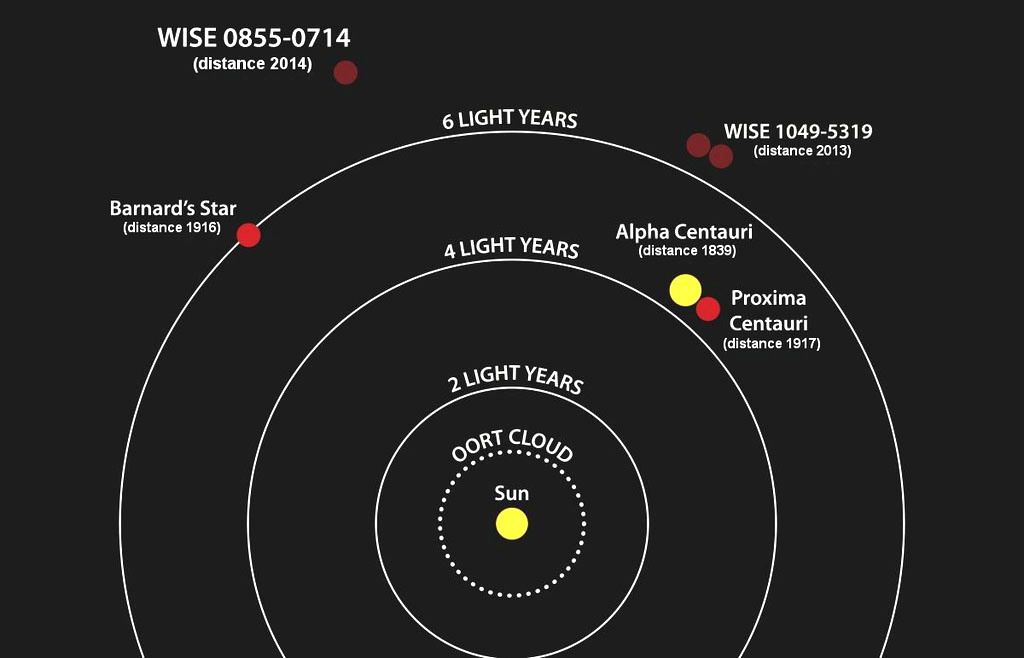
In 1962 the Scottish Branch of the British Interplanetary Society began holding informal ‘discussion meetings’ in the Geneva Room of Green’s Playhouse, which later became the Apollo Centre. As I remember, at one of the first ones I attended, in late 1962 or early ’63, one of the topics was that one or more planets had been detected orbiting Barnard’s Star, 6 light-years away, the fourth nearest to our own after Proxima and the binary Alpha Centauri (Fig. 1). The Branch founder, the late Oscar Schwiglhofer, was particularly interested in it, and since I was the only one who had read the report in the Glasgow Herald, I sent him the details.

Of all the thousands of stars now known to have planets, none has had a more chequered history than Barnard’s. As one of the nearest to us, it has a high ‘Proper Motion’ across the sky and was often called ‘Barnard’s Arrow’ (Fig. 2). Its motion in space also has a component toward us, which will bring it to within 4 light-years in 45,000 years’ time (Fig. 3).


(Both the Encyclopedia Britannica and Wikipedia disagree with that, putting the closest approach at 11,800 CE.) It’s located in the constellation Ophiuchus, the Serpent Bearer (Fig. 4), and it’s a red dwarf star, little larger than the planet Jupiter (Fig. 5), though much more massive. Despite its closeness it’s too faint to be seen with the naked eye, though from there our Sun would be a bright star in Orion (Fig. 6).


Also because of its closeness, Barnard’s Star has a relatively large annual parallax, shifting against the background stars as the Earth revolves around the Sun (Fig. 7).

But on top of that, Peter Van De Kamp of the Sproul Observatory claimed to have detected an additional ‘wobble’ caused by the pull of one or more planets. The Britannica, Wikipedia and the current Astronomy Now put that announcement in 1964, and there were Green’s Playhouse meetings that year, but it’s too late for the discussion I remember. Van de Kamp had previously published similar claims about Lalande 21185 and 61 Cygni, among other stars, and I had a head injury in a road accident in 1964, blurring some of my memory, so it’s possible that I misremember which star was discussed in 1962.

In October 1967, the late Prof. Archie Roy introduced the discussion project which led to my book Man and the Stars (Souvenir Press, 1974 – Fig. 8), and in the chapter based on his talk, citing Van de Kamp, I wrote,
“Only a few stars other than our Sun are known to have planets at all; the discovery of even one other planetary system, however, had profound consequences for scientific and philosophical thought.”
In 1969, Van de Kamp announced that the Barnard’s Star wobble had been resolved into the pulls of two planets, with 70% and 50% of Jupiter’s mass and orbital periods of 12 and 20 years.
Van de Kamp’s claimed discoveries remained largely accepted for the next 20 years, though other astronomers had not been able to verify them. The issues were discussed by Antony R. Martin in the British Interplanetary Society’s Project Daedalus report, 1978 (Fig. 9), re-issued as K.F. Long and P.R. Galea, eds, Project Daedalus: Demonstrating the Engineering Feasibility of Interstellar Travel, BIS, 2015 (Fig. 10), outlining a possible future mission to Barnard’s Star.


The conclusion was that while Van de Kamp’s results were probably wrong, there was a strong likelihood that Barnard’s Star did have outlying gas giant planets, and might have smaller planets inward from them, justifying the provision of probes and sub-probes for both, although onboard telescopes wouldn’t detect them until 1500 and 250 days before the encounter, respectively.
The Daedalus scenario involved building an unmanned interstellar probe to Barnard’s Star, taking 15 years to build and 45 years to reach its target, so that the mission could be completed in a human lifetime. It would be fuelled with 50,000 tonnes of deuterium and helium-3, extracted from the atmosphere of Jupiter in an automated operation run from Callisto, the outermost of Jupiter’s large moons, and the only one outside Jupiter’s ‘supralethal’ belts of subatomic particles trapped in its magnetic field. The gases would be separated and liquefied by floating factories in the atmosphere, taken out by space shuttle and carried to Callisto by nuclear fusion-powered freighters (Figs. 11 & 12).


In the discussions leading to my Man and the Planets (1983), the group concluded that O’Neill habitats powered by Daedalus engines, in close orbit around the planet, and Waverider flying factories in the atmosphere, would be more effective. (See ‘The Politics of Survival, Part 3’, ON, 2nd March 2025, ‘Project Starseed’, ON, November 20th 2022, and ‘Waverider, Part 2’, ON, December 4th, 2022.) Accelerating at 0.1g, the two-stage vehicle would take 18 months to reach interstellar cruise velocity of 0.12c, 12 percent of the speed of light. At that rate it would take a day or less to cross the Barnard’s Star system, depending on how far out the outer planets were. In interstellar space it would be protected by a thick self-annealing shield, but for the transit through the system, it and its sub-probes would have to be protected against interplanetary dust by ‘dust-bug’ cylinders spinning out their own particles. Remarkably enough, but no surprise to those of us who were troubled by it, cigarette smoke or the equivalent would be most effective, vaporising anything up to half-a-mile across in the path of the spacecraft. Each sub-probe would be accompanied by sub-sub probes, one of whose functions would be to record and analyse the spectra of the flashes as the larger ones hit the planets. After a slightly shocked moment, when this was announced at the 1977 BIS Interstellar Conference, Arthur C. Clarke announced from the back of the hall, “THIS MEANS WAR!” He was hastily reassured by the Daedalus team that they wouldn’t be doing that to any terrestrial planets.
It sounds as if it would be devastating, and at the time, that seemed too obvious to question. But twenty years later, the author Marise Morland asked me to work out for her the destructive effect of a vehicle at relativistic speed. Her objective was to destroy an underground base on a body the size of the Moon by impacting a spacecraft approximately the size of the Space Shuttle. At half the speed of light its mass would generate a crater 50 km (31 miles) across. At 0.999 of lightspeed, the destructive effect would be at least as great as the Chicxulub dinosaur-killer, with a crater 120 miles across and secondary impacts all over the target planetoid. The Shuttle had a rest mass of 100 tons, and the Daedalus sub-probes only five tons, and as each meteoroid crater diameter is roughly ten times that of the impactor, and the kinetic energy is ½mv2, where v is the impact velocity, even a sub-probe’s impact at the speed of light would form a crater only five miles across, and at 12% of lightspeed, less than a mile across, comparable to the Barringer meteorite crater in Arizona. Admittedly, in The Massacre of Mankind, his sequel to the The War of the Worlds, Stephen Baxter’s Martians wipe out half the British Army with Barringer-sized impacts, but it takes a lot of them.

In ‘The Phoenix at Easter’, 1982-83, my first full story for Sydney Jordan’s Lance McLane strip in the Daily Record, Sydney was so taken with my comparison between the entities attacking Earth and the Daedalus probes that he did a flashback to illustrate them (Fig. 13). ‘The Phoenix at Easter’ was another story whose beginning I dreamed, and that was the Maya sequence that I asked Euan MacKie about, which I mentioned in ‘Notes from an Arctic Journal’ (ON, 20th April 2025). In writing these notes, it’s remarkable how these different elements from the past have turned out to be connected.
From the 1940s it was thought by Van de Kamp and others that both 61 Cygni and Epsilon Eridani, two more of the nearest stars like the Sun, had superjovian gas giant planets. The 61 Cygni exoplanet was estimated to be a ‘superjovian’, with a mass first estimated to be 16 times Jupiter’s and later reduced to 8 times; I mentioned both in my sequel to ‘The Phoenix at Easter’, called ‘The Nest of the Phoenix’ (title suggested by Marise Morland, above), Daily Record, 1983. Wulff Heintz began challenging Van de Kamp in the mid-70s, allegedly losing his friendship in the process, but delivered the coup de grace when he discovered that the supposed anomalies in the star’s position coincided with times when the Sproul telescope had been dismantled for cleaning and modification. That seemed extraordinary to me, because if the telescope components were improperly realigned, every star should have been affected. Both Wikipedia and Astronomy Now now state bluntly that such was indeed the case, (Keith Cooper, ‘Worlds of Mystery, the Planets of Barnard’s Star’, Astronomy Now, May 2025) – so how was that missed for so long? The Infra Red Astronomical Satellite, launched in 1983, discovered that Epsilon Eridani was less than a billion years old and still surrounded by dust, out of which planets might be forming now. (Ken Croswell, Planet Quest, Oxford University Press, 1997.) In 2000 a Jupiter-mass planet was discovered, and in 2008 an asteroid belt was found, separated by ‘Kirkwood gaps’ which imply the presence of a fully formed planetary system, although the outer ring corresponding to our Kuiper Belt is still evolving. (Nancy Atkinson, ‘Spock’s Solar System Looks Like Ours‘, Universe Today, online, October 27th, 2008.)


The story now jumps forward to 2016, when Yuri Milner and Stephen Hawking formed the Project Starshot initiative, to send a flight of lightsails as mini-probes to Alpha Centauri (Fig. 14). The search for target planets soon expanded to include ‘Pale Red Dots’ (Fig. 15), paraphrasing Carl Sagan’s description of the Earth in the panorama taken from beyond the planets by Voyager 1. It started with Proxima Centauri, where a possibly earth-sized planet was discovered in the habitable zone, and Barnard’s Star, where a ‘super-Earth’, 3.2 times the Earth’s mass, was thought to have been discovered in 2016. But by 2021 the effect proved to be illusory, due to sunspots and the star’s very slow 145-day rotation. Before anyone could argue that the same effect might have been responsible for Van de Kamp’s mistake, the same instruments – ESPRESSO on the Very Large Telescope in Chile and MAROON-X on the Gemini North telescope in Hawaii (Fig. 16) – have found first one and then three more exoplanets in tight orbits around Barnard’s Star (Fig. 17), in a system like the famous seven planets of Trappist-1 (Fig. 18). I had to apologise to Sydney Jordan when that was found, because he’d depicted such a system in a Jeff Hawke story called ‘The Book of the Worlds’, and I said it was impossible. (See ‘Howlers that Weren’t’, ON, April 2nd 2023.)


All four Barnard’s Star planets are closer to it than the habitable zone, so the star would look larger than the Sun does from here, and they would all be too hot for liquid water or life. The first is 2.8 million km from the star, with a period of 2.34 days and 26% of Earth’s mass; the second at 3.4 million km, period 3.15 days, 30% of Earth mass; the third and largest at 4.1 million km, period 4.12 days, mass 33.5 of Earth’s; and the 4th at 5.7 million km, period 6.74 days and only 19% of Earth’s mass, roughly twice that of Mars. Their tightly grouped presence rules out the existence of earth-sized planets in the star’s habitable zone; larger planets further out remain possible, but not much larger, for the same dynamical reasons.
The evolution of life there is highly unlikely, because although Barnard’s Star is 7-12 billion years old, much older than the Earth, it hasn’t stabilised as most red dwarf stars do and flare storms would be a major obstacle to life appearing there. Just for the record, none of those planets is a candidate for the colony world of the Green Children of Woolpit (see ‘Green green, it’s green they say’, ON, 21st January 2024, and earlier articles). As I’ve previously mentioned, if we’d known that there was an earth-sized planet in the habitable zone of Proxima Centauri, we’d have gone for that as a candidate despite the flare hazard, to which there are possible answers. But if it is linked to Earth by matter-transmitter, it could be anywhere at this rough distance from the Galactic Centre; and it could be orbiting a more stable orange K-type star, as Sydney Jordan suggested in his painting of it (Fig. 19).


Duncan’s book Children from the Sky, about the mediaeval mystery of the green children, is available from Amazon like his other recent books; details are on his website, www.duncanlunan.com.



Leave a Reply to Space Notes, June 2025 – The Orkney NewsCancel reply