
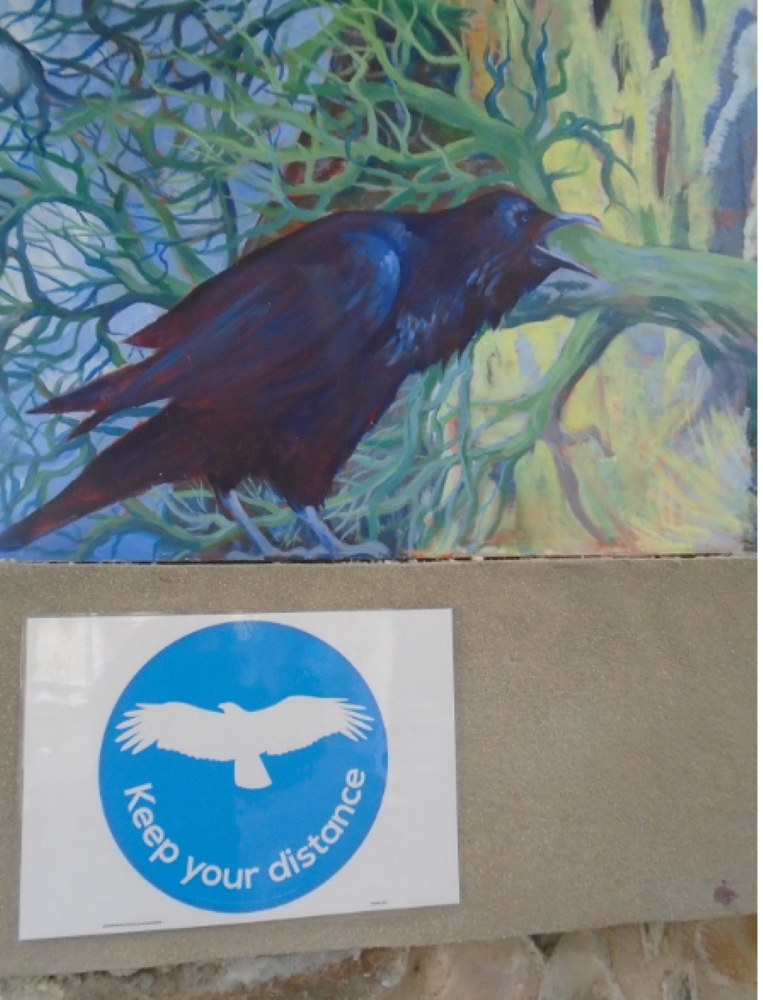
Ravens are a protected species and according to data from NatureScot there are about 40 breeding pairs in the whole of Orkney. Recent reports in the media, locally and nationally, express the concerns of some farmers that their livestock has been fatally attacked by ravens.

As a result there has been a call by some to introduce a cull of these birds. The Orkney News contacted NatureScot to find out the latest from them on the situation after they met last week with some of the farmers concerned.
Image credit: Bell
NatureScot stated:
“We met with stakeholders in Orkney last week to discuss the issue of ravens predating on livestock and there were also some concerns expressed about predation on wading birds. This was a helpful opportunity for NatureScot staff to hear from those affected about the issues and potential solutions.
“There is a perception that NatureScot may not understand the challenges, and the meeting allowed for a full and frank discussion which was welcomed.
“As a result, we agreed two main actions.
- This first is to undertake work to gain a better understanding of the juvenile raven population across Orkney.
- The second is to take forward work on an area-based licencing approach which takes into account both the impacts and damage juvenile ravens are causing, while also meeting conservation needs.“
The meeting included farmers, vets, an Orkney Islands Council official and councillors, NFUS and the local Constituency MSP, Liam McArthur.
The statement continued:
“We are currently determining whether a full census is required for breeding ravens across the whole of Orkney to inform our current licensing system.
“We recognise that there can be considerable numbers of younger non-breeding ravens that can form ‘mobs’ of up to a 100 or more birds and it is these birds that often prey upon livestock at certain times of the year, such as during lambing or calving.
“We have committed to gaining a better understanding of the number of non-breeding ravens across Orkney to better inform a potential Orkney area-based licensing scheme for ravens.“
NatureScot intend to return to Orkney in late August to meet with people with a range of interests to discuss the actions being taken.
“We are aware that there are others with views and experiences that we did not meet with last week, and we are keen to hear their perspectives. We also plan to have similar discussions on Shetland.“

NatureScot is the lead public body responsible for advising Scottish Ministers on all matters relating to the natural heritage.
Their remit is to:
- promote, care for and improve our natural heritage
- help people to enjoy nature responsibly
- enable greater understanding and awareness of nature
- promote the sustainable use of Scotland’s natural heritage
The statement continued:
“It is NatureScot’s role to balance conserving protected birds like ravens with the impact and damage they may cause to livestock. We ensure that any licences issued won’t jeopardise local, regional or the overall Scottish raven population while working with those affected by impacts to find solutions.
“Ravens can cause serious damage to livestock, and we recognise the impact this has on farmers. We issue licences where there is no other satisfactory solution. Licences permit shooting of birds that are causing the damage, with the aim of removing problem birds and deterring other ravens.
“If applying for a licence, we ask farmers to provide evidence that serious damage is occurring or is likely to occur. This could be photographic material or records of attacks and/or losses of livestock in previous years. Applications should make clear how many birds are causing the problem and the scale of the damage involved. NatureScot must also be satisfied that the applicant has tried other scaring techniques and found them ineffective.
“Licences to shoot ravens are granted only where there’s no other satisfactory solution.“
The data on how many ravens there are in Orkney is unclear. The number of breeding pairs of ravens is an estimate. How many livestock have been killed by ravens, as opposed to scavenged by them, requires to be documented.
Raymond Besant has an excellent article about Corvids, including Ravens. In this excerpt he comments:
It is a bird that has been both revered and persecuted and probably falls somewhere in the ‘difficult’ category in the Orkney psyche. These days it is mostly a bird of sea cliffs, though some can be found nesting in trees and inland crags.
I recently photographed a pair of Ravens who were nest building below an overhang of some inaccessible cliffs on our west coast. The sea spray from below hung in the air, diffused by the setting sun. All I could make out was the silhouette of these imposing birds and it wasn’t hard to imagine this bird as something ‘other’, a spirit or shape shifter.
Numerous cultures, particularly in North America and Scandinavia, have projected human characteristics onto ravens. Norse mythology in particular saw ravens as part of a manifestation of the god Odin where they were all-knowing messengers and protectors.
By the rise of the Scottish sporting estate in the mid-19th century however this reverence was long gone. Where ‘control’ became an important part of upland management in a broader context, the raven became cautious and so retired to those inaccessible cliffs. That it is intelligent is not contested and in the same way that the rock doves I can see nearby are paying me little attention, it feels like these ravens are aware that I’m specifically watching them.
It’s their awareness that has helped me in the past amongst the Hoy hills. As their distinctive ‘cronking call’ echoed across the Dwarfie Hammars, my eyes were first drawn to them and then to the subject of their ire, a golden eagle. A sight and relationship no doubt played out daily amongst the hills of Scotland.
Ornithophobia in Scotland
Meanwhile Douglas Ross, Conservative MSP for the Highlands and Islands raised the issue in the Scottish Parliament on Wednesday 28 May ‘ that gulls are posing a risk to public health or safety.’ He was supported by Fergus Ewing, SNP MSP for Inverness and Nairn who said:
“I have repeatedly warned the Scottish Government, in this chamber, that serious injury or fatality could arise from massive gulls swooping down on elderly people and infants; I have even warned about the consumption of seagull faeces causing horrific disease. After those warnings, a 74-year-old man in Nairn was injured by a seagull.”
To be factual – there is no such bird as a ‘seagull’. There are gull species – 5 of which breed in Scotland: great black-backed gull; lesser black-backed gull; herring gull; common (mew) gull; and black-headed gull. Gulls come around coastal resort areas because people leave food about – sometimes even feeding them, as tourists have been seen doing in Stromness. If less food waste was disposed of incorrectly, or thrown on the street, gulls would not be attracted to those areas. It is a problem of our own making.
Despite this, and in response to the hysteria generated around gull attacks, encouraged by ill- informed politicians, the Scottish Government is convening a Summit on controlling the gulls that dive bomb the walkers along seaside promenades. Let’s hope the Summit addresses the core problem – the food waste left by people.

And of course there are the geese:
Fiona Grahame

Donate to The Orkney News
£2.00


Leave a Reply