
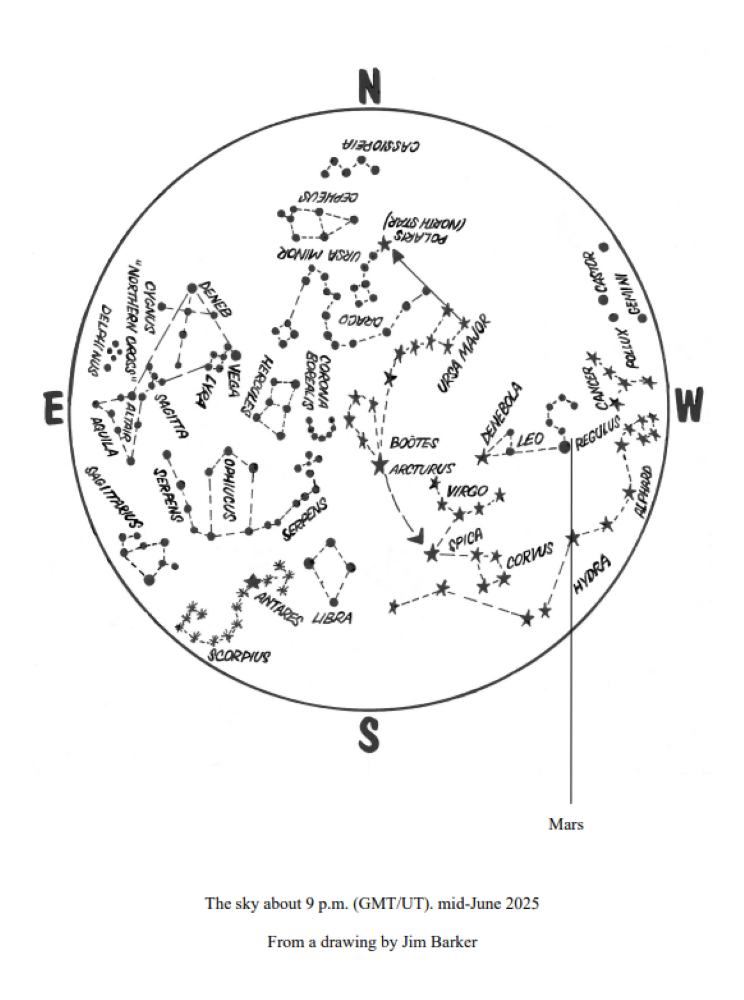

The Moon is Full on June 11th, and it will be New on June 25th. It passed Mars on the 1st, passes Saturn and Neptune on the 19th, Venus on the 22nd (a day after the summer solstice), passes through the Pleiades on the 23rd, is near Mercury as a thin crescent on the 27th and is back near Mars on the 29th.
Detailed analysis by Intuitive Machines of the crash of their Athena lander in March has confirmed that by chance it came down in a crater (Figs. 1 & 2), with whose contours the laser altimeters and optical sensors were unable to cope. More detailed imagery of the landscape near the lunar south pole will be compiled before the third attempt next year.


The planet Mercury sets along with the Sun in early June, is low in the northwest mid-June, setting at 11 p.m. and below right of the thin Moon on the 27th. Mercury remains visible to the end of the month and will be at greatest elongation from the Sun on July 4th.
Venus in Aries rises at 3 a.m., very bright in the morning sky, was at greatest elongation from the Sun on the 1st, and is below the Moon on the 22nd.
Renewed study of the radar mapping of Venus by the Magellan orbiter in the 1990s is producing ever more drastic possibilities. The crust of Venus is essentially one huge continental plate, previously reckoned to be 60 miles thick (Fig. 3).

But internal heat has to escape somehow, and about 10 million years ago Venus was entirely resurfaced by huge volcanic basalt outflows. There are volcanic cones all over the terrain, and there have been arguments about whether there’s still volcanic activity ever since Soviet entry probes detected what seemed to be very violent lightning activity around the great uplifted plateaux (Fig. 4).


My design for the VESSEL surface explorer assumed that to be the case (see ‘Waverider, Part 2 – Flight in Nonterrestrial Atmospheres, or, The Hang-Glider’s Guide to the Galaxy’, ON, December 4th 2022), and Sydney Jordan painted it with active volcanoes for Analog (Fig. 5). (A geologist told me that the volcano at the rear was impossibly steep, but in a recent episode of the new Walking with Dinosaurs, the palaeontologists had a still sharper cone in the background.) Close studies of Magellan images have revealed apparent crustal movements around Maat Mons, one of the largest volcanoes (Figs. 6 & 7).


But now the suggestion is that geologists aren’t thinking big enough. Venus is dotted with coronae, ringlike structures formed when hot material from deep inside has rises through the mantle and erupted through the crust (Figs. 8-13, not to be confused with the solar corona, coronal aurorae, or the constellation Corona Borealis, where a nova is expected any time now) and some of them are very large (Fig. 14), dozens to hundreds of miles across, but possibly still in eruption (Fig. 15).


52 out of 75 coronae studied by NASA’s Goddard Space Flight Center, the University of Maryland and the University of Bern in Switzerland, are thought to have liquid magma below, with Ozza Mons (Fig. 16) and Maat Mons particularly likely to be active today. One consequence of this interpretation is that the crust of Venus cannot be more than 20-40 miles deep, at most – thinner than under Earth’s continents, but much deeper than under the oceans. Coronae are not found on Earth today, but they may have been the major outlet for internal heat before continental drift began, and crustal spreading and subduction took over. (Paul Scott Anderson, ‘Active tectonics on Venus? Old data reveal new clues’, EarthSky, online, May 18th 2025.)

On Earth in 2016, Dr. Mike Simms, Curator of the Ulster Museum (Fig. 17), announced evidence that a 3-kilometre asteroid struck the north of Scotland c.1,117,000,000 years ago, generally rounded up in the press to 1.2 billion. (Anon, ‘Lairg Asteroid Could Bring Tourism Boom’, Northern Times, 23rd September 2016.)

The impact was at around 65,000 kph, with the force of 75 million Hiroshima bombs, and penetrated 8 km into bedrock, throwing ejecta for 50-60 km and forming the ‘Stac Fada Member’, a 50 km feature exposed on the coast of Wester Ross (Fig. 18), from western Loch Ewe in the south to Stoer Peninsula (north). (Anon, ‘North West Scotland’s Massive Meteorite Impact’, Orkney News, 5th May 2025, citing C.M. Kirkland et al, ‘A One-Billion-Year-Old Scottish Meteorite Impact’, Geology, April 28th, 2025).


At first it was thought that the impact had been in the Minch (Fig. 19), which was then a rift valley, but indicators such as shocked quartz in the coastal deposits (Figs. 20 & 21) pointed to a site inland, and a large gravitational anomaly, the Lairg Gravity Low (Fig. 22), identifies it as where Lairg stands today (Fig. 23). The broad spread of directions in Fig. 22 may have been caused by hills and valleys deflecting the impact deposit as it spread out across the landscape.


The discovery prompted Magda Macdonald, the local development officer, to organise an exhibition in 2017, promoted with a retro poster by Eilidh Price (Fig. 24) and a large banner to attract local children (Figs. 25-27).


The opening was covered by Gerry Cassidy for Space and Scotland magazine (Figs. 28 & 29), which he and I were editing at the time. (Gerry Cassidy, ‘A Wee Drap o’ the Crater’, Space & Scotland Vol. 1 No. 2, March 2017.)


The 1,117,000,000 BC date was obtained from alkaline feldspar in the impact deposits, but now a new study of Zircon crystals in the same deposits has changed the date to 990,000,000 Before Present. They coincide with regional emergence of freshwater eukaryotes, ancestors of plants, animals and fungi, which therefore have to be more recent than had been supposed.
Mars is now in Leo, passing Regulus on the 17th and setting about 1 a.m.. The Moon was near Mars on the 1st and will be again on June 29th, though by then binoculars will be needed to find it in the twilight. Mars will be occulted by the Moon on the 30th, as seen from Hawaii and the northwest tip of South America. ‘Space Notes, June 2025′ (ON, 1st June 2025), includes images of the Mars flyby by Europa Clipper on March 1st, and an image of Deimos, the outer moon of Mars, taken the same night by the Perseverance rover.


Although the results were promised a week after the flyby, there seem to be no further images of the asteroid Donaldjohanson, passed by the Lucy spacecraft in May (Figs. 30 & 31). The Psyche probe, heading for the asteroid of the same name, has had to switch to a backup fuel line after the primary one suffered a loss of pressure on April 1st. Japan’s Hyabusa 2 probe, now called ‘2#’ as in ‘2-sharp’, lapsed into safe mode over two months ago and there is no news of recovery. On May 28th China launched Tianwen-2, a probe to one of the Near Earth Objects in resonant orbit with the Earth, possibly a fragment blasted off the Moon itself – for details see ‘Space Notes’.
Jupiter is no longer visible in June, moving from Taurus into Gemini and in conjunction behind the Sun on the 24th.
Saturn in Pisces rises about 2 a.m., and the Moon will be above Saturn on the 19th.
Uranus in Taurus is not visible, though it might be found with a telescope east of Venus by the end of the month.
Neptune in Pisces rises at 2 a.m., above Saturn, and will be just one degree away from Saturn by the end of the month. Neptune is 2 degrees south of the Moon on the 19th.
From Scotland, June and July provide the opportunity to see high-level noctilucent clouds, lit from below the horizon by the Sun in the north around midnight.
My general idea in these columns is that ‘The Sky Above You’ will focus on astronomy, particularly of the planets, and ‘Space Notes’ will cover spacecraft and other hardware, and events in human spaceflight. It’s not always easy to decide where to put particular stories, and although the lead story in the June ‘Space Notes’ follows on from the articles on interstellar travel in recent weeks, it’s about the possible discovery of a planet orbiting Alpha Centauri, for which astronomers have been searching for many years.
But today’s last story is equally devastating in both fields. The effects of the cuts in the NASA budget, plus the directives from the Trump White House, have proved to be as drastic as feared. Jared Isaacman is no longer to be NASA Director, because he cannot align his priorities with the President’s, which are openly stated to be putting Americans on the Moon during his term of office, and virtually nothing else.

In Fig. 32, the missions to be cancelled are circled and crossed in red, and while it’s not quite as bad as it looks at first glance, almost everything is cancelled except ‘spectaculars’ like the Hubble and James Webb telescopes, or missions already in flight which will come to fruition after 2029, like Europa Clipper and Psyche. Critics are saying that it marks the end of US dominance in space, and once the effects in personnel cuts and closure of facilities are worked through. they are probably right – if only because the cuts in education will make it hard to find new people, even if there’s the political will to regenerate the programme.
Duncan Lunan’s recent books are available through Amazon; details are on Duncan’s website, www.duncanlunan.com.
You can download a copy of the June Sky Map here:



Leave a Reply to The Sky Above You, October 2025 – The Orkney NewsCancel reply