
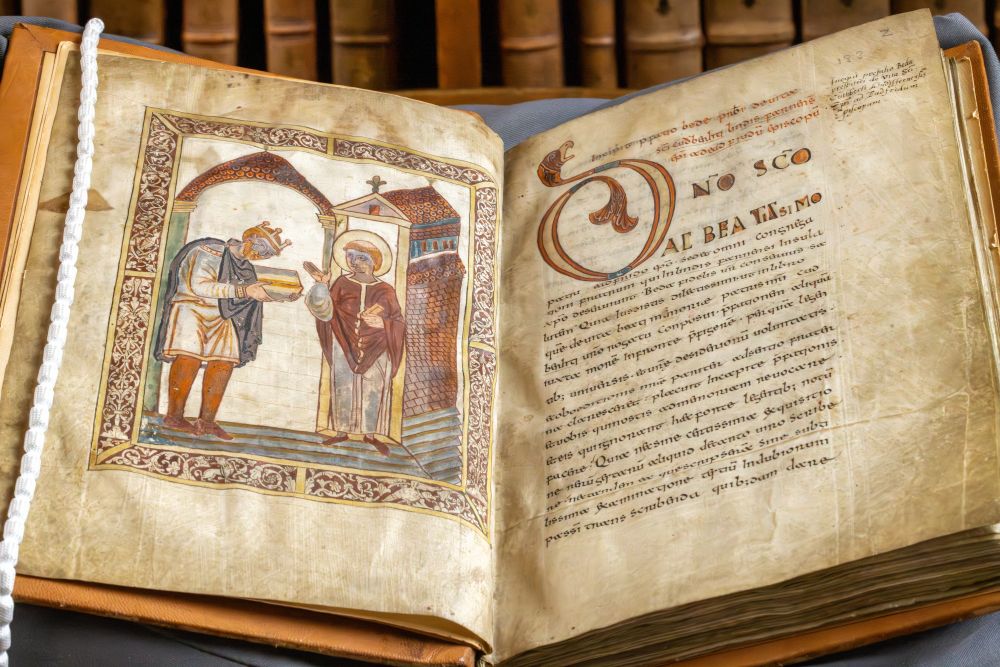
A new book The First King of England: Æthelstan and the Birth of a Kingdom by David Woodman, aims to highlight the achievements of Æthelstan, 1,100 years since his coronation in 925AD.
Professor David Woodman of Robinson College and Cambridge’s Faculty of History explained:
“As we approach the anniversaries of Æthelstan’s coronation in 925 and the birth of England itself in 927, I would like his name to become much better known.
“Æthelstan didn’t have a biographer writing up his story.
“His grandfather, Alfred the Great, had the Welsh cleric Asser to sing his praises. And within decades of Æthelstan’s death, a wave of propaganda ensured King Edgar became famous for reforming the church. This completely overshadowed Æthelstan’s earlier revamping of learning and religiosity.”

In 927AD Æthelstan established the Kingdom of England but soon after his death in 939AD, it fragmented.
Prof Woodman continued:
“Militarily, Æthelstan was supremely strong. He had to be very robust to expand the kingdom and then to defend it”.
Æthelstan had to contend with major Viking settlement in the north and the east. In 927AD, he acquired authority over the Viking stronghold at York, and, in bringing Northumbria within his dominion, became the first to rule over an area recognisable as ‘England’.
As Æthelstan expanded his kingdom, he drew Welsh and Scottish kings into his royal assemblies. Large-scale surviving original diplomas, housed in the British Library, list the very many nobles he compelled to attend. The meetings of Æthelstan’s assemblies must have been incredibly grand affairs, involving hundreds of people in total.
“These Welsh and Scottish kings must have bitterly resented being brought so far out of their territories.
“An incredible tenth-century Welsh poem, The Great Prophecy of Britain, calls for the English to be slaughtered. It’s difficult to date, but it may be a direct response to this expansion of Æthelstan’s power.”
Then, in 937AD, at the famous Battle of Brunanburh, Æthelstan brutally crushed a formidable Viking coalition, supported by Scots and the Strathclyde Welsh, determined to overthrow him.
“Brunanburh should be as well-known as the Battle of Hastings,” Woodman says.
“Every major chronicle, in England, Wales, Ireland and Scandinavia took note of this battle, its outcome and how many people were slaughtered. It was a critically important episode in the history of the newly-formed English kingdom”.
Numerous locations have been proposed for the battle. Woodman is confident that it happened at what is now Bromborough on the Wirral.
Once Æthelstan had created the English kingdom, royal documents known as ‘diplomas’ (in essence a grant of land by the king to a beneficiary) were suddenly transformed. Formerly short and straightforward, they were transformed into grandiose statements of royal power.

Professor David Woodman, is campaigning for greater public recognition of Æthelstan’s creation of England in 927AD, and there are hopes that a fitting memorial could be erected to remember England’s first King.

David Woodman, The First King of England: Æthelstan and the Birth of a Kingdom is published by Princeton University Press, 2nd September 2025 (ISBN:9780691249490)


Leave a Reply