
By Eamonn Keyes.
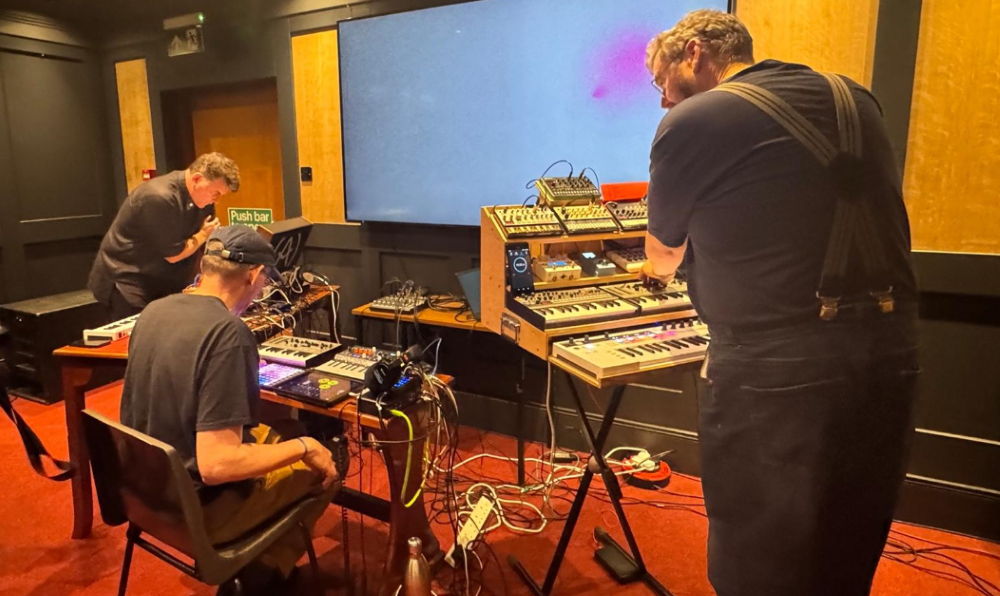
The Orkney Club, Kirkwall, Orkney International Science Festival.

This year the Orkney International Science Festival (OISF) concentrated on the world of Quantum Physics as its theme, with the Festival’s usual blend of the latest advances, the challenging, the inspiring and the weird and wonderful.
The first event in the Orkney Club was all of these, being a live music journey into the quantum world, specially composed for the International Year of Quantum Science and Technology.
The synthesizer trio QRM performed a non-stop 45-minute piece of electronic music heavily inspired by musical genres from the 70s and 80s with many of their own stylistic elements added to the mix.
The music follows themes of the quantum world including entanglement, the wavelike behaviour of particles, and the random outcomes that can result from events. At the end there was time to ask questions and have a look at the kit that the group use.
I love synthesisers. From the first time I heard them close on 60 years ago I was captivated, and longed to get one to merely drool over, as I couldn’t play a keyboard. Mind you, at that time you could only play one note at a time, so using one finger would have been the ideal scenario. I only got a chance to get to grips with one in 1980, and by 1981 I had one of my own, which I used with a top of the range Bontempi and its built in drum accompaniment to create my own feeble soundscapes.
44 years later and I’m in the Orkney Club listening to QRM doing something superficially similar, but on steroids and with a massed inventory of electronica to call on.
QRM consists of Nick Scroggie, Mark Dammer and Maarten de Vries, who are some of the founding members of the Moray Firth Synthesizer Club which was developed during lockdown to provide an opportunity for meeting and playing online. They style themselves as a DAWless band, playing live instead of the usual contemporary method of using a DAW (Digital audio workstation) to integrate and control their sound.
Nick Scroggie lives in Inverness and works with the Scottish Government on digital infrastructure projects. His musical background includes a career as a DJ. He uses modular synthesizers, the original form of the instrument (with individual modules connected by patchable cables). Think 1950s telephone switchboard and the 1960s incarnation of the BBC Radiophonic Workshop and you’re in the visual and audio ballpark.

Mark Dammer lives in Forres and is a self-employed software and IT specialist. He has a particular interest in combining his synthesizers with tablet computers and home-made electronics. Mark’s setup looks more like the advanced control system of an alien spaceship than a music setup, with strangely coloured lights in arrays, morphing shapes of sound waveforms on tablet screens and all topped off with a baseball cap.

Maarten de Vries lives in the Black Isle and works with several membership associations promoting safe work at height. His speciality is analogue synthesizers and his style is heavily influenced by instrumental electronic music from the 80s. His rig is the closest to a contemporary keyboard rig, although many of the keyboards are hobbit-sized, and many are housed in a wooden rig he’s knocked together to make them easier to get at. I did the same with metal Dexion strips in the 1980s and still bear the scars of the sharp ends to this day. There are several boutique miniatures of classic keyboards, such as the Roland SH101, and Maarten, a tall man, stands astride his rig like a musical Colossus, if a Colossus wore braces on his trousers. He acts as spokesman for the band and has much to say, and a few days later will give another talk on how playing around with synthesisers can act as therapy for Long COVID. Maarten discovered these benefits during his recovery from COVID, as they helped him cut through the fatigue and brain fog.

The performance was accompanied by computer art from Hilary de Vries, created to accompany the music. Hilary is a composer of contemporary Scottish music and a visual artist, whose recent work includes pastel drawings inspired by the landscape around her. Her musical work includes An Orkney Sampler, a collection of tunes written during her visits to Orkney.
The music began, and for the next 45 minutes wended its way through a variety of styles and genres, with nods to the various eras when synthesisers found their niche in music. The sound pulses and throbs, with analogue washes and digital plinks and chimes, eventually finding its rhythm. It morphs again and again, modulates and cascades, creating an almost visual experience.
I hear occasional echoes of Tangerine Dream, Yazoo, Depeche Mode, Jean-Michel Jarre and Brian Eno in snatches as the music evolves during the piece. In a time of music being perfected to death it is good to hear real music without that straitjacket of perfection that modern arrangement seemingly must suffer from. It’d be nice to hear an entirely freeform piece played even without sequences, with mistakes and all if necessary, just to remind us that we own the machines, instead of the reverse, which is often the case.
QRM can be found on YouTube as QRM-music and Zerobeat, where examples of their live synthesiser wigouts can be heard. They have also been performing Transatlantic electronic music together via Zoom with the Rocky Mountain Synthesiser Meet from the USA.
https://www.youtube.com/@QRM-music
https://www.youtube.com/channel/UC21VTGHghy7PJuvov9Lgb_w


Leave a Reply