
On a cold December day in 1907 a large crowd assembled in the Stromness Kirkyard for the funerals of two men. The Orcadians attending did not know the men but as islanders they were showing their respect for seamen who had drowned close to the shores. Two more funerals were to be held in the following days as the sea gave up the bodies of those who had perished.
The steam trawler, Shakespeare no 406 of Hull, had been fishing off Noup Head Westray for three or four days. In heavy seas on the 11th December,the vessel was driven on to rocks between Breckness and the Black Craig near Stromness. Although it was early morning and still dark, the sound of the Shakespeare’s whistle and the cries of the mariners alerted people living nearby that they needed help. Local man, Mr Clouston, rushed to Stromness where he roused the RNLI lifeboat with its crew of fourteen and the sixteen men of the Rocket Brigade.
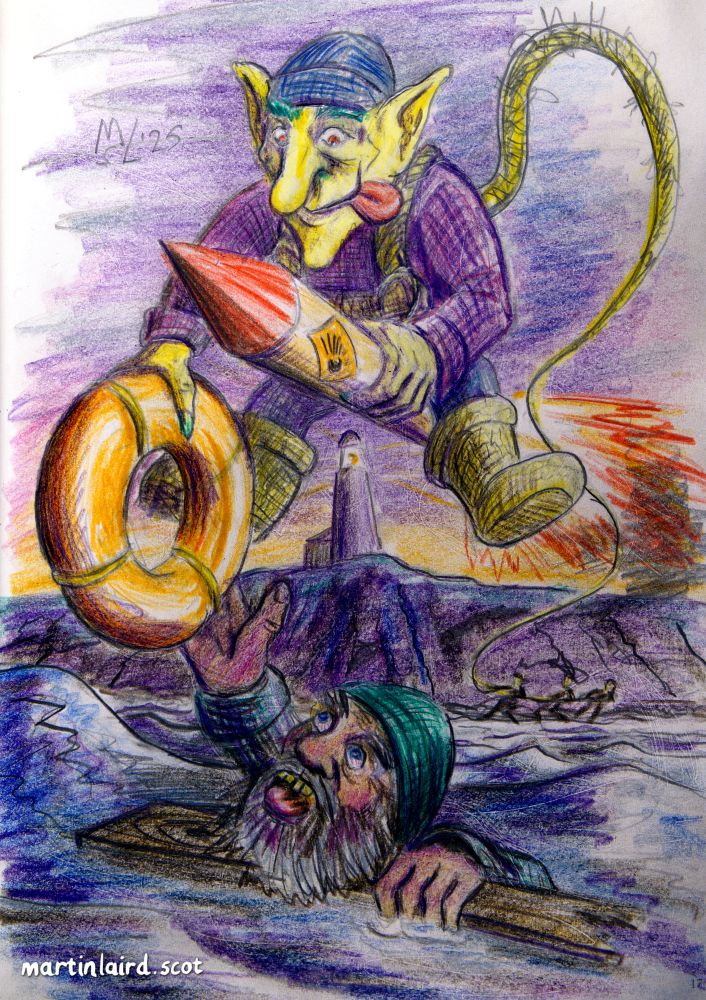
The Rocket Brigade was the first to arrive as they were able to travel faster over land than the lifeboat could in the raging seas. Today the RNLI is familiar to us all as a voluntary organisation saving lives at sea, but what was the rocket brigade? The job of the Rocket Brigade was to attach a line from the shore to a distressed vessel in order to enable a ‘breeches buoy’ or other device to be hauled to the ship and return passengers and crew safely to the shore. Invented at the start of the 19th century by Henry Trengrouse this life saving equipment built upon earlier methods of throwing lines out to vessels which were foundering near the shoreline. Over the years the rocket fired device was improved and was to save thousands of lives.

The heavy seas made it slow going for the RNLI lifeboat and it took an hour to get to the Shakespeare. The Rocket Brigade, travelling over land, was the first to arrive. By this time only the tops of her masts and a small portion of the funnel was to be seen. The rest of the vessel was completely submerged.
Two men were washed into the sea as heavy waves engulfed the wreck. Five men clung to the mizzen mast, two on the foremast, and one on the funnel. A rocket was successfully fired towards their position and soon the line was in the hands of the men. The lifeboat was now able to get hold of the vessel and took off the first man. Using the breeches buoy the Rocket Brigade was able to rescue the second. Two of those on the mizzen mast were unable to hold on such were the appalling conditions, they fell into the sea and were lost. The lifeboat and the Rocket Brigade, however, through their valiant efforts were both able to rescue three men, some of whom were suffering from severe exposure and required emergency medical assistance from the local doctor, Dr Duncan.

The bodies of those drowned were all recovered over the coming days: Benjamin Powley, a trimmer from Norwich; Harry MacDonald Sorrenson, a deck hand from Hull; Joseph Watson, aka Charles Hempsly, a cook, also from Hull; and a man known only as Ben, his full name not known by either the Master or any of the surviving crew, was later named as Benjamin Peters.
In the few days after the rescue, the skipper Arthur Patch, had to go with the police to the Stromness Town Hall where the bodies of the four men drowned were waiting to be identified.
Most of the survivors were from Hull, the master Captain Arthur Patch; Harry Adison Fletcher, mate; Thomas Rickaby, chief engineer; and John Hort, second engineer. The bo’sun William Morris, was from London; and the third hand, Elias William Edwards, was from Scunthorpe.
When the ship sank the men lost not just a profitable catch of fish, but all the possessions they had on board. They were left with just the thin clothes they had on. All coastal and island communities react with kindness when responding to the needs of survivors of wrecks, and the Stromness community was no different, providing the men with clothing, food and shelter, till they could return home. For the heroes in their own community who had responded to the call for help there was also recognition. The RNLI silver medal was awarded to Coxswain Robert Greig, and an extra 20 shillings to each of the crew ‘as a mark of their appreciation of the excellent service rendered in saving part of the crew of the steam trawler Shakespeare’.
Attempts were made to salvage the remains of the wreck by the steamer Garth, but heavy seas made it impossible, and it broke into several parts.
A public inquiry was held into the tragic deaths of the four crewmen in Kirkwall Sheriff Court. The Inquiry had difficulty in contacting relatives of the deceased but was able to confirm the names of the men, and took evidence from witnesses. The Captain, Arthur Patch, said that the compass on board was not working properly and when he sighted land he thought it was Hoy Head, having mistaken the light of Graemsay for that of Dunnet Head. In heavy rain, with little visibility, and in the darkness of the early morning, the ship struck rocks. Captain Patch said:
“The Point of Spoil is not a pleasant place – high jagged rocks, and also sunken rocks. We struck stern on and got the boat out, but it was overturned. The ship began to slew round until she was stern outwards. We struck about 5.30.”
Arthur Patch was washed into the sea but was able to grab hold of a rope, clamber aboard and join the other men in the rigging. They clung on there for three and half hours till they were rescued.
The inquiry revealed that although the Shakespeare had a crew of ten there were only nine lifebelts which were in the men’s own berths but most of the crew weren’t wearing them at the time. The cook and the chief engineer put on their lifebelts, but the cook’s was wrenched off him by the wind and he drowned. Arthur Patch did not think that the lifebelts would have made much difference in the conditions they were experiencing. The vessel also had two life buoys.
Other survivors in the crew gave evidence, and all were extremely grateful to the lifeboat and Rocket Brigade for coming to their aid. Also giving evidence were the rescuers from the lifeboat and the Rocket Brigade.
In his evidence, James Duncan Porteous, a Stromness baker, and in charge of the Rocket apparatus stated that the road to the wreck site was very poor in places hampering the time it took them to get there. He said:
‘We saw six men on board. We immediately established communication. The line fell on the mizzen mast and the mate made it fast. We took the three men ashore. The chief engineer was quite unconscious. I don’t think he was properly in the breeches buoy. We applied first aid. They were taken to a house. “
And he added: “If the ditches had been bridged we could have got there sooner. We had to go across the fields in some places.”
The jury unanimously found that the wreck was the fault of the master, Arthur Patch,in not verifying his position before assuming that the light towards which he was shaping his course was Dunnet Head, which he could easily have done by consulting his log for the distance run from the fishing ground, or by standing on till he opened Graemsay red light, or in the event of it being the Pentland Firth, till he opened Stroma Light.
A further inquiry by the Board of Trade in Hull found that the ‘vessel was not navigated with proper and seaman like care. ‘ Captain Patch’s certificate was suspended for 6 months.

Fiona Grahame



Leave a Reply to The Night Coast Watch : A Westray Tale of Courage – The Orkney NewsCancel reply