
In the Scottish fishing industry mackerel remained the most valuable species in 2024 worth £281 million, making up 40 % of the total value of Scottish vessels’ landings. Of the total weight of mackerel landed by Scottish vessels, 57% was landed into Scotland and 43% was landed abroad.
In the same year Scots fishermen landed herring worth £51 million. Herring (the silver darlings) was a boom industry for Scotland in the 19th and into the 20th century but it had very humble beginnings.
Scotland’s fishing sector grew slowly from small inshore boats to the highly successful industry it is today.
“The number of active Scottish vessels was 2,011 in 2024, a decrease of 5 vessels from 2023. There were 3,735 fishers working on Scottish vessels, down 48 fishers compared to 2023.” Provisional Scottish Sea Fisheries Statistics.
Scottish Registered Vessels
| Year | Vessels under 10m | Vessels over 10m | Total vessels |
| 2020 | 1556 | 532 | 2088 |
| 2021 | 1573 | 509 | 2082 |
| 2022 | 1545 | 493 | 2038 |
| 2023 | 1530 | 476 | 2006 |
| 2024 p | 1535 | 476 | 2011 |
The fishing industry in Scotland today is made up mostly of small vessels of less than 10m.
The European sea fish trade grew rapidly from the 16th century onwards and the waters around Scotland was the place to be. Just like today international negotiations took place and James V, King of Scots, made agreements with his European counterparts that allowed the great fishing fleets of the Dutch to fish.
The Dutch had a ‘buss’ fleet. These were large ships that would stay out to sea for 6 to 8 weeks fishing for a catch in the North Sea and up into the waters of Orkney and Shetland using drift nets. On board they would cure and preserve their valuable catch of good quality herring.
In Scotland, fishing boats were small and kept to the inshore waters, manned by four to eight men. They specialised in fishing for lesser quality herring which was exported to France, England, Flanders, the Baltic countries and later on over the Atlantic to the slave plantations. Although it was not of the standard of the Dutch buss fleet, it was plentiful and affordable for the market in Europe.
It was an efficient and successful way to allocate the fishing grounds. The Scots fished inshore and the Dutch out into the deeper waters on a licence granted to them by the Scots King. The herring they caught catered for different markets with the Scots going for the cheaper but more plentiful product. It worked all round.
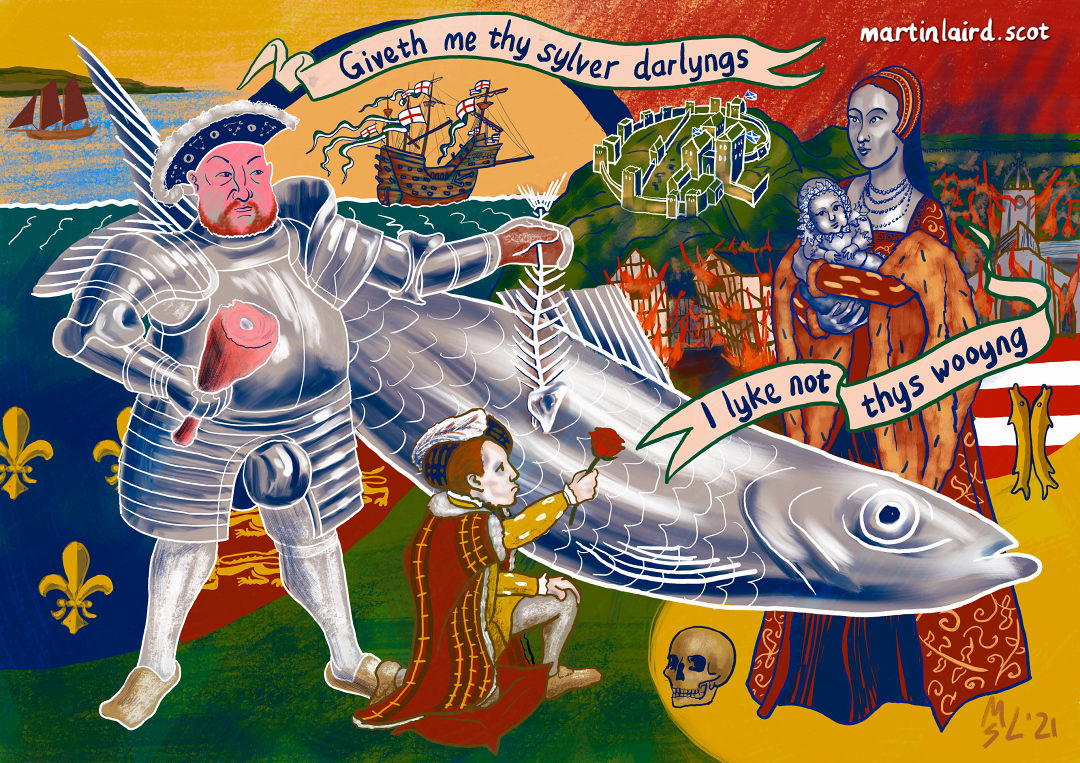
Unfortunately for James V, his Uncle, Henry VIII King of England, wasn’t one to observe territorial waters or land borders. Border and coastal raids continued until an uneasy peace was signed between the two nations on 12th of May 1534.

A year later, James V made a formal complaint that English fishermen were raiding in Orkney and Shetland, fishing where they did not have rights to and even carrying off some poor islanders as ‘slaves’.
Perhaps because of the coastal raids, or just to view the extent of his realm, James V embarked on a voyage around Scotland in 1540 with his second wife, Mary of Guise, future mother of Mary Queen of Scots.

He set sail with 12 ships, suitably decked out for the conveyance of a monarch and calling in at Kirkwall, Orkney. His retinue included his pilot the French trained Alexander Lindsay.

The French influence at the Scottish Court would continue after the death of James V when Mary of Guise became regent.
In the years following the death of James V the raids by the English affected the Scottish herring trade with exports being hit hard dropping by almost three quarters. This period was an attempt by Henry VIII to bully the Scots into agreeing to a marriage between his son, Edward, and the child Mary. Henry in the past had been unsuccessful in his pursuit of Mary’s mother so never to be deterred he set about plans for a betrothal between the two children. This would have put an end to the Auld Alliance between Scotland and France and brought Scotland under his control.

The Scots fishermen continued to supply herring to Europe and James VI, King of Scots, extended fishing privileges in Scottish waters to the Dutch fleet in 1594.
By the late 19th and early 20th centuries, herring was a booming industry in Scotland. It provided employment for island and coastal communities for those who went out to sea, those who cured and gutted the fish barrelled up for export, and all those other businesses trading along the supply chain.

The island of Stronsay, Orkney was one of the many communities to experience tremendous growth at this time due to the humble herring. In the 1920s the island had a population of 1,067 which during the herring season grew to 5,000 with something like 300 vessels at a time harbouring whilst the herring lassies gutted the fish for exporting to Germany and Russia. It also boasted the longest bar in the north of Scotland.
It’s a very different story today. The number of fishers employed on Scottish vessels from 2015 – 2024 :

Fisheries management measures for Marine Protected Areas within offshore waters between 12 and 200 nautical miles from the coast will come into effect from 16 October. Site specific measures being introduced include restrictions on certain fishing activities that could damage these habitats and species, such as bottom-towed gear.

Cabinet Secretary for Climate Action in the Scottish Government, Gillian Martin said:
“Scotland’s seas are an integral part of our national identity, and this is a major milestone in protecting our marine environment. It’s important, now, more than ever, that we address the twin crises of biodiversity loss and climate change and these new measures will help to support and enable marine ecosystems to flourish and build climate resilience.
“With these new protections in place, Scotland’s marine environment will be better equipped to support thriving marine industries, protect food security and secure the ecosystem services that we all rely on.
“This achievement is the culmination of many years of dedicated, collaborative work across science, industry, environmental organisations and local communities. I’d like to thank all those involved in progressing this work to help safeguard these important ecosystems.”
There are very few countries in the world that possess waters where the natural harvest of the sea is so bountiful. Other countries know the value of Scotland’s waters as fishing grounds but it is an industry which does not get the support it deserves in its own country.
Fiona Grahame

Leave a Reply to Concerning Trends in Scotland’s Shellfish Sector – The Orkney NewsCancel reply