
By Bill Miller and first published in The Stronsay Limpet. Republished here with kind permission.
Stronsay has been associated with kelp making for centuries, and in fact James Fea of Whitehall , Stronsay, was credited with making the first kelp in Orkney in 1719, which he sold to Newcastle .
Initially, kelp was used in the making of glass, dyes and soap, in factories in the north-east of England , it being rich in potash, soda and iodine. Eventually alternative sources were found for the production of iodine, and slowly the industry went into decline with the last kelp burning in Orkney being in 1937. The gathering of tang in Stronsay was continued for short periods in the 1940s and 1950s, and the gathering of tangles however, continued sporadically until 1998.
Tangle gathering and kelp burning are remembered as winter and spring work, but to fit in with farm work, in 1810 for instance, kelp work at Huip began in April and ended in July, using workers from Caithness who were free from the ties of farm work. The expense incurred in bringing in workers from across the Pentland Firth , reduced the profits considerably and was discontinued.
The work was carried out mainly by farm workers and crofters, who paid their rent and received meal, in exchange for working in the kelp and doing other menial tasks for the lairds. They were known as “oncas” as they were always “on call” to the laird.
Working with the tides, they could be out cutting seaweed at all hours of the day and night, resting when the rocks were covered by the tide. Although this was back-breaking work, it could be a pleasant task on a nice sunny day with both men and women taking part.
Rock-weed was cut with serrated hooks leaving the “stool” to grow again for about three years when it had its highest alkali content and would be again ready for cutting. Floating seaweed was often dragged ashore with a ware-pick or “klooro”.
Tangles came ashore during the winter gales and could be found piled high along the shoreline.

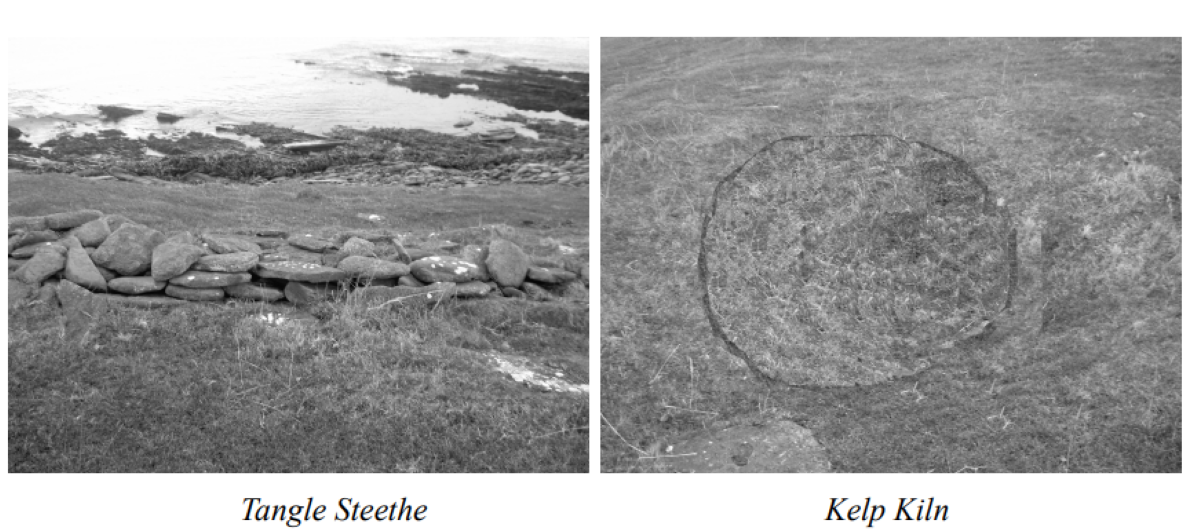
They were brought up onto the fields and dried, and although rock-weed was preferred for the burning of kelp, tangles were also utilised for this purpose. Many people utilised tangles for burning in their homes, but as coal was cheaper than kelp, some lairds brought cargoes of coal up in kelp ships and sold it to the kelp workers to maintain and preserve the supply of the more expensive kelp. Tangles used in kelp burning had to be dried as quickly as possible to preserve the alkali and iodine content, and so they were built up on “steethes”, rough walls of beach stones about fifteen inches high on which a layer of tangles, two or three deep were placed across the steethe, then alternate layers were laid at right angles until they were between three and four feet high. Air passed through the steethes and dried the “beek” of tangles ready for the kiln.
The kelp kiln was a circular pit about six to eight feet across and one foot deep cut into the ground. Some had sides lined with flat stones, but most were just a circular earth pit. A fire would be lit in the centre of the kiln using dried tang, driftwood or anything flammable. Once the fire was alight, seaweed was piled on top and replenished whenever the fire showed red. Burning a kiln would start early in the morning and continue throughout the day consuming several steethes of tangles by late afternoon when the kelp became a boiling liquid ready for raking.
Several men or women were needed for the raking which was done with a kelp rake which had an eight foot handle and a turned down metal toe, or sometimes two or three prongs. Kelp had to be raked for at least half an hour to ensure all the weed was burnt into an even texture. As it began to set, two men would beat it with kelp shovels and this was known as sealing the pit. Heavy beach stones would then be placed on top of the solid kelp to help compress it further and protect it from the elements.
After about two days the kelp would be sufficiently cool to be broken into lumps weighing about two stone, and then carted off to the kelp store where it was kept dry until shipped off to the buyers.

The years 1739 -1742 were years of extreme famine with crop failure, dying animals and starvation. Ironically the parishes where kelp was burnt did not have any deaths from starvation, unlike some where no kelp burning took place. Nevertheless, the burning of kelp and the resulting acrid smoke, was blamed for the problems, and it all came to a head in May of 1742 when some of the islanders decided to sort it all out.
On Sunday 16th May, 1742, Edward Miller who had been the Bailie’s Officer for some 20 years, and also acted as the church beadle, was approached by Peter Fea of Dunatoon (Situated along the shore between Springwell and Furrowend) who asked him to intimate at the church door that a meeting of all “boundsmen” or farmers was to be held at Milnfield the next morning for the purpose of stopping the burning of kelp. The next morning about 50 protesters gathered at the Mill of Milnfield, and armed with stout sticks, set off on a tour of destruction. Their first stop was at Clestrain where they expected to find James Fea burning kelp, but he was out of Orkney at the time. There was however, an angry exchange between his wife Barbara and the rioters. There was a scuffle between the rioters and some of Fea’s farm servants and some kelp tools were broken before the rioters set off for Huip.
At this time, Huip was the biggest of the kelp farms in Stronsay, and there, they found a kiln full of burning kelp. Thomas Balfour’s kelp workers were the main target of the rioters who stated their intention of tying them up and setting them adrift in a boat. Elizabeth Cockburn was in charge of the kelp making and she had managed to hide the workers in a secret room where, despite a search by the rioters, they were not found. The rioters then beat up Elizabeth and her maid-servant, extinguished the kelp kiln, threw already made kelp and seaweed into the sea, and smashed up kelp tools, before heading off for Strenzie (now Whitehall ) where they could see the smoke of another burning kiln.
There, the man in charge, Malcolm Delday, refused to stop burning and despite his protests, the kiln was extinguished and kelp and tools were destroyed, before the rioters set off for further raids in other parts of the island.
On the following Thursday, Thomas Balfour of Huip who was a merchant and landowner, applied to Andrew Ross, the Steward-depute, for a warrant for the arrest of the rioters including Peter Fea.
The execution of the warrant was entrusted to Steward-substitute, John Riddoch, and he was instructed to head for Stronsay with such armed forces as he deemed necessary to make the arrests.
Riddoch was no stranger to such tasks having been shot at point blank range by the Laird of Burray when trying to arrest a deserter who was employed by the laird.
The location of the embarrassing wound made it quite difficult for him to sit down for some time.
Worried by the number of people he was supposed to arrest, Riddoch swore in about a dozen Kirkwall tradesmen, armed them with swords and pistols, and set off for Stronsay on the Saturday.
Considering that an element of surprise might be the best tactic, they approached Peter Fea’s house in Rothiesholm at around midnight. Breaking down the door, they found Peter and his wife in bed, and upon being asked to get out of bed, Peter refused. He was therefore dragged out by the legs with his hysterical wife hanging on to him. She then fainted, and when Peter told his daughter to run to a neighbour for brandy, Thomas Balfour, who had joined the posse, pointed a loaded pistol at the girl and stopped her leaving. Unwilling to leave Mrs Fea in this distressed condition, Riddoch allowed Peter to stay with her on the promise that he would surrender himself at a later stage.
Riddoch and his assistants then set off to make four further arrests which were successful, and by morning they and their prisoners were on the grounds of Holland , still accompanied by Thomas Balfour of Huip, and his brother William Balfour of Trenaby, and they were heading for Cleat to arrest John Fea, the brother of Peter. They did not have to go looking for him as he appeared in front of them with a mob of about sixty rioters. As the mob kept its distance, Riddoch left his prisoners tied up in the custody of the Balfours and, accompanied by Edward Miller, the Bailie of Stronsay, approached the mob and read them “The Riot Act”, giving them a formal order to disperse in the King’s name, but they refused to do so. As the mob pushed forward, Riddoch was forced to draw his pistol while the Balfours retreated with the prisoners towards the relative safety of Holland .
However a second mob appeared on the skyline of Stebb Hill, about half a mile to the north. Word had spread around the island that Riddoch and his men were “dragging naked men and women from their beds and making them prisoners”. This mob then charged down the hill led by Peter Fea calling on his people to follow him and “spare none”.
Thomas Balfour drew his pistol and his brother William stood beside him with sword drawn. Richard Angus of Milnfield threw Thomas Balfour to the ground and was grappling with him when brother William came to his rescue and wounded Angus with a blow from his sword. William also wounded John Fea before being overcome by the mob.
Meanwhile Peter Fea, armed with a cudgel, made for Riddoch, knocking his hat and wig off, and causing a severe wound to his head. Other rioters cut the ropes binding the prisoners and it was all over in a few minutes, but the rioters were unsure what to do with their victory. Everyone – rioters, prisoners and the Steward’s men headed for Holland , talking, arguing and tending their wounds.
Riddoch and his party left for Kirkwall without being opposed but they took no prisoners with them.
The success of the Stronsay rioters spread to other islands and parishes and violence spread to every corner of the County. There was almost a kelp riot in Harray, a parish without kelp!
Eventually many of the rioters across the County surrendered, but Peter and John Fea were the only two from Stronsay who were tried.
The Earl of Morton, viewing events from the comfortable safety of his London home, thought that a great fuss was being made over the affair, and recommended leniency. John Fea was fined £60 Scots and had to find bail of 300 marks to keep the peace for three years. Patrick, whose part in the riots was more serious, was fined £140 Scots, and was forced to stay in custody until he appeared at the door of the churches in Kirkwall, St Andrews, Deerness, Firth, Orphir and Stronsay, all kelp making districts. He was forced to stand at the church door immediately before divine service, bareheaded and with a placard around his neck, on which was written a summary of the verdict and sentence. Failure to pay the fine would result in a whipping or banishment.
Next year the crops were better and there was no more talk of destroying kelp kilns. Henry Leask of Haukhouse, Stronsay, was the kelp grieve for the island, and in 1803, received a total of 52.5 tons. Does anyone know where Haukhouse was?

The fifty years from 1780 to 1830 saw the “Great Kelp Boom” when around three thousand people were employed in kelp making in Orkney, and kelp accounted for about two-thirds of Orkney’s exports, totally dominating the economy of the islands. In 1830 however, boom prices were drastically reduced, and although it recovered somewhat, the expansion in agricultural exports resulted in kelp playing a relatively minor role in the economy of the islands. Ware however, was used extensively on the land to enrich the soil and produce better crops.
In the 1700s, kelp workers received about £1 per ton of kelp. In 1998, the last Stronsay tangle gatherer, Ellie Harrison of Newfield, received £170 per dry ton and on an average day would throw up around 4000 tangles. In that year she worked hard for over 900 hours in all sorts of terrible weather, and amazingly succeeded in collecting 18.575 dry tons, for which she received just over £3 thousand pounds. Unfortunately for Ellie, despite all her hard work, this was still less than the minimum wage at that time.
Take a walk around Griceness or most of the other Stronsay shore-lines and you will still see the tangle steethes and the kelp kilns where our forefathers struggled hard to make an honest living.



Leave a Reply