
By Edwin Heath.
‘These fragments I have shored against my ruins
Why then Ile fit you. Hieronymo’s mad againe.
Datta. Dayadhvam. Damyata.
Shantih shantih shantih’
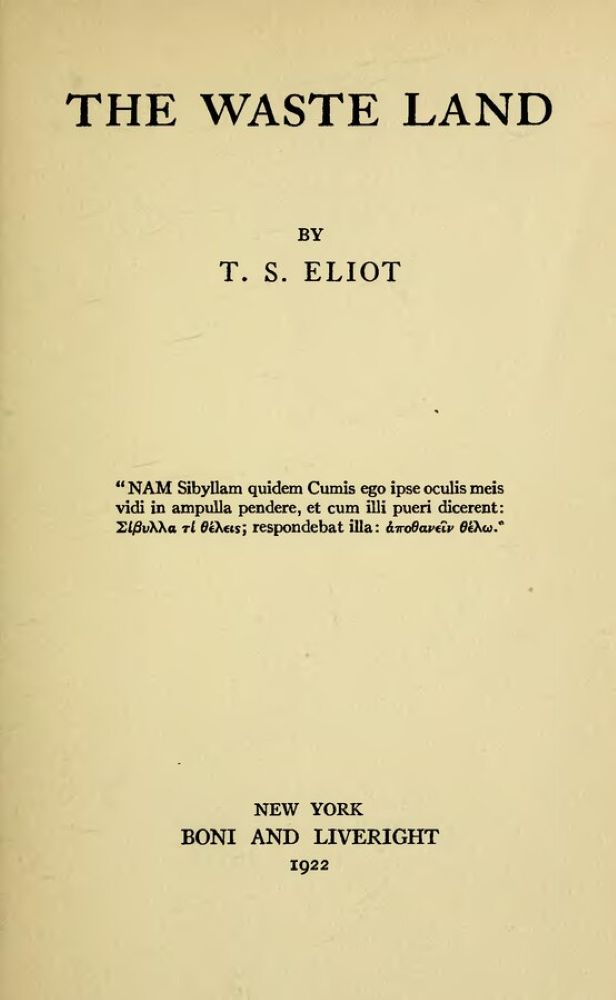
Anyone poring over these last words from T.S.Eliot’s ‘The Waste Land’ – arguably one of the greatest poems of modern times – might be forgiven for wondering what the heck they’d just read.
In truth, it was a masterpiece of creative dystopia: a concatenation of languages, of literary and historical references, of personal memories and experiences – some soul-shattering, some banal – all flowing from the broken heart and mind of a man tortured by life itself, and by his sense of a world left in ruins after World War One.

Everyone should read The Waste Land … perhaps because the best poetry is the kind which makes you want to understand it? And Eliot’s tortured poem does that in spades, in the paradoxical guise of so many personal reflections from such a deeply private individual.
One cannot help but want to join him in spirit, in that lifetime’s journey through the heart of bleakness: finishing up with the thrice-repeated Sanskrit invocation of peace through understanding – ‘shantih’.
Have I inspired you – or just confused you? Eliot seems to have done a good job himself, with the copious notes he appended to The Waste Land; some of which earned him accusations of being deliberately misleading. Not just that, perhaps … but the very idea of a poet explaining his poem! One critic complained vociferously about not wishing to be dragged back into the classroom.
So that is the nub of it: should any poem be explained at all? Especially if the ‘explanation’ leaves you feeling none the wiser …?
Of course, you might add, some poems need no explanation, they are self-explanatory, and can be read and understood at once. Such as – to somewhat cheekily illustrate – this poem of my own:
Ode to a fly
Oh fly,
I could not let you die.
I found you in a bag with my sandwich,
And in my rage imprisoned you, threw you away.
Hours passed, night fell.
I thought of you, suffocating slowly.
Oh fly, oh fly,
I could not let you die.
With matches, fumbling,
Rummaging dustbins in the dark,
I fished you out,
Still stuck to your cellophane pouch.
A motionless fly,
I carried you into the light.
With baited breath I opened the bag,
And held you up to the air.
Oh fly, oh fly, why don’t you fly?
I cried – and then you moved:
Quick little steps, a stop, a pivot,
Nose upwards – zoomph – an airborne fly!
A ceiling-bound, vertical take-off fly,
A whizz-bang, super-duper fly.
Oh fly, you apple of my eye –
So glad am I, you didn’t die!
_________
So there you go: Just a very straight poem, telling a story, plain as the mud on your face. What more needs to be added?
But to return to the mysterious Waste Land, with its multiple scenarios and languages and corresponding footnotes, including Latin (and who understands that these days?) What are we to make of it all? Especially when there are mysteries within mysteries!
I speak, of course, of the Hyacinth Girl:
‘You gave me hyacinths first a year ago;
‘They called me the hyacinth girl.’
– Yet when we came back, late, from the hyacinth garden,
Your arms full, and your hair wet, I could not
Speak, and my eyes failed, I was neither
Living nor dead, and I knew nothing,
Looking into the heart of light, the silence.
Oed’ und leer das Meer.
A chill runs down your spine, because you feel there is more to this than mere words. Sure enough, half a century later, when Emily Hale’s letters to the great poet were finally allowed to be published, some of those long-held speculations were confirmed. She was the hyacinth girl: the one he loved for years but never married, though she inspired so much of his poetry. In the end he claimed his love for her was illusory, and that marriage would have killed the poet in him. Was this consolation in retrospect for having missed, perhaps, years of happiness – which Time’s ‘Moving Finger’ could never allow him to recapture?
All this might be called biographical elucidation ‘after the event’; but surely that is half the fun, and in some ways more rewarding than any sterile contemporary analysis of a work of poetry. In other words, find the back-story. Even if you have to wait – as in this case – for fifty-year old ‘Breaking News’ from the past.
Yes, forget all those mind-encumbering details, all that classroom stuff … give us a juicy back-story every time!
You might be wondering, by this time, which side I might ultimately come down on. Such expectations are way off! All I can do is to humbly apologise for asking such an impossible question, as I slink away with my tail between my legs. Worse than that, I must confess that it is you, the reader, from whom I am begging guidance – not the other way around.
Meanwhile, I am happy to hide myself among the hordes of so-called poets who vehemently deny themselves that title. Who openly admit that they have no idea what they have been writing about, let alone what it means. Because we all live in our own little worlds, making up our own little meanings as we go along. The best we can hope for is that whoever reads our words will like the meaning they themselves have attached to them.
And so, I suppose, this is the best answer I can give. One can explain all one wants; but it is what the reader takes from us that really matters. And that can be anything – or nothing. When it comes to understanding poetry, everyone will be different. Some will be nonplussed, and perhaps desperate for any chink of light you can throw at them. Others will enjoy the challenge of trying to figure it all out themselves. Some of the latter may well resent the intrusion of unwanted external information, in the form of postscripts, or even anyone else’s opinion; to be sure, they may very well be annoyed by the little experiment I am about to propose.
Yes!, another of my dreaded poems – chosen, this time, hopefully, for its lack of instant accessibility. Who, what, or where is Nazaré ? Who are the chicken-shaped fishwives? Why is the narrator pondering his own demise? If you would like these answers handed to you on a plate, you are among the first category. If you enjoy a challenge, or hate spoiler alerts, you belong in the second – in which case, better skip straight to the poem. You can still decide whether or not you want to read the explanations afterwards. If you do that, and then decide it has ruined the poem for you, at least you will know better next time, won’t you?
The Explanation
Nazaré (named after the biblical Nazareth) is an ancient fishing village – now a popular tourist resort – on the Silver Coast in the Estremadura region of Portugal.
My wife and I arrived there one February on a touring holiday of that country, intending to stay just a couple of days. However, I had just started to come down with the worst ‘flu’ of my life (if the infamous Spanish Flu had killed millions, this Portuguese version felt not dissimilar!), and our tour ground to a halt in that one spot for the remainder of our holiday.

Nazaré is famous for having some of the highest waves in the world, getting on for one hundred feet, with surfers breaking one record after another. Rogue waves also pose a danger for swimmers – indeed our landlady spent some time talking about previous guests who had drowned there!
This wasn’t about to happen to me, as I spent most of my time recuperating indoors, just wondering if I could survive what my body was going through (hence the morbid tone of the poem).
Luckily we had a room with a balcony immediately facing the shore, and I was able to observe the daily activities of the local fisherwomen as they tended their trestles of drying cod – often having to rush about waving away seagulls which had become well practised in the art of snatching free fish meals.

These women often wore traditional costumes with several layers of petticoats, which reminded me, in my delirium, of chickens.
But the beach, the town and the weather were beautiful, so despite illness my memories of the place are happy ones. And – of course – I got a poem out of it!
So – to conclude – here’s hoping you like this little article and the following poem. I’d love to hear how it all went down. To quote Mitchell and Webb: ‘What do you reckon? You must reckon something!’
Ta ra!
Nazaré
We snuzzle together in Nazare,
At home with the foam
From the soundly-drowning,
Roundly-pounding sea.
The black-clad eternal
Chicken-shaped fishwives
Guard their sun-embalmed
Eviscerated sea-babes from
Pedro, worst of the wheeling
Cod-thieving sky rats
Who yesterday, under their life-long wary noses
Sneaked a full-beak, shrieking.
Yet there, still not there,
Under that screaming, sea-scorched sky,
I have, still have not come to live,
Nor somehow, chanced to die.


.jpg)
Leave a Reply