
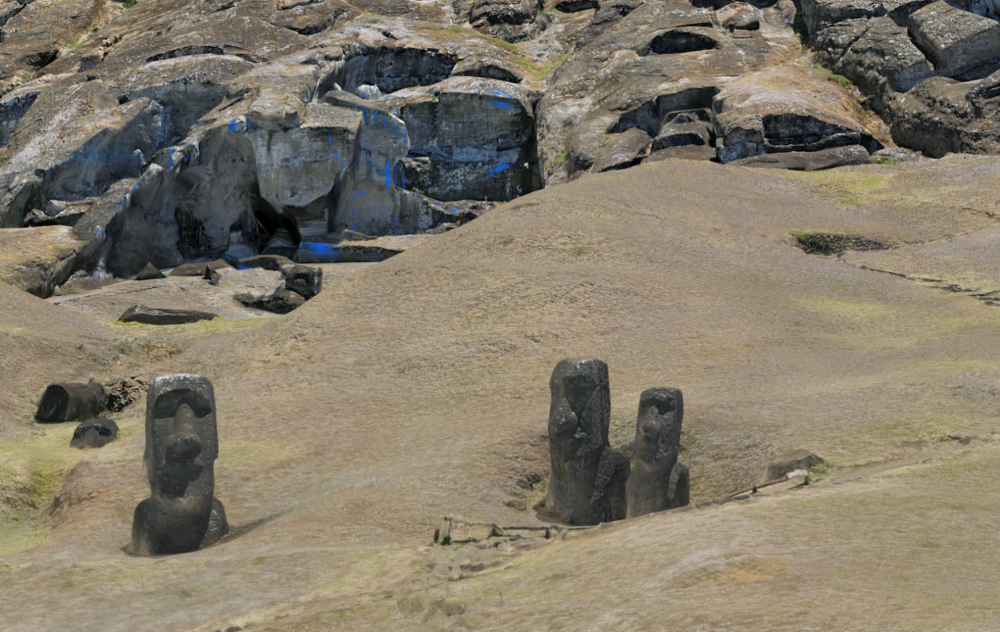
Rapa Nui (Easter Island) continues to fascinate and reveal more about the culture which created its iconic states.

The island’s location means that most of us will never visit, however, using the latest technology you can now explore Rano Raraku, one of the major quarries on Easter Island without leaving home. It may even inspire some to make that journey to see them for themselves.
A research team from Binghamton University, State University of New York has created the first-ever high-resolution 3D model of the quarry, providing people worldwide with a glimpse of the island, including almost 1,000 of its iconic moai statues.
Binghamton University Professor of Anthropology Carl Lipo explained:
“As an archaeologist, the quarry is like the archaeological Disneyland.
“It has everything you can possibly imagine about moai construction, because that’s where they did most of the construction. It’s always been this treasure of information and cultural heritage, but it’s remarkably under documented.”
The new model allows visitors to zoom in and pan across various features of the quarry, both high and low, offering views that you wouldn’t be able to see even if you did make your way to Rapa Nui. The quarry itself is located in a volcanic crater that is too steep and rugged to safely traverse.

In October 2023, a wildfire swept through the quarry, raising concerns about the site’s future. When Lipo and his team arrived to conduct research in January 2024, a community group on the island asked if the researchers could document the quarry in the event that it was permanently damaged.
The researchers, who also included Thomas Pingel and Kevin Heard from Binghamton’s Geography Department, leapt at the opportunity. They conducted around 30 drone flights, snapping 22,000 photos of the quarry at 30-meter increments. Using computer software, the images were stitched together into the resulting 3D model, a process that took months.
Using the new 3D model, the researchers examined the sites of 30 different “workshops” in the quarry. Examining the patterning of the quarrying, where carving techniques differed from site to site, the researchers found it aligned with previous evidence – that the island consisted of multiple independent groups working simultaneously rather than being managed by a centralized “chiefdom.”
“When we look at the ability for people to move giant statues, it doesn’t take that many people to do it, so that it really connects all the dots between the number of people it takes to move the statues, the number of places, the scale at which the quarrying is happening and then the scale of the communities,” said Lipo.
The 3D model will be used for further analysis of the quarry.
“This is an incredible landscape of stuff that you could really go visit, that you’ll want to see,” added Lipo.
The 3D model is available to view online.
Click on this link to access, Megalithic statue (moai) production on Rapa Nui (Easter Island, Chile), published in PLOS One.



Leave a Reply