
By Bernie Bell.
We went to see an exhibition in Tankerness House Museum of the work of Orkney jewellery makers
http://www.spanglefish.com/berniesblog/blog.asp?blogid=17591
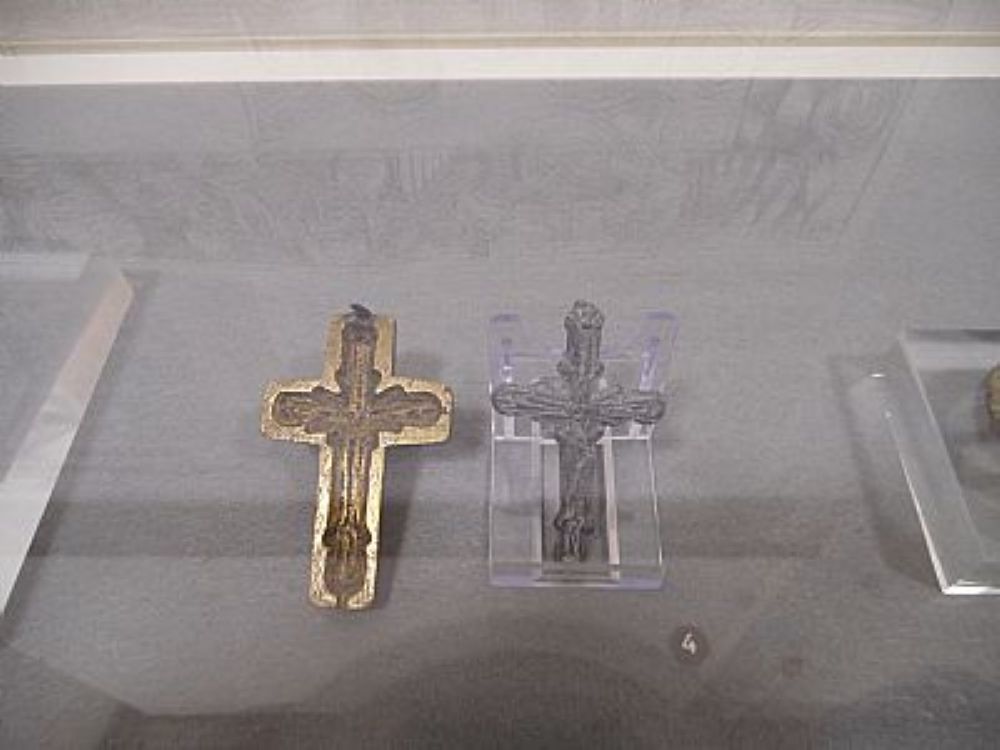
On the way into the main exhibition room, there is a display case containing some Orkney jewellery from times past. One of these pieces is a cross, and the mould it came from.

The information states ….
“Pilgrim’s cross and mould found concealed within an alcove in St. Magnus Cathedral. Date unknown.”
This intrigued me. I stood and look at it, placed my hand over it, tried to get a ‘feel’ of it in time and place.
What first came in my head, was 15 hundreds, then, farther back, rolling through time to the 11 hundreds. Maybe.
We carried on round the exhibition, and when I came home I was thinking again about the hidden cross. I was wondering why I should have had 15 hundreds in my head, as I strongly feel that it was made before that. Then, something the chap in the shop had said clicked with me – The Reformation – maybe it was placed in the alcove in the Cathedral during the Reformation, for safety. A revered piece of religious iconography – placed, then either forgotten, or the person who placed it never got the chance to come back for it. Troubled times.
The next step in its story was when I wondered about its origins. Was it made in Orkney, or elsewhere and brought here? Or was just the mould brought, and the cross made here? What I got in my head was France – that it was French and that possibly the mould, and a craftsperson who knew how to use it, came from France or was brought to Britain in the early 11 hundreds as part of the waves of folk who came after the Norman conquest. Maybe.
Then was the mould used to make this cross and probably other’s too? There would be a few centuries of history between its arrival in Britain and it being hidden in an alcove in St. Magnus. Who did it come to Orkney with? For what reason?
As the information states, possibly a Pilgrim to the shrine of St. Magnus. And then – why was it hidden?
These are just my thoughts – my conjectures. I thought it would-be good if someone made a story from it…..around it. That would entail creating characters and a lot of detail, which it isn’t in me to do!
I sent my blog piece to Tom Muir – local story-teller – and Tom reminded me that the bones of Magnus and Rognvald, as well as two small statuettes of St Olaf and St Magnus were hidden during the Reformation as, as Tom put it…..
”All of those would have come under the puritan jackboot had they been left on display.“
My response was….
“I’ve been thinking some more about the cross and mould being hidden during the Reformation and thinking…..the mould would be seen as even more of a threat by the puritans – a cross is a cross, and can be easily destroyed. A mould for a cross can mean that many more crosses can be produced.
A person wouldn’t even need to be a metal worker – rub a bit of wax or oil in the mould, press some clay into it, turn it out – bake it – you’ve got a ceramic cross – multiple crosses.
The mould is even more worth hiding and preserving then the cross.”
I asked Tom if it’s OK to add his words to the tale, and he sent the following informative response…..
“Please do use anything, but with the caveat that I may be totally wrong in my assumptions. The puritan reformers wouldn’t have had anything against the cross as a symbol of Christianity and of the martyrdom of Christ, but what this particular cross represented. A souvenir of a pilgrimage, of the visitation to the shrine of a saint. Saints were now out, along with religious art, ceremony and music. The statuettes were found upstairs in the cathedral in (I think) the 19th century. Again, Fran will know better than me. But the fact that these Medieval representations of two saints have survived the destruction of other statues during the Reformation is significant in itself. They were placed away from everyday sight. Maybe someone thought that their destruction was an unbearable thought and tried to save them, just like the bones of Magnus and Rognvald were saved from destruction and public humiliation. There has been a tendency in the past in Orkney to look on the Reformation as a bit of a non-event, because the priest and bishop changed sides so completely and continued as though nothing had happened. But for my ancestors, who worshiped in small chapels with imagery and ceremony, the sudden change must have turned their entire world upside down. Living by ceremony and ritual, observing saints feast days, decking the small churches with candles at Candlemas and the series of events during ‘the Yules’, as they were known. Not just Christmas and New Year, but all the other small rituals that were required to be observed to ensure the prosperity and luck of the farm and the family. To have that suddenly and violently ended must have seemed like the world was coming to an end.
By the way, the statuettes of St Olaf and St Magnus are on display in the Medieval Gallery in the Orkney Museum, as is the box that contained the bones of St Magnus.”
Being of Irish descent, I’m familiar with subterfuge being needed to practice religion – all those ‘Mass Rocks’….
And I’m wondering what else is to be found in the nooks & crannies of the Cathedral?
All the way through, since seeing The Cross in Tankerness House, the song by Prince has been playing in my head.
Tom’s words on how much saints and a pilgrimage cross would mean to poor people, have prompted me to post Prince’s words – which are about how much the Cross, faith, belief meant and mean to people who have very little in this life…..
The Cross
Black day, stormy night
No love, no hope in sight
Don’t cry, he is coming
Don’t die without knowing the cross
Ghettos to the left of us
Flowers to the right
There’ll be bread for all of us
If we can just bear the cross
Sweet song of salvation
A pregnant mother sings
She lives in starvation
Her children need all that she brings
We all have our problems
Some big, some are small
Soon all of our problems
Will be taken by the cross
Black day, stormy night
No love, no hope in sight
Don’t cry for he is coming
Don’t die without knowing the cross
Ghettos to the left of us
Flowers to the right
There’ll be bread for all, y’all
If we can just, just bear the cross, yeah
We all have our problems
Some are big, some are small
Soon all of our problems, y’all
Will be taken by the cross
The cross
The cross
Prince Rogers Nelson

Leave a Reply