

The Moon was Full on January 3rd, still another ‘supermoon’ at its closest to the Earth, and appeared close to Jupiter that night. At the same time the Earth came to perihelion, its nearest to the Sun, so the Sun, Earth, Moon and Jupiter were not only at syzygy, all of them roughly in line, but also almost as close together as they can get. The following night the Moon grazed the top of the Open Cluster Praesepe, ‘the Beehive’, which on some old maps is drawn as the tuft on the tail of Leo.

The Moon is New on January 18th and as a crescent, it passes near Saturn on the 22nd and 23rd. It passes above Jupiter on the night of the 30th-3lst. On the 27th it crosses the top of the Pleiades, occulting the stars Taygeta, Electra and Merope in that order as it moves eastward, all of them between 8.50 and 10.30 p.m.. The occultation of Maia can not be seen from England, but on a line from Fife to Bute, the star will graze the southern cusp of the Moon around 9.31 p.m..
The planet Mercury has now left the morning sky and is not visible from the UK in January, though it can be seen after sunset further south, e.g. from the USA. Mercury passes the Sun on the far side (superior conjunction) on January 21st.
Venus too is not visible in January, at superior conjunction on the 6th, and neither is Mars, at conjunction on the 10th.
Jupiter is brilliant all night in Gemini, rising near sunset, e.g. at 3.45 p.m. on the 10th, when it comes to opposition, due south at midnight, the night after its closest to the Earth. Astronomy Now points out that it will be visible for more than a Jovian day of 9 hours 50 minutes, so features on the right of the planet in early evening will reappear on the left before dawn. Nigel Henbest’s annual guide Stargazing 2026 recommends looking for Jupiter’s moons with binoculars or a telescope on the nights of the 15th, around 6 p.m., and the 29th, about 9 p.m., when the four large moons will be on the same side of the planet and arranged in order outward – Io, Europa, Ganymede, Callisto – making it obvious which is which. Before opposition their shadows will precede them in transit across the planet, and follow them afterwards; as always there are detailed predictions in the current issue of Astronomy Now. Jupiter was near the Moon on the 3rd and will be again on the 31st.
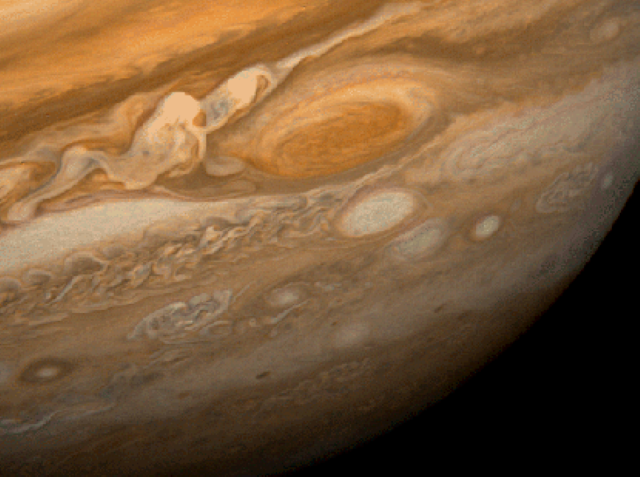

Another interesting snippet in that issue concerns the object now called ‘Oval BA’, lying south of the Great Red Spot and occasionally lapping it due to the planet’s different rotation rates at different latitudes. It formed in the early 2000s from a merger of three of Jupiter’s ‘white ovals’, so prominent in the Voyager spacecraft flybys of 1979 (Figs. 1 & 2), and then turned red, becoming the Little Red Spot for a time. When I was running the North Lanarkshire Astronomy Project in 2006 there was a lot of interest in it from school classes, because New Horizons had photographed it in close-up on its way to Pluto earlier that year, and the storm had turned white again (Fig. 3). It’s thought that the red colours of the largest spots are due to phosphorus compounds created by the action of solar ultraviolet radiation, at their slightly higher tops. Indeed, the Little Spot has now turned red once more, inside an orange ring.

Saturn, between Pisces and Aquarius, sets about 10 p.m., with the Moon nearby on the 22nd and 23rd. The rings are still very thin to our view, with a separation of less than a degree, but there are chances to see the giant moon Titan pass above them on the 9th and 25th. Titan will be hard to spot because its shadow is no longer visible on the planet.
Uranus in Taurus, below the Pleiades, sets about 4 a.m., near the Moon on the 27th.
Neptune in Pisces is only three degrees above Saturn, also setting around 10 p.m.. and with the Moon nearby on January 23rd.
The Quadrantid meteors from comet EH1 peaked on the night of the 3rd, as the Supermoon reached its brightest, so there could hardly have been worse conditions in which to observe the shower, which is normally worth watching.
Comet 24P Schaumause is in the morning sky, tracking east-south-east through the constellation Boötes as it follows Ursa Major up the sky, but the Astronomy Now headline ‘Comet Bright in the Pre-Dawn Sky’ is a bit OTT because it will be below naked-eye visibility at 8th magnitude. Below Boötes in turn is the circlet of Corona Borealis, just below which the 80-year nova T Coronae Borealis is expected any time. I’ve never seen a nova and kept watch all last year to no avail, and Astronomy Now‘s headline for it is ‘The Star that Won’t Explode’. Nevertheless, a Happy New Year to all!
Duncan Lunan’s recent books are available through Amazon; details are on Duncan’s website, www.duncanlunan.com.
You can download a copy of the Sky Map for January 2026 here :




Leave a Reply