
Revied by Erin Farley.

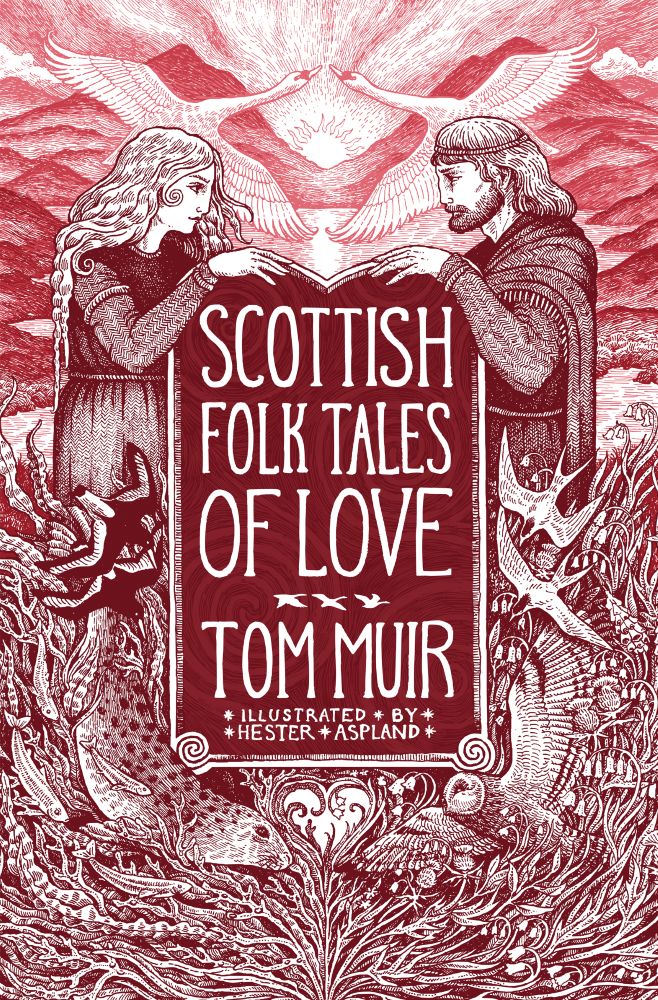
Scottish Folk Tales of Love (The History Press, 2026), by Tom Muir, illustrated by Hester Aspland.
I could pretend this is an objective review from a disinterested bystander, but Tom Muir, author of the present volume, has ever-so-slightly scuppered that by including a genuinely lovely paragraph about me in the acknowledgements. So in the interests of full disclosure, yes, this is a book by one of my dearest friends. But maybe I can get away with a little bit of soppiness here, because Scottish Folk Tales of Love is a personal book as well as a story collection. The first love story, and the one which sparked the book’s creation, is that of Tom himself and his wife Rhonda. If you haven’t heard it yet won’t spoil it for you, but I’m still not bored of it a decade in.
The traditional stories in Scottish Folk Tales of Love, told by Tom Muir and beautifully illustrated by Hester Aspland, encompass many forms of love. Romantic love is the driving force of many, but the love of siblings, friends or parents is an equally strong presence, and the book explores love as a powerful but complicated force. This is not entirely a collection of happy endings, which won’t come as a surprise to anyone with even a passing acquaintance with folklore, but there are enough throughout to keep the faith.
Jack tales may not be the first to everyone’s mind when talking about love stories, but I was delighted to see two of my absolute favourites here.
Stanley Robertson’s Auld Croovie is indeed an anticapitalist love story for Jack and his wife-to-be as they escape the greedy Laird o the Black Hairt (but it is also a love story for the trees.)
There is also the epic Green Man of Knowledge – a story which often leaves listeners wondering what on earth the Green Man’s daughter sees in Jack, who can be point-blank infuriating in this tale in a way he rarely is in others. But, when you spend time with it, this story is a truly mind-expanding journey through the unseen emotional currents of whatever it is humans do to one another, and it’s one which isn’t as present in the contemporary storytelling world as it perhaps should be given its power.
There are, of course, tales from Tom’s native Orkney here too, including another favourite of mine, the ballad-like Lady Odivere – male selkie representation is very important.
But this is not just Tom’s book. Because folk tales can be told in so many different ways, illustrations have a lot of power to shape the atmosphere of a folk tale collection and bring out subtle themes within the stories. Hester Aspland has illustrated at least one introductory image for each story, and several full-page images showing powerful moments in various tales. Her intricate, detailed artwork evokes 19th century folk tale collections but also feels very rooted in the real landscapes these stories move through, and is clearly borne of a deep understanding of the tales and their resonance.
In these stories, love is often unspoken (and not just in Ian Stephen’s anecdote, quoted early in this book, about the Lewisman who loved his wife so much he almost told her – but for all of its brevity this is one of my favourite Scottish love stories.) The act of love is sometimes visible, in self-sacrifice or epic journey. But in stories as in real life, often it is the quiet act of showing up, day after day, even when it’s boring or difficult.
Tom Muir is, these days, very deservedly celebrated as a key figure of the Scottish storytelling revival but it is a reputation built from years of doing the work to bring Orkney’s stories back into circulation, even when wider interest and understanding was lacking. It has been a true joy and privilege to learn stories themselves from Tom over the years of our friendship, but the lesson I treasure most from Tom is how to live with stories, not just for performance or publication but as something in the fabric of everyday life, part of our places and communities and as a constant conversation with the living, the dead and the yet-to-be.
Thank you for the stories, Tom. I’d say I love you but, you know, I’m Scottish.
Scottish Folk Tales of Love can be purchased at your local bookshop or from The History Press.



Leave a Reply