
I am ‘much impressed by the capabilities of Orkney.’
Partial Success.
Part 2 of this series looked at the historical context presented by the Orkney Commissioners of Supply in their argument concerning grievances they had with the UK Treasury on how the islands were taxed. They also brought up other issues they had with the state of Orkney’s infrastructure: lack of Government grants for road building; being defenceless against external and internal hostile forces; and the poor state of postal communications.
Orkney’s Mail Steamer
In the summer of 1854, Alfred Holt visited Orkney from Liverpool to assess the islands’ needs for improved postal communication. His report to the UK Government recommended a route from Stromness to Scrabster – which was contrary to the wishes of the Orkney Commissioners of Supply. They had favoured a Scapa Bay/Herston/Walls/Gills Bay route which they said was shorter and safer for all year round passage.
Alfred Holt rejected this proposal for having too many stops, and that Stromness he found to have an excellent harbour. He recommended that the mail steamer should be an iron vessel: 144 feet long, 20 feet broad, 11 1/2 feet deep; and of 281 tons. It should be lightly rigged with fore and aft sails, screw propelled, and of 70 horse power. He added that the mail steamer should be able to carry cattle, some cargo, and passengers. He stated that he was ‘much impressed by the capabilities of Orkney.’

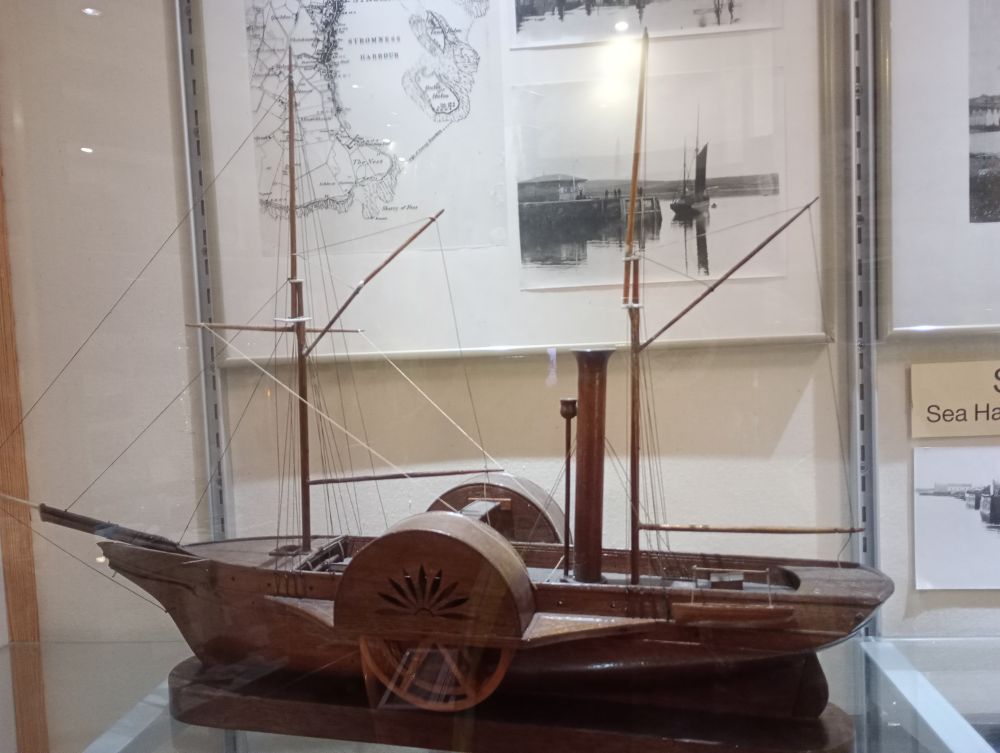
The Stromness Museum has a model of the new mail steamer that served Orkney until 1869.
The Orcadian newspaper reported on 3 May 1856 that:
“The “Royal Mail” steamer still continues to ply between this and Thurso with the greatest regularity. A new era seems to have at last been opened up in the regularity of transmission, and in the delivery of letters. The change is giving the greatest satisfaction here, as well it might, and will no doubt do so over the whole county. Notwithstanding the north-easterly gales which she had to encounter during the last few days, she continued to arrive about the specified hour. She has now got the necessary requisites according to the regulations of the Board of Trade, and, though she is carrying no passengers at present, it is expected that she will be ready for that purpose very soon.”
The service was limited in the winter months from October up till 1 April to only 3 trips a week which was one of the main concerns the Commissioners had with choosing this route.
Assessing the Land for New Tax Rates.
The Land Valuation (Scotland) Act of 1854 came into force, 10 August, and the Commissioners of Supply across the nation were charged with administering the assessment and collection of the taxes.
Across Scotland various local Commissioners of Supply corresponded with one another on what needed to be assessed. It should be remembered that in Orkney great changes were taking place as Common Land was ‘taken in’ by large farms and landowners – dividing up amongst themselves the land which had been used by the people for generation upon generation. Land was enclosed. Fences appeared where none had been before. For most of the smaller farms and crofts it was the final blow in what was an already difficult life. Eviction and removal took place throughout Orkney. It also meant that the value of the land assessed had changed as farms and estates grew in size.
How to assess the lands now ‘improved’? and owned by those in charge of administering the assessing?
In Orkney, David Petrie, Graemeshall was appointed as Assessor in 1855 under the terms of the Valuation Act. The county would be divided up into districts for the new rates to be collected. Orkney’s Commissioners of Supply decided that :
“new land being reclaimed/reclaimed within the last 14 years to be assessed at the same rate as unreclaimed land.”
Old arable land which had been improved by draining within the last 14 years was to be assessed at the same rate as unimproved old arable land in the same neighbourhood.
To let everyone know what was happening (well those who owned the lands that were to be assessed) – all proprietors were to receive a printed circular which would explain the rentals of their whole lands and heritages let to tenants. There would also be an estimated value of all the lands and heritages in the natural possession of the proprietor.
Any rise in new rates with the valuation would in turn be passed on to increases of rental payments from tenants.
David Petrie was awarded a salary of £30 per annum. (That’s about £2,500 in today’s money). Those going round the districts doing the assessing (members of the Orkney Commissioners of Supply) were paid 2 guineas a day and expenses for doing the valuations. By 8 September 1855 several of the assessors had completed their valuations and handed them over. The total cost of the clerk’s salary, expenses, and the printing of the circular etc. came to just over £404 [over £32,000].
It was further decided that the charge of the new rate passed on to tenants and occupiers would be 3d in the £.
A new account was opened in the National Bank, Kirkwall for the financial processing of the new valuations.
A serious problem continued, however, with the non- payment/delayed payments from the lands owned by the Crown in Orkney administered by the Department of Woods and Forests (today the Crown Estate in Scotland).
What was the Crown doing with all the money it was getting from selling off some of its lands in Orkney ? That story will have to wait until part 4.
Reference: Commissioners of Supply Minute Book 1854 – 1879, Orkney Archive C01/1/4
Fiona Grahame

Leave a Reply