
Selling Off The Crown Lands.
In the 19th century The Crown (the Board of Woods and Forests) started to sell off some of its lands in Orkney.
The situation in England, Scotland, and in Orkney was all very different when it came to land. In 1690 the Episcopacy was abolished in Scotland. As a consequence the land and estates of the Bishops of Orkney was annexed to The Crown.
In February 1707 Queen Anne dissolved the Earldom of Orkney and Lordship of Zetland from the Crown handing over the lands to the Earl of Morton, redeemable on a payment of £30,000 sterling. – When Orkney was Bartered for the Treaty of Union

In 1741, a Private Act of King George II authorised and sanctioned the sale of two thirds of the Norwegian Scat of Orkney and Zetland (Shetland) payable to the Earl of Morton. 1741, (15 Geo 2) c4.
Dissolving and disannexing from the Crown and its patrimony the Earldom of Orkney and Lordship of Zetland and vesting them irredeemably in James Earl of Morton and his heirs, discharged from any right or power of redemption in his Majesty, heirs or successors.
The Earl of Morton paid the Crown £500 per annum for this source of income. You can read more about the selling off of Orkney in, When Orkney was Bartered for the Treaty of Union, and the exploits of the previous Earl of Morton.
In 1790 King George III had revoked his claim to income from Crown Estates in England in return for being funded through the Civil List.
The Earl of Morton sold the rights to the Scat in Orkney’s Crown Lands to Sir Lawrence Dundas, however, the Crown continued to receive its share, £500 per annum. ( That’s over £40,000 by 1850) – this amounted to 1/3 of the Scat from the Bishopric with Dundas keeping 2/3.
In Scotland the Crown retained the incomes from its lands until 1830. Before 1837 the Commissioners of Supply were to collect the land tax from the Bishopric Estate, this was to be used for the benefit of Orkney and to pay the stipends of Ministers.
In England, all Crown property, however acquired, was exempt from taxation.
The Commissioners of Supply claimed that at the time it was ‘expressly understood’ that payments to support the clergy in the islands would continue as before. It was now the case, they said, that since the start of the 19th century the burden of supporting the clergy was falling on the Heritors – that’s themselves. The Board of Woods and Forests (Crown Lands – today the Scottish Crown Estate) were either delaying payment or not paying up at all. – ‘Statement of Grievances to which the County of Orkney has long been Subjected’ : Part 1.
On 10 August 1854 the Land Valuations (Scotland) Act came into force. The Dundee Courier reported on 6 December 1854 that there had been 18 sales of land owned by the Crown in Scotland:
- 12 sales in the parishes of Stromness and Sandwick = £13,040 [£1,045,626 at today’s value]
- 3 sales of portions of the foreshore River Tay, Dundee = £194. 19 shillings 6 pennies [£15,634]
- 1 sale of foreshore Firth of Forth, Alloa = £125 [£10,023]
- 2 sales burial lairs, Cathedral of St Andrews = £12,364. 19shillings and 6 pennies [£991,499]
There were also
- 8 sales of the Crown’s revenue for teinds in the parishes of Fordoun Barony, parish of Glasgow, Reay and Daviot = £1425. 12shillings and 8 pennies. [£114,315].
The Orkney Commissioners of Supply were aggrieved at the Crown not paying the land rates it owed in Orkney, and other financial obligations not being met in the islands. The money generated in Orkney was flowing out of the islands.
“the revenues of the property are carried out of the county and appropriated to purposes wholly unconnected with Orkney.” – Orkney Commissioners of Supply, 1853.

They were also concerned, however, about the plans The Crown had for the Earl’s and Bishops Palaces in Kirkwall.
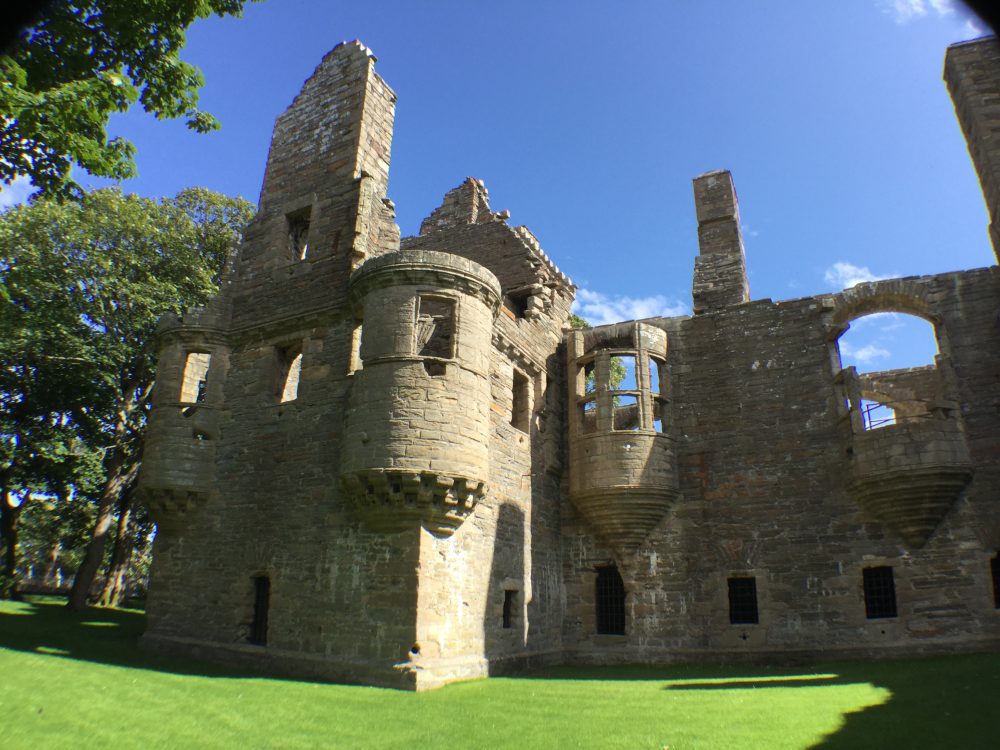
In addition to the 12 sales of Crown Lands in Orkney, it was planned to sell the Earl’s and Bishops Palaces to be dismantled for building material. The Orkney Commissioners of Supply petitioned The Treasury to stop the sale.
On 12 August 1856, The Orkney Commissioners made an offer of £500 for the Bishops and Earls Palaces, including the field and garden at Brandequoy. Their plan was to convert the buildings and to house the new prison for Orkney in the Earl’s Palace.
The land at Brandequoy was not in the original sale of land by The Crown but the Orkney Commissioners wanted it to be used as an ‘airing yard’ for prisoners after the conversion of the Earl’s Palace. They had to up their offer with a new price of £525 18shillings and 6 pennies agreed to on 14 August 1856. Taking all the costs into account, conveyance fees etc the bill came to £548. 18shillings and 6 pennies. [£32,457], as reported to the Commissioners on March 16 1857.

A sale of Crown Lands in Hoy and Walls failed to reach its asking price on 15 August 1856.


In 1920 the Earl’s Palace and the Bishops Palace passed into State care.

Today the Bishops and Earl’s Palaces are run by Historic Environment Scotland and are open from 1 April to 30 September, with an admission charge.
Fiona Grahame

Leave a Reply