
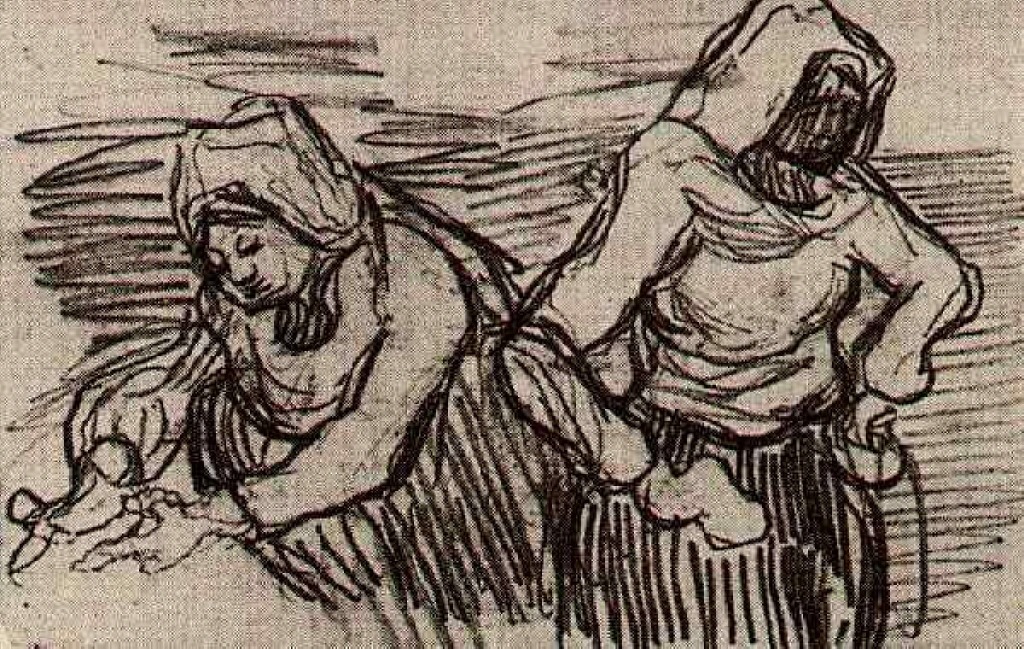
Much of Orkney’s history has been written about from the exploits of its male characters. The agricultural and rural industrial heritage of Orkney, however, was built on the backs of a female workforce, rarely acknowledged.
In this Women’s History month, The Orkney News will attempt to redress that imbalance.
In the latter half of the 18th century, and which carried on throughout the 19th, thousands of young, able bodied men left the shores of Orkney, some never to return. The search for employment took them to the whaling grounds of the Davies Straits, to enlistment in the navy and army (not always voluntarily), and to the Hudson’s Bay Company. Their pay they often sent home to those who were left to work the small farms in the tounships they came from.
Those left to work the farms were the women.
“The farms are small and trifling…The females are the chief assistants in cultivating the farms.” – Rev. James Alison, Holm, Statistical Account of Scotland (1795-1798).
Most folk in Orkney lived in tounships. They farmed in a runrig style of crop growing, with cattle, sheep, pigs, and geese, being put to the undivided commonities from the Spring onwards to graze. The commonities were shared grazing grounds with the others in the tounship. It was labour intensive, extremely hard work.
Women also took on other labours, spinning flax to make linen cloth, and in the first half of the 19th century, working with straw, plaiting it into long lengths for making into bonnets.
The Kelp industry was booming. It brought in massive profits to the landowners.
“During the 50 years of the kelp boom over £1million came to the Lairds in kelp profits.” – The New History of Orkney, Wm. P. Thomson.
Kelp making was back breaking and noxious work – collecting the seaweed from the shore, gathering it into kelp pits, burning and raking it, before digging out the hard ashen remains to be exported. Women worked alongside men at this.

For the Lairds, kelp making took precedence before working the land. Men who were still on the farms were set to work at kelp production. This was not a matter of choice, it was labour that had to be provided as a condition of tenancy – as a consequence Rev George Barry reports in the Statistical Account (1795 – 1798) that Agriculture ‘is much neglected.’
“Every man that rents a farm, however small, must have at least one male, and two female labouring servants.”
Pay was mostly in kind, and as both the men and women would be likely working for family, that would include their bed and board.
There were huge inequalities in the payment of wages. Rev Hugh Ross, states in the Statistical Account for Evie and Rendall, that men servants could earn between £3 and £4, 10 shillings a year; and women 20 to 30 shillings. It’s not surprising that many young women who could, chose to leave and find employment as servants south, in the cities of Leith, Edinburgh, Newcastle, and London. William Creech reported that in Edinburgh a maid servant could earn £3 to £4 a year . Those women rarely returned to Orkney.
Famine and the Laki Volcano
Hunger was never far from the door of the small farmers in Orkney. A poor harvest could be the result of bad weather or in events far from the islands. In 1783, the Laki volcano erupted in Iceland. It was to lead to a disastrous few years for farmers in Orkney, Scotland, and into Europe as ash fell onto the landscape. For Iceland:
“Around midmorn on Whitsun, June 8th of 1783, in clear and calm weather, a black haze of sand appeared to the north of the mountains nearest the farms of the Siða area. The cloud was so extensive that in a short time it had spread over the entire Siða area and part of Fljótshverfi as well, and so thick that it caused darkness indoors and coated the earth so that tracks could be seen. The powder which fell to earth looked like burnt ash from hard coal. A light drizzle, which fell from that black cloud that day over the Skaftártunga region, turned this powder into black, inky liquid.”
The consequences of this event were catastrophic for Iceland. The despoliation of pasture and farm land by volcanic ash and polluted rainfall, resulted in the death of more than 60% of the grazing livestock, mainly through chronic fluorosis. Over 10,000 cattle, 27,000 horses and 190,000 sheep died between 1783 and 1784. It is estimated that these figures represent approximately 50% of the total stock of cattle, 75% of the horses and nearly 80% of the sheep. As mutton made up a large proportion of the people’s diet, these losses were devastating, and widespread starvation ensued, killing over 20% of the population, i.e. approximately 10,000 people – Geoff Hellman

The Orkney News has a series of articles written by Geoff Hellman about the Laki eruption in 1783 and the devastating effects. In Scotland, a young farmer, Robert Burns, had to abandon that occupation after a series of bad harvests.
In Orkney, where growing food had suffered in order to produce kelp for the Lairds to export, the neglect of the land contributed to the dire situation the farmers were now in.
The UK Treasury was alarmed to such an extent that for the first time ever it provided state aid to address the famine which was stalking communities in the north of Scotland and the islands in particular. Before that arrived in July 1783, the Kirk Session in Kirkwall and St Ola purchased pease and cheap food from south for those on the edge of starvation. The first batch of Government meal was free to those in dire need, but subsequent deliveries of food stuffs had to be paid for.
“Most people ran up debts to buy meal, but they were able to clear their indebtedness quite quickly…
it was only in the West Mainland whose exposed coasts produced comparatively little kelp that real famine conditions were recorded in the years 1782 – 5 in Birsay ‘many were like to die’ although only one death was directly attributed to starvation. ” – Thomson, The New History of Orkney.
And there were those who were unscrupulous, charging high prices:
“Prices were inflated and people grew desperate for food.” – Sheena Wenham, Famine and Victuals on the Graemeshall Estate.
Kelp production had provided small farmers with the ability to buy food for their families – but seed for the next year, all needed to be purchased. The debts which went unpaid would eventually lead to some being evicted from their farms.
Women were farming the land, gathering up kelp, spinning flax, and giving birth to the bairns who would form the next generation. Death due to childbirth was a reality for women, including the possibility of sepsis. Child mortality was ever present. During the famine, with a weakened population, smallpox was rife. The Kirk Session in Kirkwall and St Ola, decided to bear the expense of inoculating “the children of such parents as could not afford to pay. ” In a period of two weeks thirty children from Kirkwall and St Ola were inoculated, and Rev George Barry reports that all recovered fully.

The lives and stories of the women of Orkney may not, as yet, fill the history books, but that massive gap in our understanding of our heritage and culture will be covered as more researchers publish what has so long been missing from the history of our islands.
Fiona Grahame
Leave a Reply