
Elections to the Scottish Parliament take place on Thursday 7 May. In this series we look at what decisions are made in our parliament which affect daily lives in Scotland. So far we’ve looked at Education, NHS Scotland, Transport, and Migration.
Energy.
The UK Government controls most what covers the issue of Energy including: the generation and supply of electricity, oil and gas; the exploration and extraction of offshore oil reserves; coal ownership and exploitation and deep and opencast coal mining; nuclear energy and safety.
Scotland has the power to promote renewable energy and energy efficiency, and for onshore oil and gas licensing.
The energy crisis has hit the global economy (which is based on oil) due to the US/Israel war against Iran, and retaliation by Iran. This has seen increases in prices at petrol stations in the UK but will also affect prices on all goods. It’s also shown how precarious a world economy is based on oil.
OIL and GAS
In the 1970s oil production in the Scottish section of the North Sea was booming. Tax Revenues generated from Oil and Gas production go straight into the UK exchequer. At the same time as drilling was taking place in Scotland’s waters, Norway also undertook oil exploration and discovery. Although its reserves were much smaller what it did was to set up an Oil Fund.
Norway’s Oil Fund—formally known as the Government Pension Fund Global—is the largest sovereign wealth fund in the world. – The Norwegian Oil Fund.
Key facts and figures: The Norwegian oil fund…Kopier Lenke
- owns 1.5% of all public companies in the world, with over 9,000 stocks in 69 countries.
- is the largest owner of European stock.
- owns stocks in thousands of individual companies like Apple, Amazon, Unilever, Microsoft, and Visa.
- owns hundreds of properties and real estate in cities like London, New York, Berlin and Tokyo.
- aspires to invest ethically and responsibly. This means that they do not invest in companies like tobacco producers that cause harm to the environment.
- transfers at most 3% of its worth to the Norwegian budget each year. This money supports social services like healthcare, unemployment benefits, pensions, infrastructure projects and education.
Norway is the 8th largest producer of oil and 3rd largest producer of natural gas in the world. The oil industry accounts for 40-70% of all of Norway’s export.
This type of fund was rejected by the UK Government at the time. The potential of using revenues and other aspects of the Oil and Gas being taken from the North Sea was never realised by successive UK Governments: Revealed: How Premier Thatcher vetoed thousands of North Sea oil jobs. The local councils of Orkney and Shetland were, however, allowed to make separate deals with the oil companies bringing oil ashore to be processed in their islands. In Orkney, most of the island of Flotta was taken over. The two councils now rely heavily on their oil fund reserves to prop up public services.
UK Government revenues from oil and gas production September 2025 were:
Total revenues from UK oil and gas production were £4.5 billion in financial year 2024 to 2025, compared with £6.1 billion in 2023 to 2024, a reduction of £1.6 billion (27%)
N.B. those are figures from last year. The US/Israel War of Choice against Iran has affected oil and gas prices this year.
Renewables.
Scotland is a power house of renewables. Post war Hydro Schemes transformed electricity generation in the Highlands. Tom Johnston, a former Labour MP, and member of the Cabinet for Scottish Affairs, became the Chair of the Hydro Board in 1945. His vision was that cheaper energy through Hydro would be created in the Highlands and Islands with the surplus being sold south for profit.
‘We sell that surplus power at the best steam coal station price to the Grid down south, and all the profits are poured back into the Highlands, every penny of it in the form of development of the non-economic, cheap schemes of electricity in rural areas where otherwise there would be none.’ – What has happened to Tom Johnston’s Energy Vision for the Highlands & Islands “We shall make a different future” ?
Orkney has an international reputation for the testing of marine renewables, and the islands have for over a decade produced more than their own energy needs in renewables (mostly wind) – it also has one of the highest rates of fuel poverty in the UK.
This may seem mad – how can it be ? It’s because the National Grid, the system whereby energy is transported from where it is generated, to where demand lies, favours areas where the largest population lives and works. Scotland with a population of just under 5 and half million may generate the renewables to power its own businesses and homes, but it has to buy that back once it has fed it into the National Grid. Quite the opposite to the future Tom Johnston envisioned.
As Energy is mostly a power reserved to the UK Government, the Scottish Parliament, and its Government, can only mitigate the worst effects of price increases to people. There are 6 big energy companies in the UK:
The UK’s Big Six energy companies are dominated by foreign ownership, which has major implications for domestic energy control and profit allocation. Here’s a brief overview from ‘Power to the People’ :
- British Gas (Centrica): The only UK-rooted company in the Big Six, Centrica is publicly traded, with a significant portion of shares owned by international investors.
- EDF Energy: Owned by Électricité de France, which is majority-owned by the French government. Profits from UK operations flow back to France.
- E.ON: Based in Germany, E.ON acquired Powergen to enter the UK market. UK profits contribute to E.ON’s global operations rather than staying local.
- ScottishPower: Owned by Iberdrola, a Spanish multinational. While it has invested in UK renewables, decision-making and profits primarily benefit Spain.
- Npower: Originally part of German-based RWE, Npower was acquired by E.ON, consolidating German influence over UK energy supply.
- SSE (Retail Acquired by OVO): SSE’s retail division was sold to OVO Energy, a UK-based firm. However, OVO relies on international investment to operate.
Scotland can take measures to help people with their Energy costs.
The recent rise in Oil and LPG will affect many households in Scotland that rely on oil heating. The Scottish Government’s Emergency Heating Oil Scheme is available to users of both heating oil and LPG who are struggling with recent price increases. It more than doubles the contribution which was made by the UK Government from £4.6million to £10million. Heating Oil/LPG Financial Support : How to apply.
Scotland made over 1.5 million winter heating payments, including more than a million payments to older people in the winter.
Available in Scotland is the:
- Pension Age Winter Heating Payment
- Child Winter Heating Payment supports families caring for children with the highest disability support needs. Over 44,000 payments have now been made.
- Winter Heating Payment an annual payment that is not triggered by weather. People can get the payment if they receive certain benefits, with over 454,500 payments made this winter so far.
Social Security Scotland’s winter payments are issued automatically in most cases.
Offshore and Onshore Wind.
The devolved power Scotland has to ‘promote renewable energy’ – means it grants licenses for Offshore Windfarms, and planning permission for Onshore Windfarms.

The industrialisation of Scotland’s seascape and rural landscape is surging ahead. However, although the power will be generated in Scotland, that same power will be fed into the National Grid for export , and eventually where Scots can buy it back.
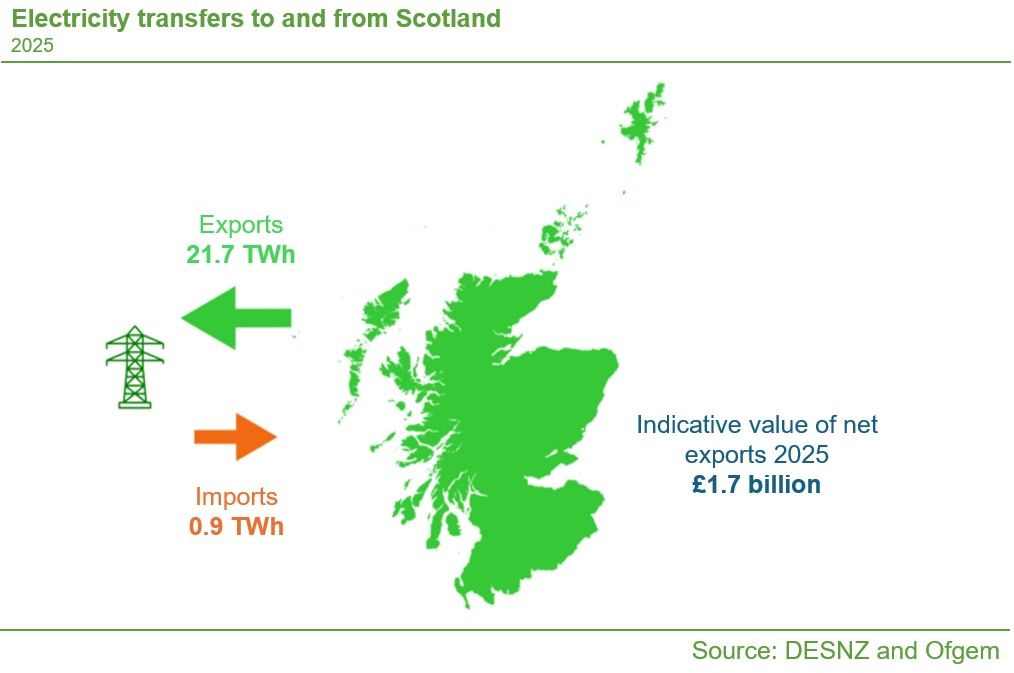
Electricity transfers data show that Scotland exported 21.7 TWh of electricity and imported 0.9 TWh of electricity in 2025. This means that Scotland’s net exports of electricity (exports minus imports) in 2025 were 20.8 TWh.
Scotland’s net electricity exports in 2025 had an indicative value of £1.7 billion based on the average wholesale day-ahead contracts price trend for 2025 – Energy Statistics for Scotland.

Planning is a power devolved to The Scottish Parliament and is very important as the scramble to construct Windfarms and their related infrastructure goes on apace.
As of the end December 2025, there were 1,201 renewable energy projects with an estimated capacity of 84.8 GW in the planning pipeline in Scotland.
MSPs may only be able to make decisions about some aspects of Energy but those could very well affect the very community you live in.
Fiona Grahame
There is also a vote for Regional List MSPs. These are made up of political party lists, and independents.



Leave a Reply