
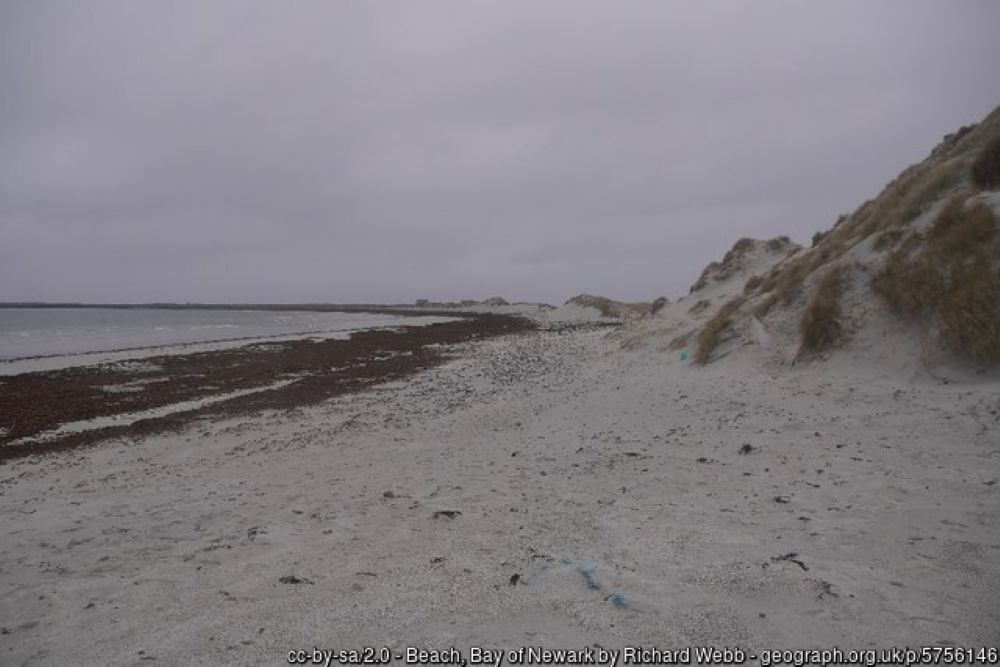
On 21 January 1776, a sailing vessel described as a ‘dogger’ was spotted drifting at the Bay of Newark, Sanday. It was found dismasted and abandoned. What had happened to the crew in a ship so far off its original course? What happened to its cargo?
The Ensgeizentheit (various spellings of the vessel occur in the written accounts of the time) of 120tons was carrying a cargo of rye and deals from from Perau to Amsterdam.
The Caledonia Mercury newspaper published on Wednesday 14 February 1776
Extract from a letter in Kirkwall (in Orkney) Jan 27
“On the 21st current, the wreck of a vessel, supposed to have been a Dutch dogger, about 120 tons burden; was observed upon the island Sanday. Two boats put off, and brought the wreck to the nearest land. She is loaded with rye and hr dales: there was no living creature on board: the bodies of two men were found in the cabin; one of them is supposed to have been the Captain. No papers have yet appeared. It is supposed the vessel will be beat to pieces by the present hard gales of wind on shore.”
The Captain was Cornelius Jans de Boer.

The Vessel didn’t get ‘beat to pieces’, but was towed ashore and salvaged. The Caledonian Mercury confirmed this :
Caledonian Mercury Wednesday 21 February 1776
The Dutch Dogger, towed ashore upon the island Sanday, as formerly mentioned, proves to be the Een Gifon Hynd, Cornelias Jans De Bore, master, from Perau, in Livonia, bound from Amsterdam, and supposed to belong to a place in Holland, called Ender Skilling. Most of the cargo, consisting of grain is lost. The rest of the cargo, dales, is saved.
It is often supposed that islanders could just help themselves to what washed ashore. That was not the case in Sanday in 1776 and what happened next led to questions about the salvage, expenses claimed, taxes paid, and a public roup of the personal belongings of the unfortunate seamen who had died on that fateful journey. Many of the handwritten documents are in the Orkney Archive, Balfour of Balfour & Trenabie Papers, D2/36/3. I have transcribed 17 of them.
What unfolds is a story of the process that swung into action when a ship and its cargo – both of value monetarily were wrecked or stranded in Orkney. Who would get the benefit financially ? It also reveals the complexity of salvage and protecting commodities when they came ashore.
On 2 February 1776, the Vice Admiral Court of Orkney granted a warrant to William and Thomas Balfour, Shipmasters, along with Richard and James Spence, Carpenters, to inspect the condition and situation of the ship. They were also to assess whether or not the ship could be left where she was or be transported to somewhere safer. They were to ascertain if she could be repaired and the expense of doing so.
According to their assessment the vessel, which I will refer to as The Ensgeizentheit, was:
‘not a new vessel nor quite old that her uper works are entire & in appearance sound, only the gunwalls above the deck are mostly carried away, but that her keel is beat away almost every where to the plank, her bottom is cut through to the timbers almost in every part of it That such of the floor timbers as we saw or most of them are broke and also several of the footoaks, so that altho’ it might have been possible to have repaird her had she lain in a place of security, as the place where she now lies is rugged rocks and quite exposed to all winds from the South to the East, we are of opinion that she is irrepairable & a total wreck and Richard Spence & John Reid Ships Carpenters in the island of Sanday who also inspected her with us are of the same opinion amd this report we herby certify to be true according to our judgement as we shall answer to God. ‘
It is signed by William Balfour and Thomas Balfour, at Trenaby, 3 February, 1776, and sworn before Will Balfour V.Ad.Deput.
Now you would think that all was being conducted properly – but the warrant granted was done in retrospect because a letter sent from Trenaby 26 January 1776 by Robert Callem revealed that Richard Spence and John Reid had already been dispatched to assess the vessel. Robert Callem had also appointed David Balfour to supervise the proceedings ‘ who being sensible & a good Seaman I judged the most proper person to charge with this bussiness.’
The letter is one of apology as the Vice Admiral of Orkney was already on his way to Sanday to take charge of the wreck.
Everything that was aboard the vessel was taken ashore. The public sale was held quickly, and according to Robert Callem he advertised the sale for two days in Kirkwall and Sanday. The list of what was sold was documented dated 18 May 1776. Amounts are in Pounds, Shillings and Pence.
- The Hull: £12
- The Masts : £4, 1 shilling
- Anchor blocks and ropes : (unsold) valued at £2, 10 shillings
- Ships materials and clothes (sold 29 January) £3, 10 shillings and 2 pence
- Sales of the deals at Sanday : £108, 17 shillings and 1 and 1/2 pennies
- Other parts of the ship (sold 18 May): £11, 8 shillings, 7 and 1/2 pennies
Then there were duties to be paid and some other expenses. These included the wages paid to the men who were employed to keep watch over the deals 24 hours a day. Seven men had to be paid for sorting the deals and 6 men for ferrying the deals ashore.
Deals were planks of wood and were a valuable cargo, especially for the making of furniture.
Expenses were also claimed for six men ‘burying two dead bodies’ which came to 6 shillings.
The sale of ‘sundries belonging to the crew’ and other items from the ship sold as follows:
- Two old Linen waistcotts Sold to Dav. Drever in Newark : 1 shilling, 10 pence. (David Drever was the local Tacksman and had been the man who actually supervised the salvage and proceedings).
- An Old Tweedle Jacket Sold to D. Drever: 1 shilling, 5 pence
- A Jacket which was Sold to Arch Learmonth in Tresness : 1 shilling, 7 pence
- An Old Black Coat to James Miller : 4 shillings, 4 pence
- An Old Stript Waistcoat To John Greive: 10 pence
- An woolen Jacket to George Drummond : 1 shilling, 1 penny
- A Red waistcoat To John Linklater in Bea: 3 shillings, 1 penny
- An Old Linen waistcoat To Jas Sclaiter in Viga: 7 pence
- An Old Frock & waistcoat To Jn Guthry in Northwall : 1 shilling, 3 pence
- Two warm Jackets To Thos Fotheringham in Elsness: 1 shilling, 1 penny
- Two pair Old Britches To Rob Learmond in Kirkwall: 7 pence
- Two pair Old Drawers To Magnus Irvine in Appy house: 1 shilling, 1 penny
- Two pair Old Drawers & Two pair Trousers to Archd Learmond Senr: 2 shillings, 1 penny
- Two pairs of Britches To James Scott in Burgh: 2 shillings and 1 penny
- A Checque Shirt To Jn Guthry in Northwall: 1 shilling, 7 pence
- A White Shirt to Geo Drummond: 1 shilling, 2 pence
- A white Shirt to Jn Guthrie in Northwall: 1 shilling, 1 penny
- Another white Shirt marked J.M. To Jn Guthrie in Northwall: 1 shilling, 1 penny
- A white Shirt to Dav Drevir in Newark : 1 shilling, 8 pence
- A Checque Shirt To Dav Drevir: 2 shillings, 2 pence
- An old Checque Shirt To John Sclater in Skellbrea : 1 shilling, 4 pence
- A Coarse white Shirt To James Scollay : 1 shilling, 3 pence
- Two Old Shirts To Archd Learmond jnr: 1 shilling, 9 pence
- An Old Jacket To Arch Learmond Senr: 6 pence
- Seven Shoes To John Martin: 3 shillings
- Seven pair of Stockings To Dav. Drevir in Newark : 2 shillings, 5 pence
- Two Pillow Slipps & three Mittons To Jn Sclater in Burness : 7 pence
- Two Earthern Jars to Edwd Prett in Collegar: 1 shilling
- An Earthern drainer to Mr Strang : 3 and 1/2 pennies
- Five Same Trunchers & a mugg To Archd Drummond : 4 pence
- An Old Hatt To John Martin: 9 pence
- Two Small Gray Beards To Mr Strang 1 shilling, 1 penny
- A Chest To Mr Strang: 1 shilling, 1 penny
- Two Ankers & Some Staves To Peter Miller : 1 shilling, 10 pence
- A white Shirt to John Meal Officer: 1 shilling, 4 pence
It might be thought that this was the end of the matter, and a sad one at that as two bodies were buried and their possessions sold off – the whereabouts of any other crew was never found out.
It was not the end. The owner of The Ensgeizentheit and its cargo , Cornelius Van Castricum of Amsterdam, engaged Robert Laing merchant in Kirkwall to act on his behalf when he eventually heard what had happened to it. He queried as to why the vessel could not have been saved but was instead so quickly declared a wreck and everything sold off. He also disputed the claim of the expenses put forward by David Drever, tacksman of Newark, Sanday, which he considered to be ‘extravagant demands’, although he felt that Drever should get ‘a reasonable gratification.’ This dispute continued for months, and eventually Drever did slightly amend his expense claim, but it would have been extremely difficult for Robert Laing on behalf of the owner to show that the vessel could have been saved when there were so many men prepared to be witnesses for the action that Drever took in Sanday to declare it a wreck and salvage what there was.
Apart from burying the two bodies, one of which it was suspected was that of the ship’s captain, there was no concern expressed for the lost seamen or of the fate of the rest of the crew.
Fiona Grahame

Leave a Reply