
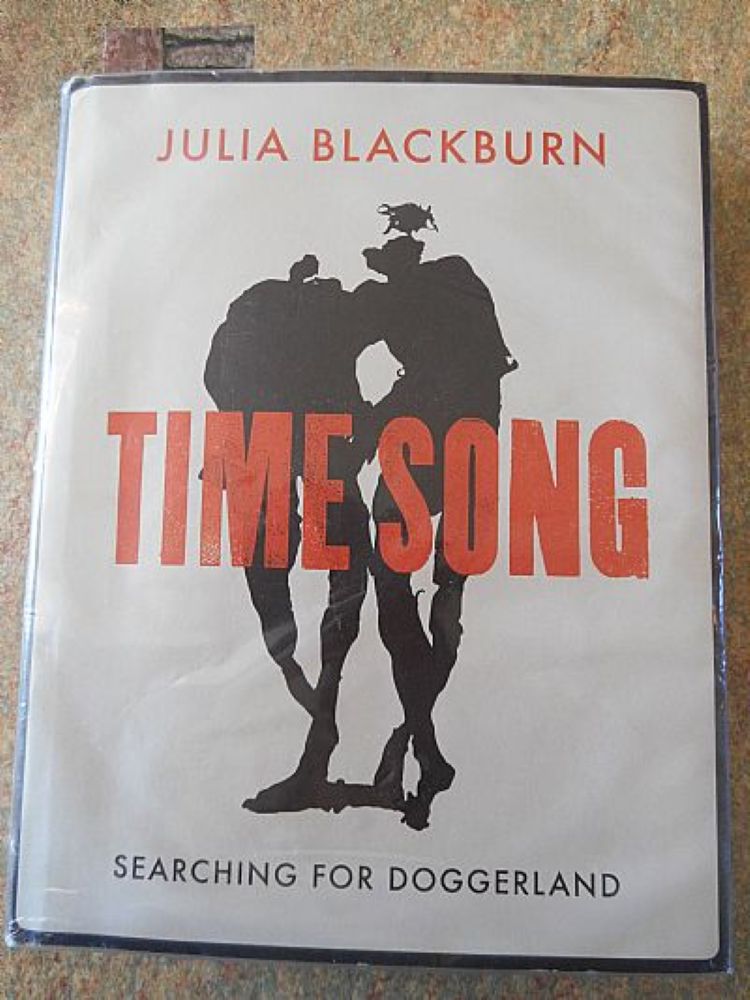

I’m reading ‘Time Song’ written by Julia Blackburn with illustrations by Enrique Brinkmann
The ‘blurb’ on the inner sleeve says….
“Julia Blackburn has always collected things that told stories about the past, especially the very distant past: mammoth bones, little shells that happen to be two million years old, a flint shaped as a weapon long ago.”
This reminded me strongly of Joanne Bourne’s book ‘Flint’….
…and of how Jo wanders and wonders at what she finds.
‘Flint’ is one of the most well-written, intriguing, full-of-deep-time-magic books I’ve read for a long time, so I thought I’d step into Julia Blackburn’s deep-time world too, and started to read.
As with Jo’s book, Julia mixes human stories with stories of the land and the sea – how land-became-sea-became-land and how to read the stories from what we can find and observe.
The two books are based in very different places – Kent and the coast of what was once Doggerland, but a thread connects them as all land and all humanity are, ultimately, connected.
One big difference, for me, is that I’ve never been to Kent, while the stretch of East Coast described by Julia is very familiar to me, having lived near Lowestoft and walked at Covehithe, Southwold and Dunwich. We have a big piece of what we believe to be fossilized bone, found eroding out of the cliff at Benacre Broad – a prize find, which is why Jo and Julia’s ways and writings appeal to me so much.
In ‘Waterlog’ Roger Deakin writes…
“I swam the length of Benacre Broad at Covehithe a few miles up the coast the other side of Southwold. It is a salty fresh-water lagoon separated from the sea by a low spit of sand and shingle beach, and its days are numbered.”
Its days were numbered – the last time we went to Benacre Broad, the sea had breached the spit of land and the Broad had drained – it was just a muddy dip in the land. That stretch of coast is being eaten by the sea, so the Broad will fill again.
Something like how Julia describes the water receding, then returning, to Doggerland.
I also read echoes of Fiona Robertson’s ‘Stone Lands’
Ways of being…connecting.
In ‘Time Songs’ Julia tells of a nuclear bunker which ‘hearsay’ claims is nearby but which, if it exists, will be gradually moving towards the sea – or vice-versa.
This idea of a well-stocked bunker which should shelter and provide for the people in it for 30 years ending up opened up by the sea, reminded me of Robert MacFarlane writing in ‘Underland’ about some of the things which emerge from ice, or which might emerge in the future, such as Camp Century, The Top Secret Cold War Project That Pulled Climate Science From the Ice
Sometimes things are purposely placed deep in ice and those who place them think they will be ‘preserved for eternity’.
We humans have such a ridiculously limited idea of time, of things staying where they are or where they’re put. The Earth teaches us different as sea-bed becomes mountain, jungle becomes desert, mountain becomes valley or sea-bed. Preserved for eternity? People do play fast and loose with the concept of ‘eternity’.
These three books approach Time……passing, reminding us, taking us back and forth in our minds.
TIME. A thought to conjure with.
Reading of Julia’s meeting with Ray and his collection of local finds at his house in Pakefield, I decided to bung this in for good measure…
https://www.spanglefish.com/berniesblog/blog.asp?blogid=16338



Leave a Reply