
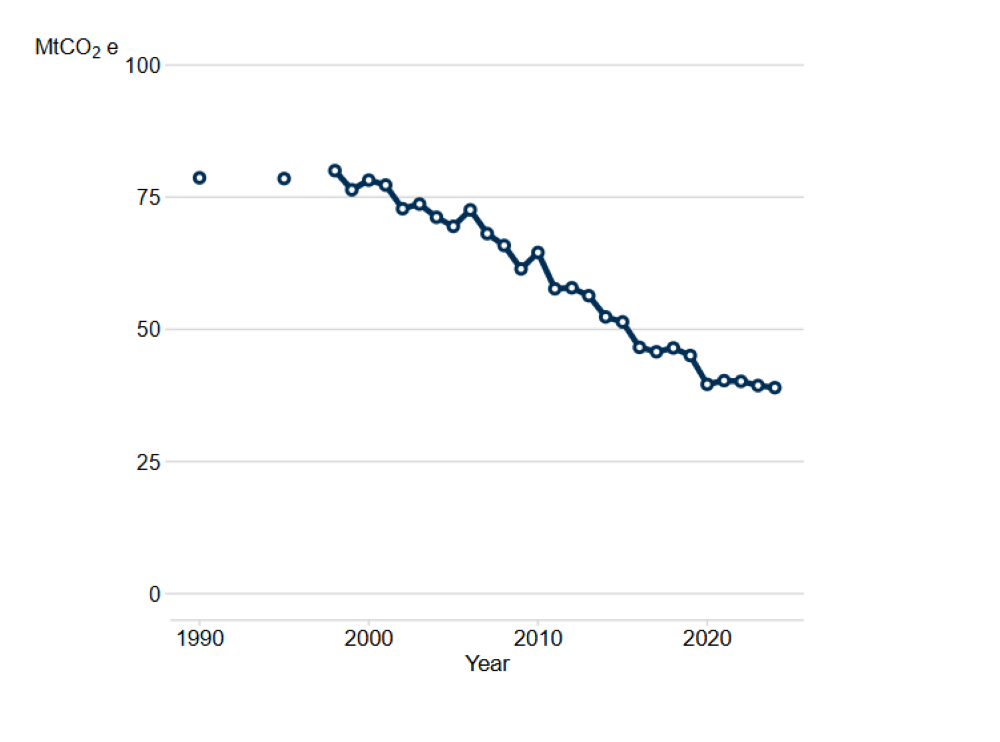
Estimates calculated of greenhouse gas emissions produced solely within Scotland have seen a drop in the period 1998 – 2022 of 49.8%. But that’s only part of the picture.
Consumption Emissions.
Scotland’s greenhouse gas emissions went up after a decrease during the 2020 pandemic. Between 2021 and 2022, Scotland’s carbon footprint (emissions from all greenhouse gases) increased by 1.6 per cent from 60.0 to 61.0 million tonnes carbon dioxide equivalent (MtCO2e) in 2022.
These are the latest statistics published in ‘Scotland’s Carbon Footprint 1998-2022.’

The figures are an estimate based on a number of factors: heating, motoring, and from other goods/ services which may have been produced somewhere else in the world – consumption emissions.
Scotland’s greenhouse gas emissions can be broken up into three main categories:
- emissions embedded in imported goods and services
- those embedded in UK produced goods and services
- those directly produced by Scottish residents, through activities such as heating and motoring.
Estimates calculated of greenhouse gas emissions produced solely within Scotland have seen a drop in the period 1998 – 2022 of 49.8%.

However, when taking in the estimates of consumption emissions it has seen a drop in the period 1998 – 2022 of 17.5%.
Understandably it is difficult to calculate greenhouse emissions when so many of the goods we buy are from overseas.

Think how far bananas have to be transported to reach your local supermarket, or that small toy from a factory in China?
The figures for greenhouse gas emissions produced solely in Scotland are for the year 2024.
Domestic transport (excluding International Aviation and Shipping) (11.0 MtCO2e) was the largest source of net emissions, followed by Buildings and product use (7.6 MtCO2e), Agriculture (7.5 MtCO2e), Industry (4.7 MtCO2e) and Fuel supply (2.8 MtCO2e).

And the change over the same period:

Carbon dioxide was the main gas emitted.
One of the things being done to offset the emissions we produce in Scotland is to create and encourage projects which would remove carbon dioxide from the atmosphere – ‘sinks’. It will come as no surprise that trees are great at doing this.
A success area for reducing greenhouse gas emissions in Scotland is in electricity supply. This was mainly due to the ending of coal powered stations.
Greenhouse gas emissions in agriculture have been reducing consistently since 1990. The main gas emitted in agriculture is methane. Cattle and sheep numbers decreased by 21% and 35%, respectively over that same period.
However, in arable farming, where large machinery is used, there has been a 1.9% increase in emissions. This is one for vegetarians to consider if they wish more people to eat less/no meat products. The report on Agriculture Emissions states:
In 2024-25 average emission intensity (the carbon footprint) for cereal production on cereal and general cropping farms rose by 14% (to 293 kgCO2e/tonne crop) and 6% (to 258 kgCO2e/tonne crop), respectively. The rise was driven by an overall increase in diesel emissions across arable farms and a rise in average fertiliser use on some general cropping farms.
Whatever Scots do there are consequences to eating less meat, growing more crops, importing food, taking an international flight, driving a car, and buying cheaper clothes produced outwith Scotland.
Creating and protecting ‘sinks’ to offset our choices is essential.

Fiona Grahame


Leave a Reply