
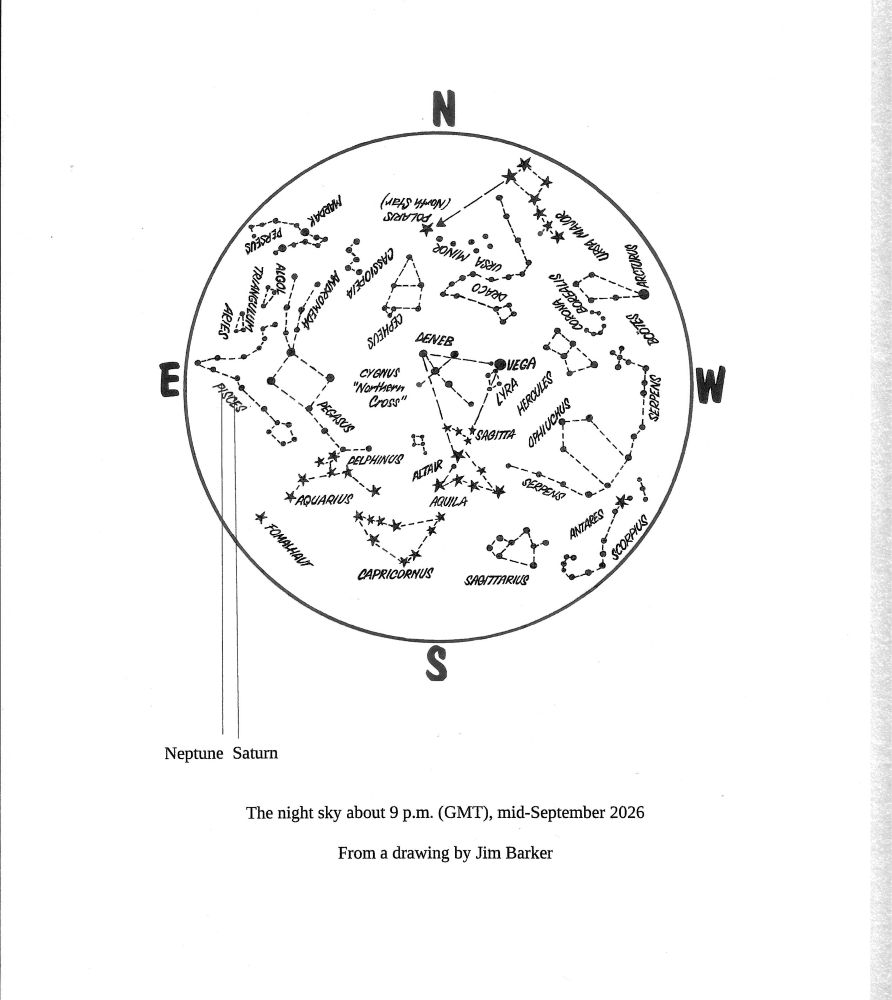
After Full Moon on August 28th the Moon is New on September 11th and Full on September 26th, meanwhile passing Mars on the 7th, Jupiter on the 8th and 9th, Venus on the 14th, and Saturn on September 26th and 27th, rejoining the Pleiades on September 30th, a week after the autumnal eqinox, after first passing them on the 2nd and 3rd.

On the morning of September 8th, the crescent moon occults the outer regions of the star cluster Praesepe, with Jupiter below. Jupiter lies above the crescent Moon the following night, when there may also be meteors from the boundary of Pisces and Aquarius. The shower comes from Comet 45P/Honda/Mrkos/Pajdusšáková, in 1927, and in Stargazing 2026 Nigel Henbest warns that the meteors may be ‘sporadic’, so don’t expect too much.
The planet Mercury is too close to the Sun to be visible from here.
Venus is in Virgo, still lower in the evening sky, right of the crescent Moon on September 14th, at its greatest brilliance on the 18th and disappearing into twilight to the right of the Moon, around September 22nd.
Mars moves through Gemini, as bright as Castor and Pollux, below them and left of the Moon on September 7th, and goes on into Cancer, visible from 2 a.m. till sunrise.
New data from previous Mars missions has come up with surprising results including the presence of a waterproof layer deep below the surface, extending far beyond the site of the Insight lander which fell silent in 2022, suggesting that there might be liquid water even now at that depth; new analysis suggests that the earlier Spirit and Opportunity rovers, on opposite sides of the planet, may nevertheless have visited the floor of the same former ocean; and it’s possible that Mars is literally a planet of two halves, with different compositions under the north and south hemispheres. With the new ESCAPADE probes already in Earth orbit, awaiting their launch window to Mars, no doubt there’s a great deal more news to come.
Jupiter is brilliant in the morning sky, rising about 3 a.m. in Cancer, with the waning Moon above on the 8th and 9th, and moving into Leo late in September.
Saturn, between Pisces and Cetus, rises at 8 p.m., passed by the Moon on September 26th and 27th.
Uranus, in Taurus, between Aldebaran and the Pleiades, rises at 9.30 p.m., passing its ‘stationary point’ and starting to move retrograde (westward) on the 10th, as the Earth begins to overtake it.
Neptune is at opposition in Pisces on the 26th, closest to us and visible from 10 p.m. BST, with optical aid.
The September issue of Astronomy Now ends with an interesting feature, imagining a new observer (or an old one revived) on the surface of Comet 67P/C-G, 10 years after Europe’s Rosetta mission ended with a landing on it by the main spacecraft after more than two years of observation from orbit, during which the Philae lander had made a less than successful attempt to make observations from the surface. So much was learned, particularly during the final approach, that there was serious discussion of a second mission. That hasn’t materialised, and may not happen till the comet next passes the Sun in 2028, but Emily Baldwin vividly describes what may be happening there meantime.
On September 23rd, nights become longer than days for the first time since the spring, with the Sun moving across the equator at the Autumnal equinox, towards its position at the winter solstice in December. Apart from a few hot days last month there has been little sign of global warming on Arran and there have been more cloudy nights than there were last year, with little chance (for example) to watch for the anticipated brightness of Tau Corona Borealis, which produces a nova every 80 years or so. I’ve never seen a nova and kept watch all last year to no avail, and in January Astronomy Now‘s headline for it was ‘The Star that Won’t Explode’. It has still to do so, but after the disappointment of last month’s near-total solar eclipse, I wouldn’t be surprised if it remains cloudy for the nova as well.
Immediately before I put this column together there was a major development, many years in planning and strongly opposed by the Trump administration, which attempted to cancel it last year: the launch of the Nancy Grace Roman space telescope to the L2 point, on the far side of the Earth from the Sun, already orbited by the James Webb Space Telescope. The launch was conducted by SpaceX’s Falcon Heavy booster and went so smoothly that it looked easy, rather than being one of the largest and most complicated to date.
Working with the Hubble Space Telescope in Earth Orbit, the two telescopes orbiting L2 will be working together to compile entirely new and regularly updated views of the entire sky in a complete range of wavelengths from the optical to far into the infrared, including frequencies not previously covered. The Roman telescope’s field of view is far larger than those of the other two and it’s expected that within a year it will match the coverage of the sky to date by both of them, while highlighting targets for both of them to look at in more detail. Unlike the Hubble Telescope, which needed several years to correct an initial flaw in the optics, and the JWST which needed several months of fine tuning on arrival, the Nancy Grace Roman telecope will take three months to reach L2 and will be fully operational when it gets there.
Duncan Lunan’s recent books are available from booksellers; details are on Duncan’s website, www.duncanlunan.com.

Leave a Reply