
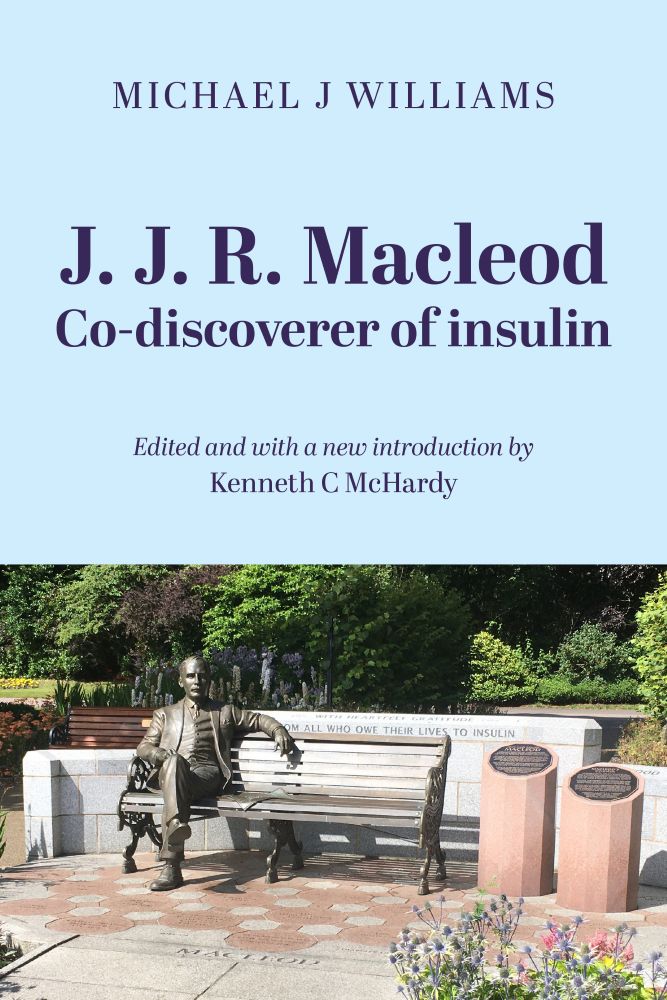

‘J.J.R. Macleod Co-discoverer of Insulin’ tells the story of an Aberdeen-educated professor who led the life-saving discovery of insulin.
It was an achievement for which he was jointly awarded the Nobel prize but for decades the name John James Rickard (known as JJR) Macleod, was mired in accusations that he had stolen ideas and claimed credit where it was not deserved.
More recent research has helped to restore the reputation of Macleod, who spent his later years back in the University of Aberdeen as Regius Professor of Physiology, and a new edition of a biography of his life will now be published.
Originally produced in 1993, the work by Aberdeen-based diabetologist, Michael Williams (1931-2020], has been refreshed by Aberdeen University Press with a new introduction by Dr Kenneth McHardy, another Aberdonian who succeeded the author as a diabetes specialist, and will be released on November 5.
Dr McHardy has championed the revision project which details a far more complex, if no less acrimonious, story of insulin discovery demonstrating that its realisation was indeed a team effort with Macleod, a recognised world leader on carbohydrate physiology, at the helm and rightfully earning his credit.
He said:
“JJR Macleod Co-discoverer of Insulin tells the story of Macleod’s life and work and this new edition describes several interventions over recent years to restore his reputation as a scientist whose work contributed to saving hundreds of millions of lives.
“We are delighted to produce this new edition of the biography as even in Aberdeen, the memory of Macleod had been eroded just as it has in Canada and around the world.
“Remarkably, the author first heard of JJR on reading the 1982 book ‘The Discovery of Insulin’ by Toronto academic historian Michael Bliss, whose reinvestigation of the story began the restoration of Macleod’s place in history.
“This was despite Dr Williams attending the same school and university as Macleod, studying in his Physiology department only 14 years after his death, and having been a diabetes consultant in Aberdeen since 1968.”
The new edition will make Macleod’s remarkable life story accessible to new audiences either as a free online publication or in print in a paperback edition, already available for pre-order.

Born in rural Perthshire in 1876 Macleod was educated at Aberdeen Grammar School and the University in Aberdeen. Rapid career progress in Leipzig, Aberdeen and London culminated in his appointment as Professor of Physiology in Cleveland, Ohio aged only 27. He moved on to similar positions in Toronto then back in Aberdeen.
In Cleveland he became an expert on carbohydrate physiology and in Toronto in 1922, he led the four-man team that discovered the world’s first clinically useful insulin.
The following year he was jointly awarded the Nobel Prize in Medicine or Physiology for this life-saving scientific breakthrough, together with colleague, Frederick Banting but the latter claimed that Macleod had stolen credit for the work.
This was the dominant narrative until later detailed interpretations of what had happened in Macleod’s department concluded that history had underestimated Macleod’s contributions.
Click on this link for more information about JRR Macleod.
Dr McHardy added:
“We have seen significant restoration of JJR Macleod’s reputation in recent years.
“Thanks to a project spearheaded by local businessman, John Otto, recognised by the University with an honorary degree last year, there is now a memorial statue in Aberdeen’s Duthie Park dedicated to his memory. This was unveiled in October 2023, on the centenary of Macleod’s Nobel Prize for the co-discovery of insulin.
“As we now mark what would have been his 150th birthday, it is fitting that a biography written and published in Aberdeen will provide a new ‘go-to’ for those wanting to learn more about the life and work of a Scottish scientist who led a medical discovery which has saved millions of lives.”
Further information about Aberdeen University Press can be found at https://aberdeenunipress.org/

Leave a Reply