
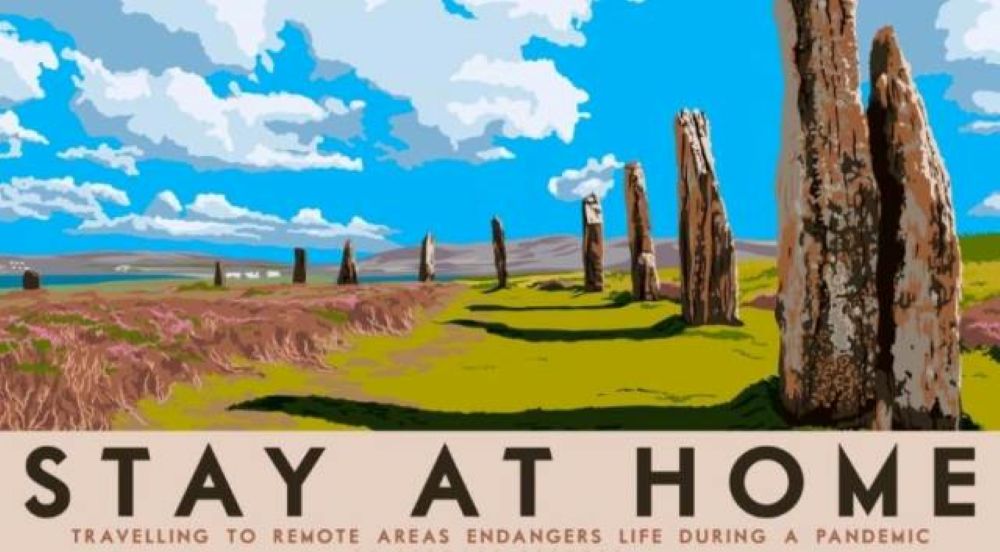
Cover image by Stewart Bremner from 2020 during lockdown ‘Stay at Home’ advice.
A wide range of people who received financial and welfare support during the pandemic have told their stories , alongside accounts from employers and employees in a new publication by Let’s Be Heard, the Scottish Covid Inquiry’s public participation project.
The Scottish COVID-19 Inquiry was set up to establish the facts and learn lessons from the devolved strategic response to the COVID-19 pandemic in Scotland for the period 1 January 2020 to 31 December 2022.
Let’s Be Heard Events were held across Scotland

Those who took part expressed their admiration for community volunteers and the Third Sector organisations upon whom many came to rely on to a great extent.
For those who were told to work from home, it could be quite a stressful experience as children were also at home – schooling – and household costs increased. This was particularly impactful for people with a disability. There were also many people who because of their work, could not stay home.
For women who were trying to work from home and school children – it was extremely difficult. Costs rose as more meals and snacks had to be found for the children.
Some participants told Let’s Be Heard that childcare services stopped being
widely available during the pandemic, but despite this, they were still charged
fees. They said that they continued to pay fees because they feared losing their
child’s place when services reopened, and this was difficult for some parents to
afford while their income was reduced. One parent, who was also a student at
the time, said that while they could have had a reduced rate at a student
nursery, however due to the pandemic, they had to enrol their child in a private
nursery at twice the cost.
This comment from a NHS key worker describes the additional costs and stresses:
“I am an NHS worker. My husband is employed with a private company.
We had no leave. Our children were left for long periods of time without
direct adult supervision/support. They lost valuable education. Both
struggled academically on their return to school. We paid for a tutor to try
and get their education back on track.”
On the other hand there were people who saved money when they had to work from home as they were no longer having to commute. This form of hybrid working has become very unpopular with some employers, both private and public because they have less control over an individual’s working day.
Many workers caught Covid – and some to this day are still struggling with the effects of long Covid. Self-isolation was compulsory and often had a negative impact not only on an individual’s income but also on their mental health.
For those who were self-employed the financial insecurity of this period brought a terrible toll on their mental health. The report includes an account from the Northern Isles from an individual who was self- employed but unable to work due to the lockdown restrictions. Due to financial hardship and the additional costs of heating in the north the account by this individual is a reminder of how the lockdown affected islanders:
“In 2020-2022 I had no choice but to live for two years with virtually no
heating in the house, and unable to afford to eat properly. I lost weight I couldn’t afford to lose, and the house grew black mould inside on the walls.
I had literally no help, apart from a small grant (c.£3k) from the Scottish
Government, which I remain pathetically grateful for. I exhausted literally all of my savings and am left with a financial legacy of being unable to financially help my young adult son on his first steps in the world – something every parent would like to do, but I cannot…I fell completely through the cracks in the pavement of society.”
There were additional support packages in Scotland from the Scottish Government which many of the respondents to the inquiry said had been a great help to them. For others, however, the additional money simply did not cover the increase in expenses. At the start of the lockdown when millions were told they had to remain home, there was difficulty getting through to access social security services due to the numbers calling them.
During the Covid pandemic food security – or our lack of it – was soon seen as supermarket shelves emptied and were slow to refill. The use of Foodbanks continued to rise but also in many areas Community Cupboards were set up – many which continue to exist today, mostly dealing with sharing out food which would otherwise go to waste.
Foodbanks and Community Cupboards/Larders rely on volunteers, often these are older members of the community, and during the Covid pandemic many of those had to shield, decreasing the number of volunteers able to be on hand.
Readers will remember how at the start of the Covid pandemic there was a shortage of PPE (Personal Protective Equipment) or that it was not fit for purpose. This was not only the case for Health and Social Care workers, but for members of the public who were required to wear a mask, for example when out shopping.

There was money to be had by profiteering during the Covid pandemic.
Transparency International UK uncovered four key issues in the UK’s pandemic response and billions of pounds of potentially mismanaged public contracts.
Political connections: at least 28 contracts worth £4.1 billion went to those with known political connections to the party of government in Westminster.
This amounts to almost one in ten pounds spent on the pandemic response
VIP Lane for PPE: 51 contracts worth a total of £4 billion went through the unlawful ‘VIP lane’, of which 15 contracts worth £1.7 billion were awarded to politically connected suppliers 24 contracts worth £1.7 billion were referred by politicians from the party of government at the time or their offices.
New inexperienced suppliers: eight contracts worth a total of £500 million went to suppliers no more than 100 days old.
Uncompetitive procurement: the UK government awarded over £30.7 billion in high-value contracts lacking competition – equivalent to almost two-thirds of all COVID-19 contracts by value.
Baroness Michelle Mone and her husband Doug Barrowman are among individuals being sued in an attempt to recover some of the millions owed to the government by his collapsed company, PPE Medpro, the BBC understands. – BBC
Failed pandemic-era PPE contracts cost the British taxpayer £1.4 billion. A report commissioned by the then UK Labour Chancellor, Rachel Reeves, in June 2025 found that the previous ” government’s over-ordering of PPE, and delays in checking it, mean that £762 million is unlikely to ever be recovered. These failures saw substandard PPE – gowns, masks and visors – not inspected for two years, meaning public money could no longer be recouped.”

When reading the report from Scotland’s Covid Inquiry, the financial and mental health stresses Scots were struggling with on a daily basis – it is galling to think of those who were profiteering by the suffering of others.
Some businesses had to close altogether during the Covid lockdown or so severely limit what they could do that it became extremely difficult to keep going. Scotland’s small business owners came up with innovative ideas. The report uses as an example one local island gin distillery which produced hand sanitiser instead of gin during the pandemic.
This report is important as a reminder, through lived experiences, of how the Covid pandemic impacted our communities. The direct quotes used from individual stories were particularly moving, the impact on mental health and the ongoing issues faced by those struggling with long Covid.
“I felt we were flung in at the deep end, didn’t know what we were supposed to
do, listen to verbal abuse from customers, people licking their fingers to separate notes, having to serve folk without masks, it was just a nightmare and I honestly couldn’t do it again. We couldn’t see our families but could serve strangers for hours every shift.” -Supermarket worker.
Click on this link to access the report ‘Financial and Welfare Support: Voices from Businesses and Individuals.’

Fiona Grahame




Leave a Reply