
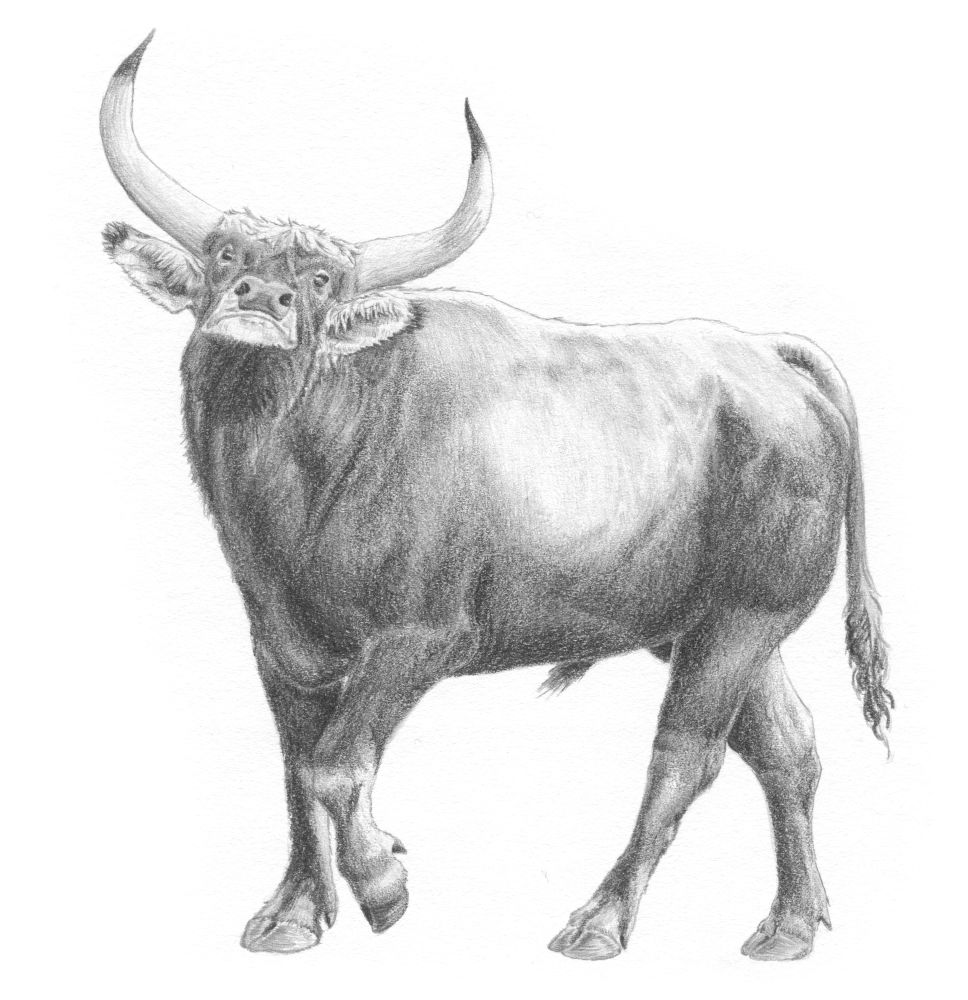
Excavations in Orkney have revealed the remains of aurochs in Neolithic settlements.
With a shoulder height of up to 1.8 m (5 ft 11 in) in bulls and 1.55 m (5 ft 1 in) in cows, it had massive elongated and broad horns that reached 80 cm (31 in) in length.

Aurochs, the predecessor to domestic cows, are now extinct. Their final disappearance from Poland in the 17th century marked the culmination of a decline that had been ongoing for 8,000 years. Human activity is considered to be the main reason for its global extinction, but what were the other factors leading to its disappearance?
New research by an international team led by Lund University indicates that multiple factors contributed to their demise in northern Europe – one of the areas where they became extinct the earliest.
“These ancient case studies reveal long-term patterns – which species are most vulnerable, how ecosystems shift and transform over time, and when and how human activity began shaping these environments,” explained Erika Rosengren, a doctoral student in historical osteology at Lund University and lead author of the paper.


Aurochs began colonising Scandinavia 11,700 years ago, after the end of the last Ice Age.
The researchers were surprised to learn that the aurochs likely suffered a sharp population drop, a so-called population bottleneck, during their migration to Scandinavia. This left them with lower genetic diversity.
“I found it incredibly interesting to see how the genetic diversity of the aurochs decreased as you moved north from mainland Europe up through Jutland and then dropped further across Zealand and Scania. It’s a textbook example of a bottleneck in evolutionary genetics,” said Mikkel-Holger S. Sinding, associate professor at University of Copenhagen and a senior author of the study.
It was previously believed that the population became isolated around 10,000 years ago. However, the research team found genetic evidence that the Scandinavian aurochs were still in contact with the main European population beyond this time. Instead, it was only when the land bridge connecting Scandinavia to the European mainland was flooded around 8,000 years ago that the Scandinavian aurochs population became completely isolated.
The formation of the Danish-Swedish straits coincided with a period of seemingly intense human hunting, which led to a sharp decline in the Swedish aurochs population and the complete disappearance of the aurochs from the island of Zealand in Denmark.
In southern Sweden, the aurochs population persisted in low numbers until at least 6,500 years ago. The aurochs likely disappeared from Sweden as its habitat changed – the once open landscapes gave way to dense forests, a shift that is thought to have been detrimental for the species.
The study therefore points to a more complex set of factors setting the extinction in motion than previously thought. The research team believe it was the combined effects of genetic depletion, human pressure, habitat fragmentation and degradation.
The findings hold clues that could be useful to wildlife management today.
“Our results add nuance to our understanding of human impact on animal populations. They confirm that species rarely disappear because of a single factor. Conservation plans must therefore be comprehensive and consider multiple stressors at the same time.
“Our results support the need to establish ecological corridors for threatened wildlife, rather than isolated nature reserves,” concluded Erika Rosengren.
Click on this link to access, The immigration history and extinction dynamics of the Scandinavian aurochs (Bos primigenius), published in The Holocene.



Leave a Reply