
“The members of the Neolithic community trod a fine line between starvation and plenty”, Caroline Wickham Jones, ‘Between the Wind and the Water’.
Orkney’s Neolithic People were farmers, but they were also skilled builders, including monumental structures, the remains of which only leave us in wonder at this Stone Age architecture. Internationally famous is the Village of Skara Brae, now perched precariously on the edge of the Bay of Skaill. Hidden until revealed by a tremendous storm in 1850, the houses lay buried and their amazing level of preservation has accorded them UNESCO World Heritage Site Status.

Less known, but contemporary with Skara Brae, is the settlement of Barnhouse beside the fresh water Harray Loch. A few hundred meters away are the immense Standing Stones of Stenness. This is part of a monumental landscape of Neolithic Orkney with the Ring of Brodgar, the burial tomb of Maeshowe, and the astounding Ness of Brodgar, all close by.


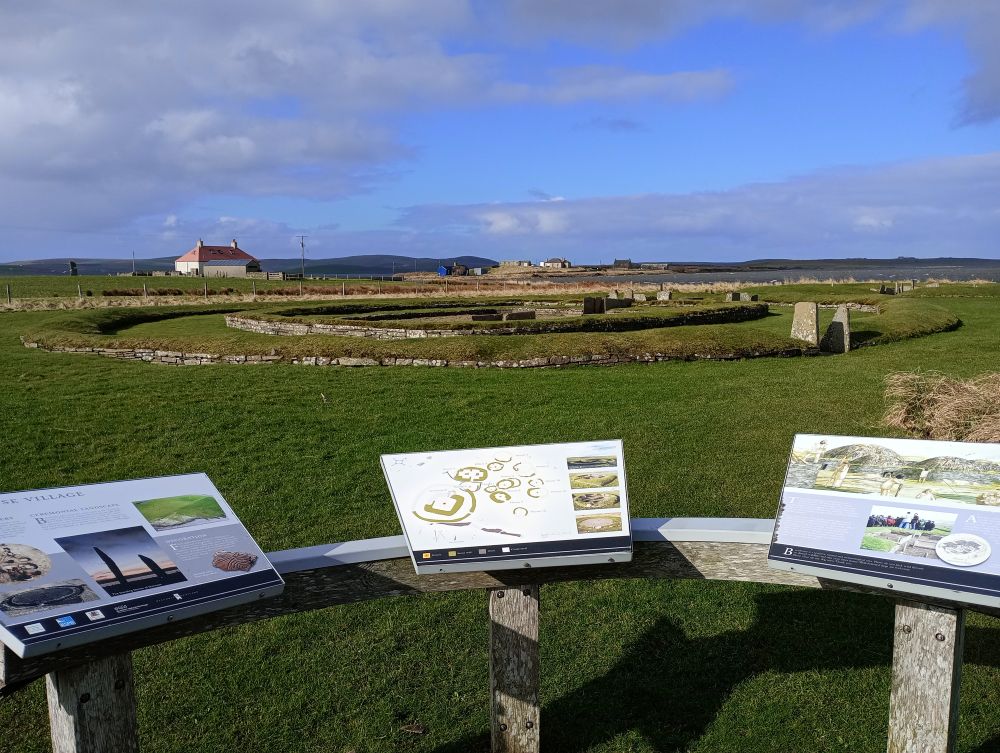
The Barnhouse village is a small group of houses, some now lost to the encroachment of the Harray Loch, and some to historic ploughing activities. It was discovered in 1984 by Professor Colin Richards. Excavations took place over a period of years between 1986 and 1991. Unlike Skara Brae the structures had not been buried in a sand dune and, therefore, less has survived, but it adds to our understanding of the everyday life of the people who farmed these islands.

The excavations uncovered four houses at first, and then as the work proceeded, 12 were revealed. It is believed that there would have been more because of the evidence from geophysical surveys. The houses were small and round with stone and turf walls. The site was occupied from c3115BCE to c2874BCE. Each house was free standing. At Skara Brae there were covered passages between houses. This is not the case with Barnhouse. The houses were built around an open central area and there was a drainage system for the inner and outer sections.
In the centre of each house, and they are of varying sizes, is a hearth, to the side of which are the sleeping areas, very like the box bed which continued to be used into the 19th century in Orkney farmhouses, as can be seen at Kirbuster Farm Museum in Birsay. Facing the doorway as you enter the house is what has become known at the Skara Brae site as the ‘dresser’. A shelving and storage unit.
Over the 300 years or so that people were living at Barnhouse, the houses were rebuilt and in some cases remodelled. There is a large building, Structure 8, which was part of the later development of the settlement. This building is similar to one of those uncovered at the Ness of Brodgar.

The Ness of Brodgar is a massive site close to Barnhouse village. Excavations there have revealed several layers of occupation over a long period of time with the remains of magnificent buildings some which would have have stone roofs. A high and impressive wall once surrounded the Ness of Brodgar. More exciting, however, are the discoveries of colour and fragments of patterns that have been found on some of the stones. Only a fraction of the site has been excavated before being covered over in 2024 for future generations to continue the work there.
In July 2026 a Time Team excavation on a section at the Ness of Brodgar opened up a new area after a geophysical survey had revealed a ‘circular feature’.
Other ancient villages have also been unearthed in Orkney including Rinyo in Rousay, The Links of Noltland in Westray and the remains of the oldest houses in Scotland at the Knap of Howar, Papa Westray.
Fragments of the lives of the people tell the story of farmers who grew wheat, and barley. The animal bones found in their midden heaps are of aurochs (large cattle), pigs, sheep, and red deer. Animal parts were used for multiple purposes – deer antlers as tools for digging.
The sea produced harvests of shellfish and large marine mammals would have washed ashore. Farming, fishing, hunting and foraging, took time and skill. Rope was made from twisted heather. Rushes and long grasses woven to make baskets. Stone, painstakingly polished, for beautiful axe and mace heads. Decorated pottery and in some cases, still with the marks of the potter who pressed their fingers into the soft clay.

No remains of clothing have been found but we can take a good guess about how they would have softened the skins of the animals they slaughtered. Decorated with beads, shaped, sewn together, and designed to keep out the winter winds but clothing to look good too.
Lots of needles, toggles and pins were found at Skara Brae, a village possibly hastily abandoned and leaving such a rich source of artefacts behind.
The replica house at Skara Brae tries to re-imagine how the inside of these Orcadian Neolithic homes might have looked.


Barnhouse village stopped being used about 400 years before the ending of Skara Brae. Generation upon generation of islanders, farming through good years of harvests, and those where survival was precarious.

Fiona Grahame
Interested in taking part in local archaeological excavations ? Check this out:

Leave a Reply