
There are two reasons why Mike and I became Members of the John Rae Society.
The first was the hope that John Rae’s achievements would achieve recognition – which is now the case
The second is the possible restoration of the Hall of Clestrain, which is a fine building
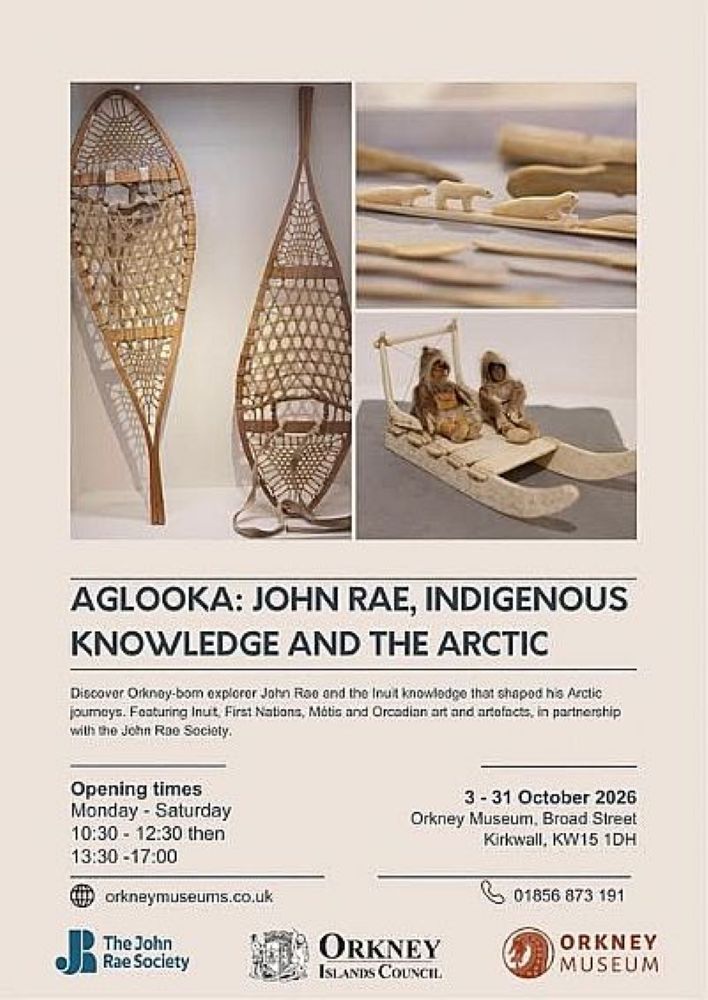
We were pleased to see that an exhibition exploring the connections between Orkney, northern Canada and the Arctic is taking place in Tankerness House Museum, Kirkwall

As an introduction I can’t do better than to transcribe the Museum’s own publicity statement……
“AGLOOKA: John Rae, Indigenous Knowledge and the Arctic
The Orkney Museum is delighted to present AGLOOKA: John Rae, Indigenous Knowledge and the Arctic, a new exhibition developed in partnership with the John Rae Society. The exhibition aims to introduce visitors to the Society’s work in preserving the legacy of Orkney-born Arctic explorer John Rae while showcasing a remarkable collection of Inuit, First Nations, Métis and Orcadian art and artefacts.
Aglooka was the name by which John Rae was known to the Inuit he met and travelled with. Usually translated as “he who takes long strides”, it refers to his remarkable endurance and his ability to cover vast distances on foot and by snowshoe, and reflects the respect he earned among the Inuit who shared their knowledge of the land with him.
Born at The Hall of Clestrain in the parish of Orphir, Orkney in 1813, Rae became one of the nineteenth century’s most successful Arctic explorers. Unlike many of his contemporaries, he worked closely with Indigenous peoples and learned directly from Inuit knowledge and experience, skills that proved critical to his success in the Arctic.
Drawing on loans from members of the John Rae Society, objects from the collections of the Orkney Museum, and works by both Indigenous and Orcadian artists, the exhibition explores the connections between Orkney, northern Canada and the Arctic.
Many of the objects on display are not directly connected to Rae himself but have been selected to illustrate the cultures, knowledge and artistic traditions that helped shape Arctic exploration. These include Inuit carvings and artefacts loaned by members of the John Rae Society, many collected directly from Inuit communities by Society member David Sharp, alongside examples of Cree First Nations and Métis craftsmanship from the collections of the Orkney Museum.
The exhibition also features works by Indigenous artists, including Professor Willie Ermine and Connie Dickens, as well as contemporary Orcadian artists whose work reflects the continuing legacy of John Rae and the enduring links between Orkney and northern North America.
Through art, artefacts and personal stories, AGLOOKA celebrates cultural exchange, highlights the work of the John Rae Society, and invites visitors to discover the people, places and traditions that shaped one of Orkney’s most internationally significant historical figures.”
And so, we went to see – working clock-wise round the room
First, a ‘squint’ to help to cancel the glare from the snow

Then ‘The Captain’s Wife’ by an Inuit artist

An Inuit harpoon and harpoon head

I then turned my attention to the cases in the middle of the room – full of Ivory and bone carvings


Around the walls of the room, are vibrant art-works.
John Goodwin’s indigenous name is Nytom, meaning ‘He who walks around’. He is a Makah Tribal member, born in 1948 and raised in the community of Neah Bay


Apologies to John – I forgot to write down the titles of your pieces – by this time I think I was going into sensory over-load!
And then art-work by Connie Dickens, who is located in the Coast Tsimshian village of Lax Kw’alaama

And Joe Wilson’s ‘Killer Whale’. Joe is a young Coast Salish artist, born and raised at Koksilah on Vancouver Island, British Columbia

In a side-room, the focus is on John Rae and the Hall of Clestrain

including Joyce Stewart’s image of the Hall itself

a ceramic plaque depicting The Two Johns by Andrew Appleby

more of which, here….
and a glass plaque by Jean Holdsworth, representing John Rae’s finding of the North-west Passage

There’s also a pair of hand-knitted honeycomb pattern socks made by Jenny Flett of Fort Chipewyan. Jenny was Metis, with Orcadian ancestry through her Grandfather


I must admit – I covet those socks!
To finish our grand day out – Trenabies for lunch – yummy as always!


Leave a Reply