
By Ian Cooper, from his excellent series, Records of a Bygone Age, first published in The Stronsay Limpet, and republished here with kind permission.
Last month’s article concentrated on the tragic loss of the eight crewmen aboard Longhope’s TGB lifeboat when she capsized, and of the Stronsay Lifeboat’s role in searching for the missing boat.
This tragedy must still have been fresh in the minds of the crew of the Stronsay Lifeboat when she was called out to respond to a Mayday call the following year. With a heavy swell running and a south-westerly gale whipping up large waves, conditions were particularly challenging.
This is the story of that particular search as still vividly recalled by a member of the crew 56 years later.
Although not a regular member of the crew, John Fiddler was one of the pool of volunteers available to crew the lifeboat if the need arose. He recounted this particular callout which took place in December 1970 when the regular lifeboat, the John Gellatly Hyndman, was away on refit and a relief boat, The Princess Royal, was stationed in Stronsay. This boat had been built pre-war and had recently been re-engined with diesels replacing her original petrol engines. These engines were considerably heavier than the originals which had the effect of making her ‘light in the head’ and, John said, not a very good sea boat.
HM Coastguards had earlier received a faint Mayday call, with the position given placing the ship apparently in distress about 30 miles east of Stronsay. The lifeboat was launched in a strong south-westerly gale while the cargo ship Islander, making her way from Sanday, also headed to the scene, along with the Aberdeen trawler Grampian Glen which had been fishing east of Auskerry. Also involved in the search was a Nimrod aircraft, the first time this aircraft had been used in that role. On the lifeboat’s outward voyage, John and another crewman were sent to the foc’sle to add some extra weight to the bow to try to hold her head in the water!
After an extended search in the area, which was confused by a report of white flares in the general area and a further report of some objects spotted in the water by the search aircraft, nothing was found and the Stronsay lifeboat was instructed to head back to station.
Sea conditions were very poor, with a huge westerly sea running against an opposing tide and, with the loss of the Longhope lifeboat the year before, the Fraserburgh lifeboat earlier that year and being in wild seas in a boat they were unfamiliar with the crew were extremely concerned for their own safety.
With the boat being light in the head, John told how on numerous occasions they climbed a larger than normal wave and could only hope that she crested the wave and made it down the other side. These concerns were relayed to Kirkwall Coastguard, along with a message that they should perhaps never have been called out on what was looking very like a hoax call.

The Coastguard responded by asking the Grampian Glen, a vessel more than twice the length of the lifeboat and well able to withstand such sea conditions, to escort them back to Stronsay and this they did, with some great seamanship keeping them in position on the weather side of the lifeboat for some considerable time until they reached calmer water. To try to make the best they could of sea conditions and tide they had finished up off Auskerry but eventually made it to the shelter of Odiness Bay, at which point the trawler left them.
Now in calmer waters, they made their way back to Stronsay pier, arriving about 11 hours after they had left. It transpired that the call had indeed been a hoax and the call sign given was that of a boat thought to be in Hong Kong!

Other services provided by the lifeboat in 1970 included going to the aid of the 299 ton Danish cargo vessel MV Pedersen on 15th March. The vessel had lost power four miles north of Westray’s Noup Head and was drifting toward the Papa Westray shore when the lifeboat arrived and managed to get a line aboard, towing her to the safety of Pierowall in Westray .
Then, on 4th November, she went to the rescue of the 149 ton Danish fishing boat Silver Star, aground on Helliar Holm near Shapinsay. The lifeboat, with the assistance of two local boats, managed to tow the boat off the shore relatively undamaged.
Captain Edward (Ted) Clements, who had been the driving force behind getting the Stronsay lifeboat station reopened in 1952 and had served as Honorary Secretary of the Station from that time, reached a personal milestone in 1971. This was his 85th birthday and, in October that year, he decided it was time for him to retire from the post. Andrew Burghes of the Smiddy in the Village then took over his role as Hon Secretary, serving for only a few months until the Station was to close on 30th May 1972.
On 19th October 1971, around the same time as Captain Clements’ retiral, the 228 ton trawler Glen Isla ran hard aground in high seas on the submerged Bow Rock at the entrance to Stronsay’s Mill Bay. The John Gellatly Hyndman was called to her rescue and, with Bow little more than a couple of miles from her moorings, was soon in attendance. The lifeboat was able to manoeuvre close enough to get a rope aboard the Glenisla and pass the rope to two other trawlers, the Mount Everest and the Admiral Frobisher, who together were able to get her pulled off with very little damage.

Less than 3 weeks later, on 5th November, the lifeboat was again called to the assistance of a trawler, this time even closer to home, when the Vera Grace (later renamed the Norseman’s Bride) ran aground at the entrance to Whitehall Harbour, just a few hundred yards from where the lifeboat was moored. Little assistance was needed from the lifeboat this time as Jimmy Stout, returning from a fishing trip in his own seine-netter Ocean’s Gift, was able to pull the trawler off undamaged. This was to be the JGH’s last call to a ship in distress.

A new lifeboat station was opened at Kirkwall in 1968, with the 70-foot (21-metre) lifeboat Grace Paterson Ritchie taking up station there. Its arrival prompted a review of lifeboat provision throughout Orkney and, much to the dismay of the Stronsay crew, the local committee and many residents of the outer North Isles, the RNLI concluded that the Stronsay station was no longer required. The decision was therefore taken to close the station and withdraw its lifeboat, with 30th May 1972 set as the final day of operations.
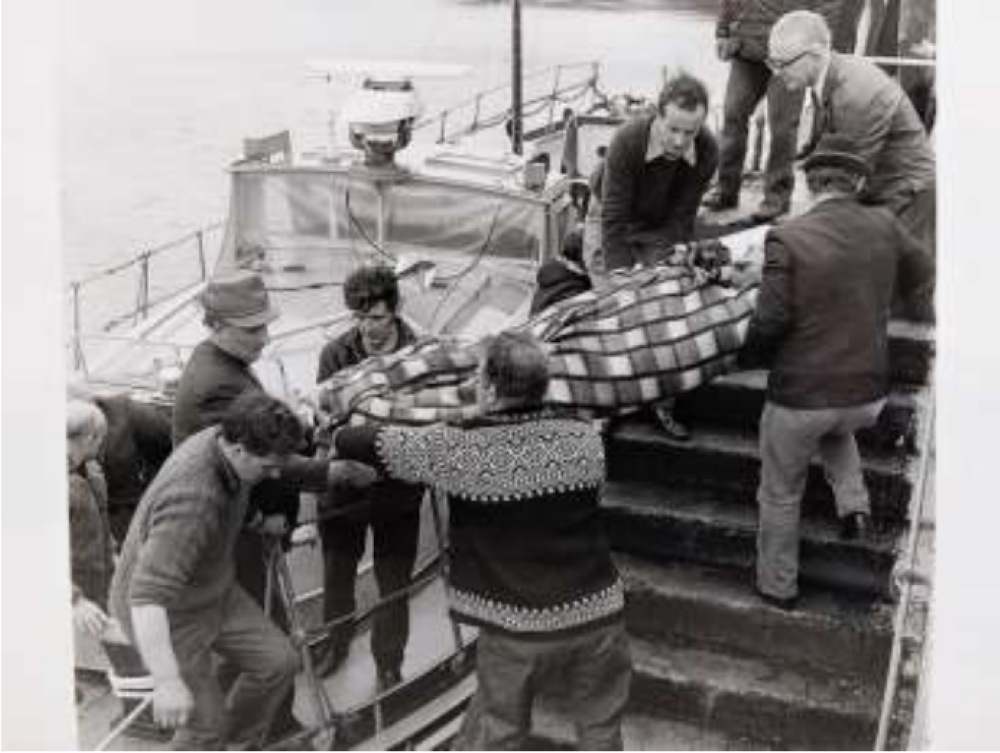
Just two days before the JGH was withdrawn she carried out her last service, a mercy mission carrying a sick man from Stronsay to hospital in Kirkwall.

Great concern and disappointment had already been expressed by the people of Stronsay and the other North Isles at the prospect of losing their lifeboat service. This particular rescue operation was widely cited as a compelling example of the invaluable role a locally stationed lifeboat could play, demonstrating both the speed of response and the local knowledge that only an island-based crew could provide.
While there was considerable regret at the loss of a service that had become an important part of island life, the changing circumstances of the time made the decision increasingly difficult to resist.
The introduction of the larger, faster and more modern Kirkwall lifeboat had marked a significant development in the provision of lifeboat cover for the northern isles. This, together with the commencement of a regular air service to the isles using Loganair’s eight-seater Islander aircraft, with its capacity to undertake speedy air ambulance and mercy flights, completely altered the pattern of rescue and medical provision across the islands.
Though many felt the loss of the local lifeboat service keenly, the inevitable had to be accepted and, on 30th May 1972, the curtain fell on this chapter of Stronsay’s seafaring history.
For two decades the station had provided not only a lifesaving service but also a source of reassurance to all living in the North Isles or sailing its seas, its closure marking the end of an era.
Part 8 next month.


Leave a Reply