

“History doesn’t repeat, but it often rhymes” (Mark Twain)
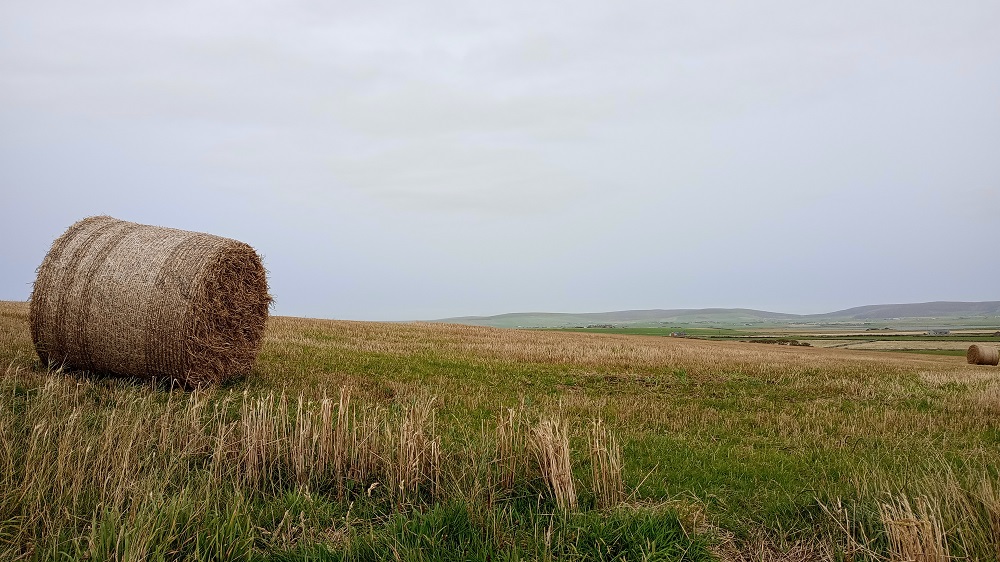
 I’m sitting in my holiday house in Quoyloo, Orkney, where I’m staying this week. I’m enjoying a dram and thinking about the past. These things may not be entirely unrelated.
Orkney reminds me of an essential truth. There is nothing new under the sun. The people of Skara Brae were every bit as sophisticated as we are – arguably more so. The architectural genius of St Magnus Cathedral and Maeshowe grows more evident with every passing millennia. We think of globalisation, aerial bombing, the motor car, the telephone, package holidays as modern phenomena but they were all established facts of life long before my great uncle fought at The Somme.
In farming, we get very excited about the importance of soil pH, but this was old hat to sixteenth century Orcadians who used sand (lime) as an essential part of their crop rotation. There was a great article on Twitter recently by a Norfolk farmer about the “min-till” sowing technique, which eschews ploughing for drilling seed into stubble leys directly, thus reducing establishment cost and carbon loss. It’s all the rage amongst farm journalists at the moment, how here’s the thing – it was written in 1905.
There is nothing new under the sun. Every generation thinks it has a franchise on new ideas, but in truth we’ve all been here before. Clichés should be avoided (like the plague), but they endure because they are often true. And this one is truer than most – the failure to learn from past mistakes condemns us forever to repeating them. The lack of outrage over a DUP deal that, at a stroke, endangers a fragile and hard-won peace and ends Barnett and its consequentials, is explained by a simple fact – time marches on. There are a lot of people who weren’t even born when the Good Friday Agreement was signed, far less The Troubles. We’re already forgetting why it was needed in the first place. That much is regrettable, but in terms of immorality, a political class that knows why the agreement was needed but chose to rip it up for naked party advantage? That’s off the scale. It’s unconscionable. It’s unforgivable.
Without knowing our history we have no way of understanding the present malaise in which we find ourselves. For what it’s worth, here’s how I see it.
Love her or loathe her – and I was always in the second of those camps – Margaret Thatcher was a proper, old-school, conviction politician. The last of the Mohicans. Not for nothing did the late, great Scottish journalist and writer Ian Bell describe her as “The Last Great Class Warrior”.
In the autumn of 2002, her health was starting to fail her but, at the party conference in Southampton where she was the keynote speaker, a crowd of around five hundred loyal devotees saw her on a good day.
Which was just as well. They were needing some good news. Tony Blair’s New Labour, pre-dodgy dossier, has been returned to power the previous spring and pundits were asking, in all seriousness, whether the most successful political franchise in British political history could ever win again. There had been cheerier wakes.
Against this backdrop, Mrs Thatcher was resolutely upbeat. “Why are you all so glum?”, she demanded. “We’ve won!”.
The delegates looked at each other nervously. Perhaps the rumours of their spiritual leader’s health weren’t so far off the mark.
It was only when she brandished a copy of the Labour Party manifesto that the penny dropped. “Our Greatest achievement”, she said, “was Tony Blair”.
Of course. By relentlessly pursuing a neoliberal, greed-is-good, low tax, small state, privatised, de-regulated, “free” market agenda, Thatcher had moved the so-called Overton Window – the range in which ideas form the consensus view – firmly to the right. Labour became New Labour. Its links to the unions were weakened, and finally severed completely, as it shamelessly courted big business and the Murdoch media. No-one encapsulated the change better that Peter Mandelson. His grandfather, Herbert Morrison, had served in the Attlee government that brought about the NHS, yet here was his grandson saying he was “relaxed about people becoming filthy rich, as long as they paid their taxes” (which, of course, they didn’t). His old grandpa must have been birlin’ in his grave.
So why is this important? Actually, it’s more than important. It’s not possible to understand the current debate around the future of the Scottish farming industry without seeing it the context of the parameters of the discussion.
The shift to the hard right has been cemented by the most right-wing media environment in British history, with the exception of the Daily Mail’s support for Adolf Hitler in the 1930s. It means that the gap between what the political, business and media establishment see as normal and desirable – and unarguable- and what the other 99.9% of the people want – has never been greater. In fact, I don’t believe the gap can be bridged in the normal manner. We now have a world where things that are, by any objective benchmark, mental, are seen as self-evident truths and, in terms of rational debate, off the table completely. The establishment shibboleths are sacrosanct.
Bonkers is the new normal. Not only is there a magic money tree, there’s an Amazonian rainforest full of used fifty pound notes. Give any one of them a shake and – bingo – £230 billion pounds for new Trident falls out. As does a 12% pay rise for Her Majesty. And a round billion for the DUP. And crossrail, and an HS2 that sees plans for Welsh railway upgrades shelved, and which will see hundreds of people evicted from their homes and, in some cases, their graves.
This is your Brave New World. A world where six billion buys you an aircraft carrier that doesn’t have any aircraft to carry. A world where peace dies on the altar of party politics. Where we must unite behind Brexit but where Scottish independence advocates like me, without any sense of irony, are called divisive. Where Supreme Court judges are chillingly labelled enemies of the state. Where opposition MPs are labelled “saboteurs” for daring to point out that Brexit negotiations aren’t actually going all that well, and that the Prime Minister isn’t all that strong and stable after all.
It’s utterly bonkers. So strong is this narrowly expressed consensus that when somebody normal – like Jeremy Corbyn, say – runs on a ticket that deviates even slightly from the madness, he gets slaughtered by the right-wing media (or, as I call it, the media), even though to normal observers he is both rational and credible.
The media reaction to Corbyn is a good barometer of how far the window has shifted. Think about it – his call for a top rate of tax of 50% is fully ten points below its lowest level under Thatcher. Indeed, when Maggie came to power it was 80% – and nobody thought this strange. Arguably, Corbyn isn’t even as radical as 1997 vintage Blair, yet if you read the Daily Express you’d think he was 1917 vintage Leon Trotsky.
But even Corbyn is mostly on-message. Witness his recent (unchallenged) claim on the Marr show, when he stated that Single Market membership was dependent on being in the EU. Which must have been highly alarming news to the good people of Norway and Lichtenstein. He’s just as hard a Brexiter as any of them.
So what has any of this to do with the ongoing discussions in Scottish farming?
Everything.
Farming is no different to any other industry in the sense that its leaders are not immune to the effects of groupthink and establishment ideas.
In the run up to the National Farmers Union elections this year, I watched the hustings from Kirkwall live on Facebook. The group of candidates, while mostly impressive, didn’t strike me for their diversity. The industry in Scotland is remarkably eclectic – highly productive cereal farms to West Highland crofts, with everything in between. Yet all the candidates were white, male, middle-aged reasonably wealthy with similar life experiences and worldviews. I’ve argued for years that Westminster doesn’t represent the people, and I wonder if the same charge could be made about our industry. In fact, I know it could.
More worryingly, as in the wider political sphere, the debate was conducted within some very narrow parameters. Brexit has happened and we must get on with it (well, no it hasn’t and no we don’t). Not one of them wanted a second Independence Referendum, despite one of them being a Yes man. I’m sure these views were honestly held and I have respect for them, but it felt a bit like they were telling folk what they wanted to hear. Blue Sky Thinking it wasn’t.
In an excellent article in last week’s Scottish Farmer, fruit and cereal grower James Porter called for the Scottish Government to be brave over the GM issue. Rather than simply ruling it out so as not to scare the horses, he said, the government should look at the issue objectively and, if it proved to be favourable, have the courage to argue the case on its own merits.
I think that type of courage is crucial to the future of our industry. Producing a list of demands for Michael Gove isn’t policy. It’s a wish list. As I’ve said before, I wish I could go for dinner and cocktails with Scarlett Johannson, but that’s not happening either. She must have lost my number.
It needs the courage of our farming leaders to go to its members (and non-members) and say “look lads – we have to be honest with you here. We’re getting nowhere with these clowns. The powers we have are going to London, not Edinburgh. They aren’t going to cut us a deal. They openly despise us anyway. Best case scenario is half your current support payment, and that’s if DEFRA can squeeze any money at all out of the treasury which now controls the budget and will have a lot less money as the economy shrinks after Brexit, which it will. They’d sacrifice us for a trade deal with Trump without looking back. The chlorinated chickens will be home to roost, followed closely by the hormone treated cattle. Although at least they’ll be glowing so they’ll be easier to check on a winter’s night. So basically we’re screwed unless we go it alone. You’ve told us what you want the industry to look like and we’re telling you right here, right now, that we cannot deliver it within the current constitutional framework. Even if you hate the idea of independence, it’s your least worst option and we can’t afford not to back it. So I’ll be calling Bute House on Monday morning and lobbying the First Minister for a new plebiscite. Not at the end of the Brexit negotiations, but now. Right. Now.
You need to back me on this, or I walk away and you can find yourself a new team. It’s up to you. Well?”
The great Robert Kennedy once said:
“Some men see things as they are, and ask why. I dream of things that never were, and ask why not”.
It is time for us to dream. It is time for us to ask “why not?”
It is time for us to leave.
Alec Ross is a regular contributor with The Orkney News


Leave a Reply