
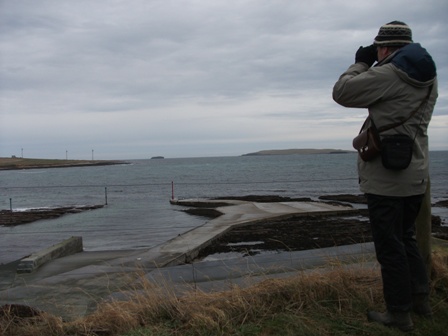
By Bernie Bell
Pics by B&M Bell
We’ve walked Newark Bay – Deerness, many times, but I haven’t written about it, until now. I did mention it, here…….. https://theorkneynews.scot/2019/01/05/orkney-walks-more-matters-geological/
The Bay does collect a lot of rubbish – plastic rubbish – I think that’s because it faces the North Sea, that poor beleaguered ocean, which has all sorts of crap thrown into it, which then washes up at places like Newark. Most of the beaches of Orkney are clean – partly due to remote location, partly due to tides, and partly due to the effort of local folk who take part in ‘Bag The Bruck’, and ‘Pick Up Three Pieces’. https://www.orkney.gov.uk/Service-Directory/R/beach-cleaning.htm
Newark Bay, just happens to be facing the wrong way, and so, collects more than its fair share of rubbish. The plus side of this, can be the things you find there. We found a very useful big blue round thing which is now one of the herb containers in our veg patch….

And some good whirly bits of metal, which form part of my ‘installation’ – only joking! We have an arty friend, who refers to it as my installation – I say it’s my archaeological dig, and charge people 5 quid to look at it!


It’s actually stones which Mike cleared when he made the veg patch, then I messed with them a bit until I liked the look of it, and…now…it’s my……whatever it is! I’ve just noticed – it’s the same shape as the outline of Africa!
I was reminded of Newark Bay, when I saw a notice the Orkney Archaeology Society Facebook page https://en-gb.facebook.com/OrkneyArchaeologySociety/, asking for help with filling and placing extra sand bags to protect an ancient Chapel at the far end of the Bay, to try to stop it being claimed by the sea.
The Bay also faces the right/wrong way for receiving some of the worst of the weather we’ve been having lately, and the archaeology of the area, has been suffering. https://canmore.org.uk/site/3033/newark https://archaeologyorkney.com/category/newark/
This is the case at many of the ancient sites of Orkney – the sea is eating away at them. County Archaeologist Julie Gibson, and photographer Frank Bradford put together a book named ‘Rising Tides’ https://www.orcadian.co.uk/shop/history-and-archaeology/238-rising-tides-revisited.html which deals well with this problem.
Some sites are being lost, some are being found.
And so, we thought we’d go to Newark Bay, to see what has been happening. Having dodged the Trowies at Trowietown, at the end of the road leading to the Bay, we turned slightly to the right, and tucked ourselves into a small car park, up on the cliff, which has a wonderful outlook across to Copinsay (Spellcheck always offers ‘Popinjay’!) and the Horse of Copinsay. The Bay has a lovely sandy beach, looking across to where the recent archaeology rescue attempt has been made …


There is a picnic place, by the old winches which were used for hauling boats up the slipway..

We then headed down to walk along the beach, passing an anchor, with its history attached to a whalebone – useful things, whalebones…..


Did we begin the archaeology with a Motte & Bailey Castle? Naaaa – just a splendid sandcastle, with aspirations……..

From the beach we could see the wall of sandbags, and, looking at the waves on what was a day of quite gentle winds, could get some idea of how and why this site is being eroded so badly, and was in need of some TLC…


And so, cutting up from the beach, and on to the cliff-top path, we came upon the remains of the Chapel, with their newly acquired defences. It was something of a case of ‘Orkney Ancient & Modern’, as there is a stoat trap in place…

The folk who used this chapel and lived in the area, didn’t have a problem with stoats – that’s a newly acquired problem https://theorkneynews.scot/2018/01/28/be-ware-of-stoats/ . They, no doubt, had problems of their own to deal with, and didn’t have access to the resources that we have, for doing so.
The outline of the chapel is plain to see, especially the internal layout –

There is what looked to me like a drain –


Why would they need a drain, in or by a chapel? I don’t know! – that’s for the archaeologists to figure out – if it is a drain.
The work done here, is a valiant attempt….

But, the sea laughs at sandbags, and walls, and human defences. We were pleased to have had the opportunity to come to this place, at this time, and think about the sequence of life there – the souterrain – prehistoric (maybe Iron Age?), the Pictish stone, the Viking settlement, the ancient chapel, and all those people, living their lives there. Now, we look around, and there are a few farms and houses dotted about the landscape, not such a busy place now – but the life is still there, being lived. And, it’s also still there, under the earth, being eroded out, and away to the sea.
Some of the stones from the Chapel, might have been used to build the nearby farm wall, so – there is some continuity of use.
And – the archaeologists are having the opportunity to study and record these sites, before they disappear.
On the way to Newark, we stopped at Dingieshowe https://theorkneynews.scot/2018/01/18/orkney-tings/ , at the toilet block, and I noticed this ……….

– ‘the sea giveth, and the sea taketh away’. It deposits in some places, covering things up, and eats away at others – revealing.
We used to live in Suffolk, and often walked at Dunwich. https://en.wikipedia.org/wiki/Dunwich
Though not on the scale of Dunwich, what has happened and is happening at Newark, has some parallels.
When we first went to live in Suffolk, and walked along near the old Priory, we walked through a small piece of woodland, which used to be part of the cemetery. There was a headstone of a man buried in 17?? , to our right, about 30/40 feet back from the path. Gradually, the cliff to the left advanced, and so the path got nearer to the headstone. Then, one time we went there, the path had been moved, and the headstone was now on the left of the path. Eventually, it disappeared, and the man’s bones, presumably went onto the beach and then into the sea, as many had done before him When we walked on the beach there, Ben-The-Dog would find bones, play with them, throw them about, chew on them. Maybe some of them were from people – who knows – maybe Ben could tell the difference – but to him, bones were bones, and good fun, who or what ever they had come from!
If you’re walking on the beach at Newark Bay, and you find a bone ….you never know!




Leave a Reply to The Newark Project – The Orkney NewsCancel reply