
 By Alec Ross
To the long list of things that we can blame Nicola Sturgeon for, we can now it seems add the weather.
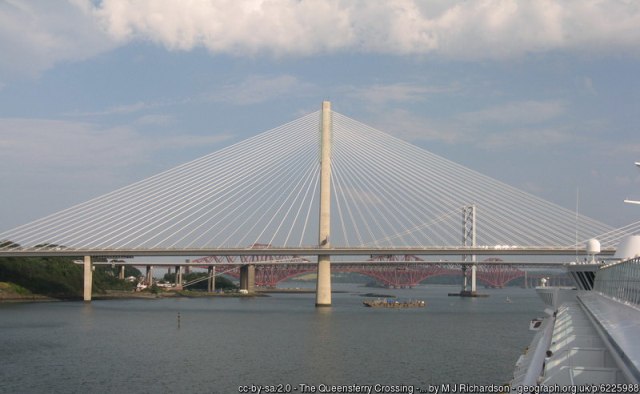
This morning’s news agenda seems to be dominated by two bridge stories – the temporary closure of the new Queensferry Crossing across the Forth, and the floated idea of a bridge from Portpatrick to Larne.
The closure of the Forth bridge due to Storm Ciara shouldn’t really be a story at all – or if it is a story, it should be a good one. I mean, imagine a bridge so robust that it takes a storm of this magnitude to disrupt the flow of traffic? The real story is the number of times it doesn’t shut. There’s something predictable and fairly depressing about the reaction to today’s closure, and you can already feel the undisguised glee amongst the usual British Nationalist dullards. Not for nothing did one commentator imagine that The Scotsman headline the day after Scotland votes for independence would be: “Blow for Sturgeon as SNP loses Raison d’Etre”. It’s a bit windy in Fife. Sturgeon must surely resign.
 I don’t dismiss the inconvenience that commuters in Lothian and Fife suffer from time to time, particularly when I’m fortunate that my usual daily commute is twenty yards from the kitchen to the office in my garden.
And on the occasions when I have to travel to Dumfries or Ayr, weather and traffic issues roughly add or substract fifteen minutes to or from the journey. So in my area (I live just outside Stranraer), my view that we don’t necessarily need to dual the roads in and out of the town in their entirety is a minority one. I take the view that places like London have wonderful infrastructure, but, as I found out last week, that counts for nothing if you haven’t moved for three hours.
A lady from Radio Scotland called me this morning asking me to take part in the ‘phone in about the proposed bridge from Portpatrick to Larne. While I didn’t get on, it got me thinking about the issue. Would we want one? Is it possible? And why now?
Readers of this column will know that I run a business supplying farmers across the UK and Ireland. The island of Ireland is an area of real growth for the business, and the idea of one day crossing from an independent Scotland to a united Ireland is a lovely prospect – however I choose to travel. And while I have some sympathy with the view that ferry jobs would be at risk, I’d balance that against the positives of investment much needed since the ferries left Stranraer in 2011, particularly when the town’s primary role could be, post Brexit, as a lorry park.
So, yep, theoretically it’s good for me. But there are problems. Not least that the primary author of the idea is a certain Boris Alexander de Pfeffel Johnston. It takes a major suspension of disbelief to buy the notion that a guy who couldn’t build a bridge from London to London when Mayor could somehow deliver one from Scotland to Ireland.
You’ve also got a timing issue. The Oserund Bridge from Sweden to Denmark took five years to build (for a remarkably cheap €2.6m). What we’re looking at here is a twenty mile stretch, and you’d have to find a way to engineer a way round thousands of tonnes of conventional and chemical munitions and nuclear waste dumped on Beaufort’s Dyke since the war (the practice didn’t stop until 1976).
So why is this suddenly on the agenda?
As this morning’s Common Weal article notes, there is something quite Trumpian about all this. Just as The Donald’s wall – or the idea of it – gives form to a hostile immigration policy, Johnston’s bridge is largely symbolic. It’s an inference that, for really big projects, we need the “broad-shoulders” of the Union. He uses it to peddle the myth that we are a happy, special, equal family of nations and that we should figuratively build bridges rather than go our separate ways. Which, from the architect of a Brexit that will see barriers on twenty-seven borders when previously there were none, is a quite stunning display of chutzpah.
We are in pure “The Thick of It” territory. This is a classic “dead cat” strategy (the idea being that if things are getting out of hand, you throw a dead cat on the table. Suddenly everyone forgets the inconvenient yet important stuff and talks only of the deceased feline). It’s pure deflection.
And what it deflects from is the news – although it’s hardly news – that Michael Gove et al now admit what people who pay attention have been saying for years: there will be border checks everywhere. Including Stranraer, bridge or no bridge. That’s kind of the whole point of Taking Back Control. Who knew?
It’s also a deflection from the news that HS2 – which, if it ever gets built at all – will double in cost to £106 billion. Scotland will, of course, pay for the privilege of a rail network whose northern terminus is Manchester and that we will in all likelihood rarely use. It’s another reminder that the Brexit Britain neoliberalism fantasy cannot be paid for without Scotland’s revenues. If it could, we’d have been a self-governing country years ago.
Scotland does need some infrastructure investment. Car free city centres and more affordable public transport, to name but two. For Scotland’s deathly boring British Nationalists, the temporary closing of a major Scottish Government transport link must feel like Christmas Day, but successive Holyrood administrations continue to deliver big infrastructure projects on time and to budget. It doesn’t fit with the narrative that we aren’t big enough, wealthy enough and bright enough to deliver on decisions that we will soon be making entirely for ourselves. I trust the government of Scotland because I trust the people of Scotland who elect it. I trust them to, on the whole, deliver.
Boris Johnson? I wouldn’t trust him to deliver the post.


Leave a Reply