
By John Mowat
Ukraine is the third biggest country in Europe, slightly smaller, in land area, than France. It lies in Eastern Europe, sharing borders with Poland & Slovakia to the west, Belarus to the north, Russia to the north east, East & south east, Moldova and Romania to the south and Hungary to the south east and a long Black Sea coast to the south. Its population is 44 million.
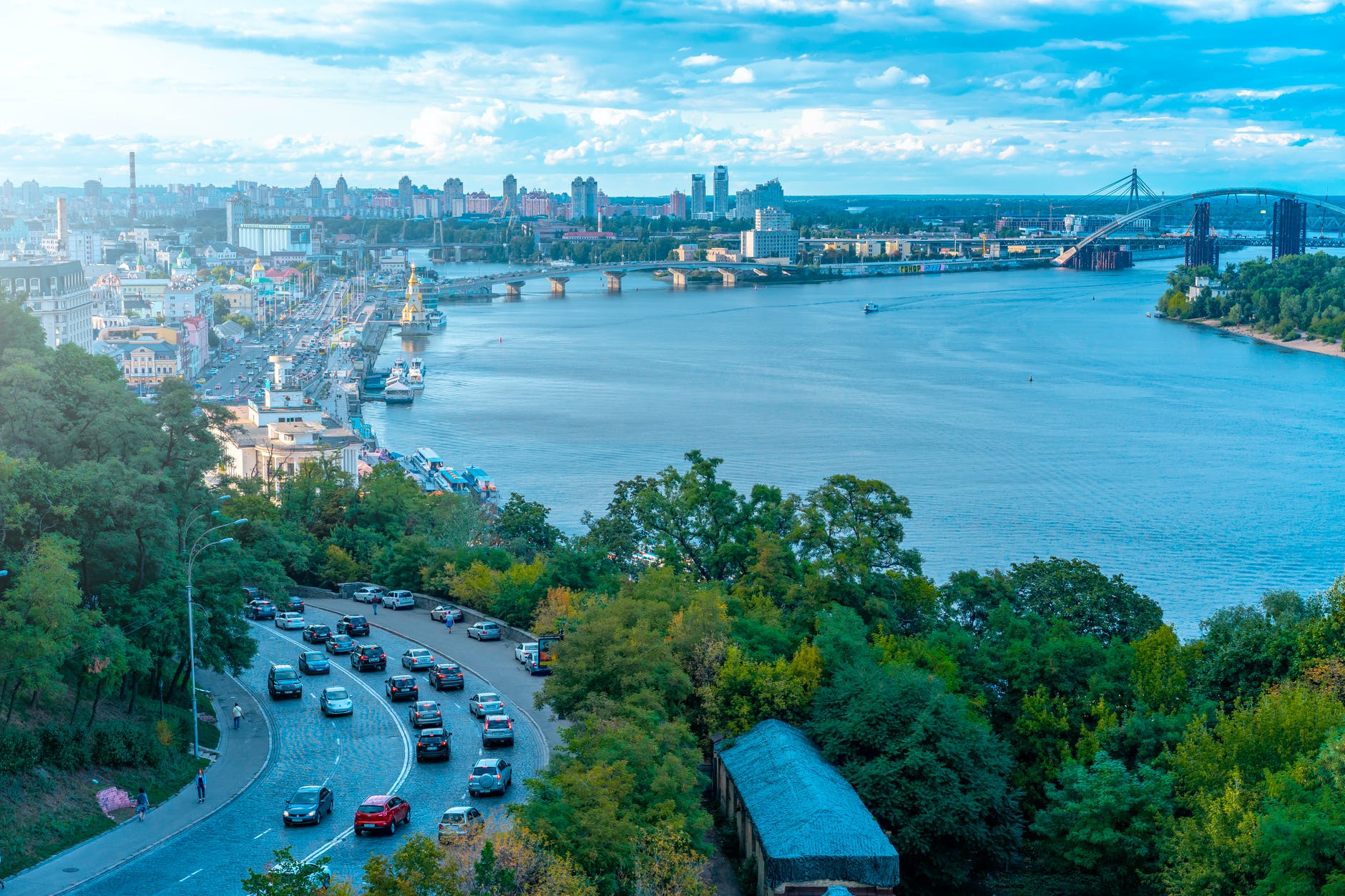
Ukraine, as we know it today, emerged in the latter part of the 20th century, following the collapse of Communism. It was successively dominated by Poland, Lithuania, Czechoslovakia, USSR & Russia. It had a brief period of independence, following the end of WW1 but became a Soviet Socialist Republic soon after that. The capital, Kiev stands on the Dnieper River, a major, north to south trading route, in Viking times and before that.
Ukraine suffered badly during WW2 from hostile neighbours of both Hitler’s Germany and Stalin’s Russia, suffering 5 million casualties. Recovery post 1945 was slow and difficult, under Stalin’s Russia. Things started to improve, particularly during the Gorbachov era and Peristroika, from 1985 to 1991 when greater freedom and economic development became possible.
Two thirds of the population speak Ukranian, an eastern Slavonic language, with close links to Polish, while the remaining third , in the eastern part, speak Russian. Some of the Russian speakers could be described as Russian immigrants but most Russian speakers are happy to be Ukrainians; only a small minority would opt to join Russia. There are smaller numbers of nationals from neighbouring countries who regard themselves as Ukrainians.
Ukraine is relatively poor country with one of the lowest GDPs in Europe, given its geography and proximity to Russia.
Much of Ukraine consists of rich fertile agricultural land, and a warm summer climate, good for the growth of grain. The eastern part of the Black Sea is industrial, but has lacked modern investment. Chernobyl was another legacy of post war Communist Russia, with a resulting loss of life and largescale pollution.
Ukraine has been a multi party democracy since the early 1990s. Culturally and politically Ukraine is closer to Poland than other neighbouring countries. Many younger people have studied at Polish Universities over the past 30 or more years, while Germany has become a close ally. Many young Ukrainians study in Germany too. Younger Ukrainians often work for German companies, particularly in the travel, tourism and educational industries.
The majority of today’s Ukrainians, look westwards to Europe and the European Union. Countries such as Poland, Hungary, Czech Republic, Slovakia, Romania & Bulgaria have greatly benefitted from EU Membership.
Unfortunately for the majority of Ukrainians, in February & March 2014, Russia coveted & annexed the Crimea along with its 2.5 million inhabitants. A small majority of people there spoke Russian. Since then, many Ukrainians have had to leave Crimea. Russia coveted its port and former naval base and tourism facilities. The Russians failed to take over the important port of Mariupol.
February and March 2014 marked a Russian–Ukrainian War.
In addition to Crimea, parts of Dombas and Luthansk in Eastern Ukraine were invaded. A low level war, sponsored by Russia has continued, ever since. Russia has now ramped up the 2014 low level war backed by 190,000 hostile Russian troops. In 2014 Ukraine successfully repulsed further Russian incursions.
For Europe we are seeing what appears to be a new Iron Curtain descending over parts of Eastern Europe. The Baltic Countries, Poland and many others have embraced Membership of NATO and protection as they see it provides. While the majority of Ukrainians may well like this prospect, there is little possibility of this anytime soon.
A bit like Poland and Finland, in 1938 & 1939, Ukraine finds itself being bullied by a big, powerful militarily neighbour Putin makes no secret of wishing to recreate Russia and its role of the old Communist USSR. As a Dictator, he is seen as being unpredictable and thus dangerous. It is difficult to predict Putin’s next move.
Meanwhile Russian gas supplies to Germany, Austria & Italy have been an important of their energy requirements. Germany has halted the opening of the flow of Russian gas, via the Nordstream pipeline from the Baltic. A gas pipeline, through Ukraine is also seen to be important to Russia. Western European and EU Countries are finding themselves entering a more unstable & unpredictable period. Oil and gas prices have risen sharply to their highest levels in the past 10 years. 40 % of Europe’s gas and 25 % of its oil presently come from Russia. Putin understands economic and military power but does not greatly care for the people caught in the middle, whether Russian or not.
Russia is believed to have meddled in elections in USA, UK, other European countries along with the Brexit Referendum, in recent years. There is considerable sympathy for the sovereign independent country of Ukraine during its present predicament. European Countries have hitherto declined to send troops into Ukraine but many have supplied some military hardware. European countries and Turkey are thus having to adapt to a new and more threatening reality. They along with NATO will need to remain vigilant.

Archived story: A flame of hope?


Leave a Reply