
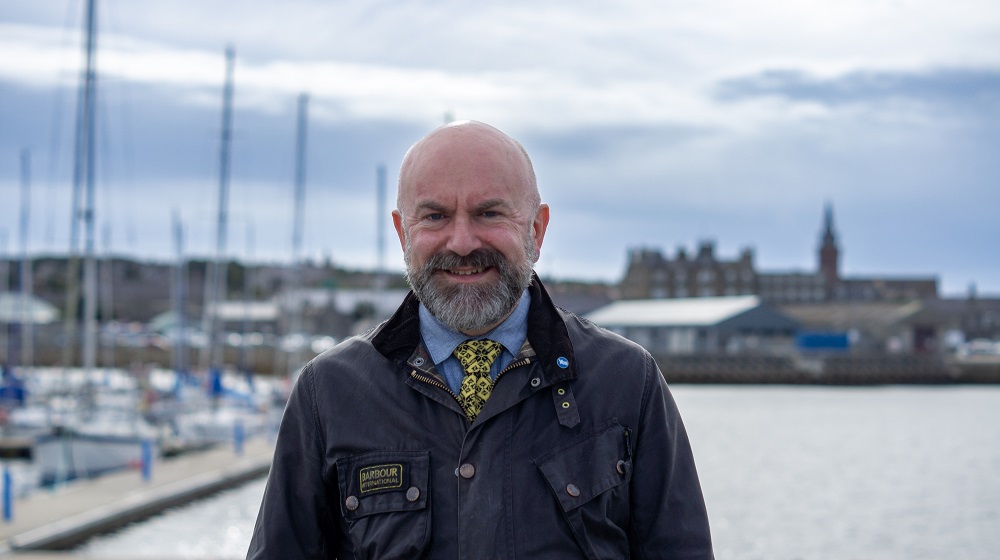
Robert Leslie, SNP candidate for Orkney and Shetland for the upcoming General Election says he is looking forward to meeting folk across both island groups as he focuses his campaign on the case for independence.

“Our islands are feeling the impact of Brexit right now, and a continued vote for the Liberal Democrats will do nothing to change that. Only a vote for the SNP will offer a route back into the EU and an opportunity to rebuild vital links with our neighbours on the continent” – Robert Leslie
And Robert Leslie says he is convinced that greater autonomy for both island communities will be delivered via independence for Scotland.
Robert Leslie was speaking after attending the SNP’s campaign launch in Glasgow last Friday, at which First Minister Humza Yousaf, called for an end to the cosy Westminster consensus that led to Labour and Liberal Democrat politicians that once warned Brexit would be a disaster “now rolling in right behind it. Despite the evidence of course, telling us, showing us, demonstrating that it has been a complete and utter, unmitigated disaster”.
Robert Leslie said:
“Only by voting SNP can we deliver a Scotland free from Tory rule once and for all, protect our values and make sure decisions are made in Scotland. That is why page one, line one of the SNP manifesto will say ‘vote SNP for an independent Scotland’.
“And I also want to ensure that powers will be devolved further to Orkney and Shetland at the time that we are drawing up the constitution of an independent Scotland.
Robert Leslie, who is visiting Shetland for the Lerwick Up Helly Aa later this month, said he was interested to see that a weekend conference exploring ways of how Shetland could gain more autonomy from central government was set to take place in Brae in April.
“I will be really interested in the outcomes of these two days of discussions and any actions agreed. Orkney Islands Council started work on investigating alternative models of governance during 2023, and I am convinced that further autonomy will be best delivered for both Orkney and Shetland as part of an independent Scotland.
“That was clearly evidenced in the Our Islands Our Future conference in 2013 by the late Jean-Didier Hache, then Executive Secretary of the CPMR Islands Commission.
“I was at the conference, and recall Mr Hache describe how many European islands already enjoy special status with the EU and that the demands of Our Islands Our Future were reasonable and legitimate.
“Indeed, from what he said, the majority of island regions in Europe already had some kind of special status or autonomy with the Scottish Islands being the exception.
“Seven of the European Union’s island regions already had legislative autonomy, and in eight EU member states there were special provisions for islands in the national constitution, or in the structure of national government, parliament or administration.
“Mr Hache said at the time that in the event of a ‘Yes’ vote in September 2014 there would be a tremendous opportunity for Scotland to negotiate a special deal for the islands as part of an Accession Treaty. The phrase I remember him using was that these negotiations were best made when ‘the cement is still wet’ on such a treaty.
The conference report stated: ‘The islands could demand ‘permanent representation’ in Scotland’s European Embassy to ensure that the islands get a ‘heads up’ on what law and policy may be coming their way. Alternatively the islands could have their own representation/offices in Brussels like the Canary Islands, Corsica and Sicily. This would provide added opportunity for the islands to seek any change or exception to laws and policies if required.
‘Any special status for the islands at a national level would only have a very limited effect without an EU dimension because such a high percentage of national laws stem from the EU. Special status could be demanded on the basis of considerations such as the island’s combination of insularity, low or very low population density, peripherality and harsh climate. Alternatively the islands could seek to leave the European Union as Greenland did in 1985 after securing autonomy from Denmark. The Faroe Islands, Isle of Man, Jersey and Guernsey are other islands that are not in the EU.’
“In Mr Hache’s view, the UK government was unlikely to welcome a permanent islands representation at the UK’s European Embassy. However, Mr Hache insisted that there were other ways in which the islands could influence Europe.
“We all know the impacts of voting ‘No’ to becoming a normal independent country, and thus losing the opportunity for the islands to negotiate greater powers at that time, and we now feel the impact of that 2016 Brexit vote on Scotland, after we were ripped from the EU against our will.
“With the Tories, Labour and Lib Dems now all signed up to Brexit, the only way back into the EU and to allow Orkney and Shetland to negotiate meaningful autonomy, would be to back the independence cause, not tie ourselves to the insular British Nationalist state that the dysfunctional UK is becoming.”
The next UK General Election is likely to take place later this year and before January 2025.
Click on this link to Register to Vote
You must be aged 16 or over (or 14 or over in Scotland and Wales).
You must also be one of the following:
- a British citizen
- an Irish or EU citizen living in the UK
- a Commonwealth citizen who has permission to enter or stay in the UK, or who does not need permission
- a citizen of another country living in Scotland or Wales who has permission to enter or stay in the UK, or who does not need permission
Check which elections you’re eligible to vote in.
You can vote when you’re 18 or over. If you live in Scotland or Wales, you can vote in some elections when you’re 16 or over – check which elections you’re eligible to vote in.
You normally only need to register once – not for every election. You’ll need to register again if you’ve changed your name, address or nationality.
Registering online usually takes about 5 minutes.


Leave a Reply