
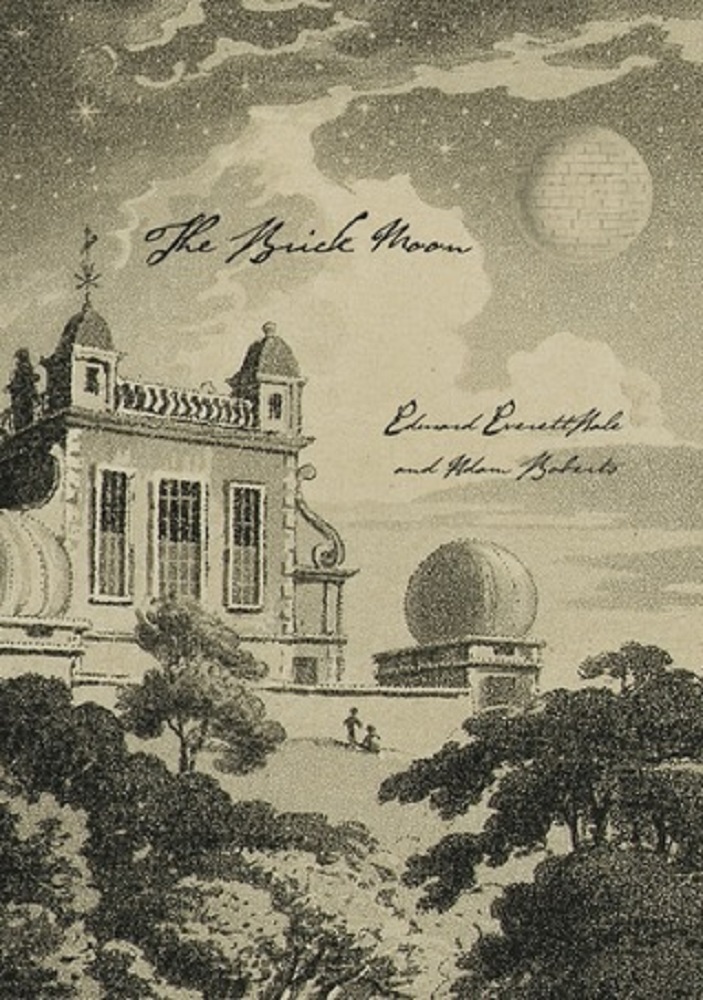
Richard Dunn and Marek Kukula, eds., Edward Everett Hale, “The Brick Moon, and Another Brick in the Moon: The lost classic of Victorian science fiction, with a new sequel by Adam Roberts”, Jurassic/Gold Medal Books, 2014, paperback, 419 pp..
First published in different form in Interzone 256, December 2014.

After last week’s article on space stations, it seems fitting to hark back to the first book on the subject. In the 1950s, no book on space flight generally or in anticipation of Earth satellites (and there were lots of them) was complete without a reference to E.E. Hale’s The Brick Moon (Fig. 1). Published as a serial in The Atlantic Monthly, 1869-70, it was the first written work on artificial satellites since Sir Isaac Newton (Fig. 2), the first account of them in fiction, and probably the only one until Konstantin Tsiolkovsky’s Beyond the Planet Earth in 1916 (Fig. 3). Yet it didn’t seem to be available in print, and as far as I could gather, was reprinted only twice during the 20th century, with no more editions until very recently. Hale died in 1909, so there don’t seem to be copyright reasons to explain why this ‘classic of Victorian science fiction’ should have been ‘lost’ for so long.


The publisher’s logo itself has nostalgic significance: Gold Medal Books were an imprint of the US Fawcett Publications, publishing high-quality SF in the 1960s. The Jurassic/Gold Medal logo looks similar but has a dinosaur superimposed. As the introduction says, the reprinting of this particular ‘dinosaur’ was timely, marking the 300th anniversary of the first Longitude Act (see Dava Sobel, Longitude – Fig. 4), while Europe was beginning to deploy its Galileo system, to be compatible with GPS while greatly expanding the civilian uses of satellite navigation, and incidentally make European armed forces independent of GPS if need be (Fig. 5). It went live in 2016 and as of December 2023 it had 23 satellites on-orbit, five of which were unavailable, and a second generation of satellites is expected to be deployed in 2025.


The Brick Moon was to be an applications satellite, to help navigators find their longitude. Although Harrington’s chronometer’s had won the competition run by the Admiralty and the Royal Observatory, described in detail in Longitude, they were expensive and could be broken, lost or stolen, but once launched, an artificial satellite would always be there to sight on. Brick was adopted as the building material (Fig. 6), to withstand the heat of passage through the atmosphere – the editors’ claim that it foreshadows the Space Shuttle’s ceramic tiles might seem far-fetched until you realise that supposedly it’s travelling at orbital speed from the outset.


The Brick Moon would be placed in polar orbit over the Greenwich Meridian (Figs. 1 & 7), and as the Introduction points out, in real life it would drift in longitude, due to the pulls of Sun, Moon and the Earth’s equatorial bulge. Even in geosynchronous orbit 22,000 miles above the Equator, it would drift in a figure-of-8 pattern. However those effects can be offset in a suitably inclined orbit to make the satellite Sun-synchronous (Fig. 8 – see ‘Launch Costs per Vehicle’, ON, 12th November 2023), and weather and Earth resources satellites use that to bring them over the same locations at the same times each day.

The Brick Moon’s usefulness would be somewhat limited by its faintness: after its accidental launch, when astronomers report it they think it’s an asteroid with a large movement in declination. 18th and 19th century astronomers thought there could be natural undiscovered moons like that, and the idea persisted until Clyde Tombaugh searched for them in the 1950s without success. (‘Epsilon Boötis, Clyde Tombaugh, Black Knight and STS-88’, ON, June 12th, 2022.)
Like the occasional ship in real life, the Brick Moon is launched accidentally when it breaks free of its cradle during a storm – with the workers, wives and families who were sheltering inside. Like the occupants of the shell fired in Jules Verne’s From the Earth to the Moon, they are unaffected by the very high acceleration along the launch track. Once located in orbit, they communicate by jumping up and down in unison, in Morse code. They survive because evolution proceeds in their new world at high rates – “Write to Darwin that he is all right. We began with lichens and have come as far as palms and hemlocks” (Fig. 7), and their chickens have already evolved into ostriches. Further supplies are launched to the occupants using the same flywheels which propelled the Brick Moon itself. But to the disappointment of their sponsors on Earth, they are more interested in the outcomes of newspaper serials than in improving texts on law, politics and religion, much less in the schism within the sect to which the sponsors belong. (Newspaper serials were the soap operas of their day: crowds lined the quays of New York shouting to incoming ships, “Is Little Nell dead?”)

As that implies, the narrative is light-hearted and filled with digs at mid-19th century society, some of them still topical – the joke about the composition of a board in Arthur C. Clarke’s A Fall of Moondust (Fig. 9) – “a board is long, hard and narrow. It is made of wood.” – is shamelessly stolen from The Brick Moon, without accreditation. Another Brick in the Moon, the sequel by Adam Roberts, brings the story up to date: if the Brick Moon still exists, but we can’t see it, then it’s in a different inertial frame of reference, due to warping of space-time by the flywheels which launched it, and now it presents a major threat to us – which is a nod back to Arthur C., recalling the gimmick of ‘What Goes Up’ in his Tales from the White Hart (Fig. 10). But now that the story is back in circulation, one has a feeling that this may not be the end of the matter.




Leave a Reply