
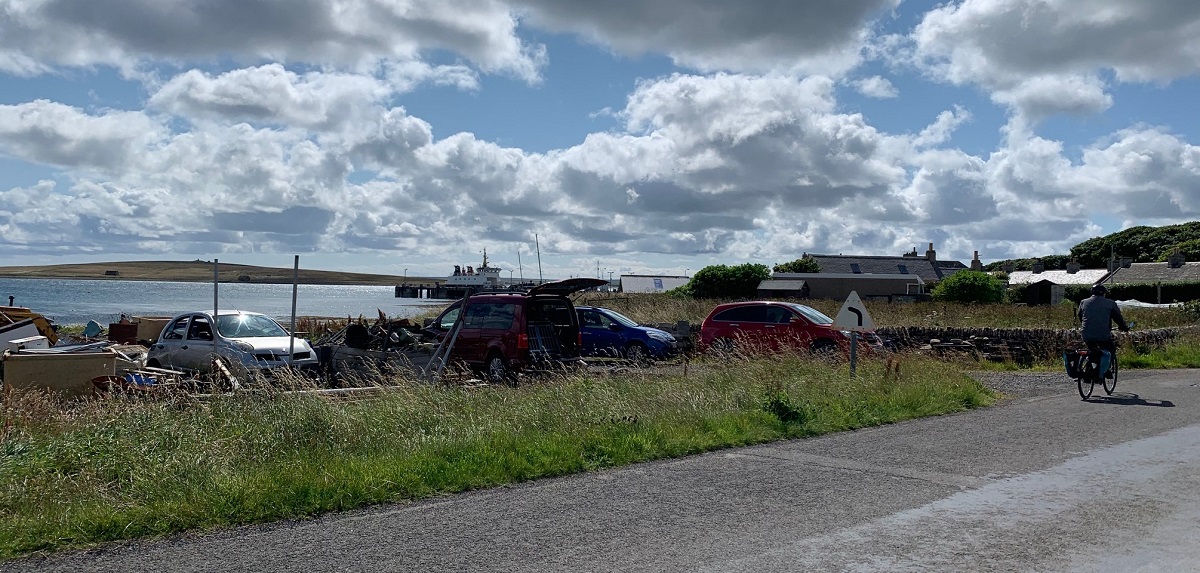
Lack of affordable housing and depopulation – two issues intertwined – and if not addressed leads to communities becoming unsustainable.

Scottish Government Housing Minister Paul McLennan visited Shapinsay to meet members of the local development trust and find out more about a range of local housing projects being taken forward on the island. He was joined on the visit by Orkney Constituency MSP Liam McArthur LibDem.
The visit was hosted by SDT Chair, Ashley Boyd and SDT Manager, Lisa-Marie Muir were able to show the Minister and his officials the outcome of recent projects delivered in Balfour village, including the refurbished Smithy Café, which has proved enormously successful since it reopened, popular with visitors and local residents alike.
Over coffee in the café, Ashley and Lisa, along with SDT Finance Director, Davie Campbell talked through the plans for further ambitious projects in and around the village, opening up opportunities to attract and retain population on the island.
Discussion also focussed on what support Scottish Government and its agencies, as well as Orkney Islands Council might usefully offer to support these and other projects, not just in Shapinsay and the other isles but across Orkney as a whole.

Commenting on the visit, Liam McArthur said:

“There is a growing housing crisis across the country, with demand for almost all types of housing outstripping supply. As ever, though, there is a specific islands dimension to what we are seeing nationwide, not least with significantly higher costs on the smaller isles and difficulties in attracting labour.
“However, it was really encouraging to see what is happening in Shapinsay, where the local community is taking a lead in trying to address their current and future housing needs. There has been an impressive amount of creativity as well as a lot of hard work, which is really starting to deliver results. That is something we are also seeing in other island communities, whose needs may be similar but which require a tailored approach.
“It was clear the Minister and his officials were impressed by what they saw and that Orkney is taking a lead when it comes to finding innovative ways of identifying and meeting local housing needs. However, going forward this will require sustained support from the Council and Scottish Government, but Shapinsay is demonstrating what can be achieved when this happens.”

Shapinsay has a population of just over 300 and is a short ferry journey to Mainland. There is a primary school but for secondary education the students study at Kirkwall Grammar School. Many people in Shapinsay travel on the ferry to Mainland daily for work.
Scotland as a whole, like Orkney, has an ageing population, which itself brings about issues in the provision of public services, especially in health and social care. It is essential that young people and families are able to remain in the islands but also to encourage others to come. A lack of affordable housing makes this very difficult to achieve on the scale it is needed.
The Scottish Government has a Depopulation Fund. In the latest round of funding it is being targeted at the areas worst affected by this trend. £180,000 of the Addressing Depopulation Fund has been provided this financial year by the Scottish Government for Community Settlement Officers in Argyll & Bute, Highland and Comhairle nan Eilean Siar, enabling them to continue supporting people living in or moving to those areas. Part-funding for these roles has also been put forward for the next financial year, as well as support for a Community Settlement Officer to be established in Inverclyde.
Migration Minister in the Scottish Government Emma Roddick said:

“The factors that lead to depopulation are complex and interdependent, and every place is affected differently. This plan cuts right across government – in policy areas including housing, healthcare, transport and education – to help deliver solutions that address the needs of individual areas.
“Local leaders, councils and organisations are the people who know their communities best – that’s why this plan commits to channelling community expertise and backing a range of local-led initiatives. This will not only benefit the places leading these projects, but could also generate learnings that can be applied elsewhere.
“Bringing together new actions with a programme of ongoing government work, these steps will underpin our work to ensure every place in Scotland is equipped with the population it needs to thrive into the future.”
The funding is to support the Scottish Government’s Addressing Depopulation Action Plan. Power over migration is retained by the UK Government.
Scottish Labour Rural Affairs, Islands and Land Reform Spokesperson Rhoda Grant MSP has welcomed the plan but also has criticisms of it. She said:

“More homes, jobs and services in rural communities is central to stemming depopulation. Having modern and fit-for purpose infrastructure is essential to attract families and businesses. This new strategy sets out the importance of this yet fails to make clear commitments on how to improve things beyond previously announced policies.
“This new Government strategy contains very little new information. There is a host of old commitments and rehashed ideas, with a promise to further explore and engage with groups to find solutions. This was a missed opportunity to take action rather than further consultations and taskforces.
“For rural communities to have faith in this government, it is important now to turn the words into action; deliver not delay is the message.
“Although very delayed, I welcome this publication. It sets out in black and white why people are leaving rural areas and what factors affect people moving in. The fact that this plan will create a population impact assessment and make available some funding is a signal in the right direction. There was scope for introducing new polices based off recommendations and evidence gathered yet there is a familiar statement of further engagement, discussions and more consultation. This strikes of inaction and will further delay meaningful interventions.”

Click on this link to access: Supporting and enabling sustainable communities: action plan to address depopulation
Projections show that Scotland’s population is set to fall and with fourteen local authority areas projected to experience population decline over the next decade. Schemes which will retain young people and families are within the powers of the Scottish Government and Local Authorities. When it comes to the wider issue of migration, however, that is a power firmly held in the hands of the UK Government.
Fiona Grahame

Leave a Reply