
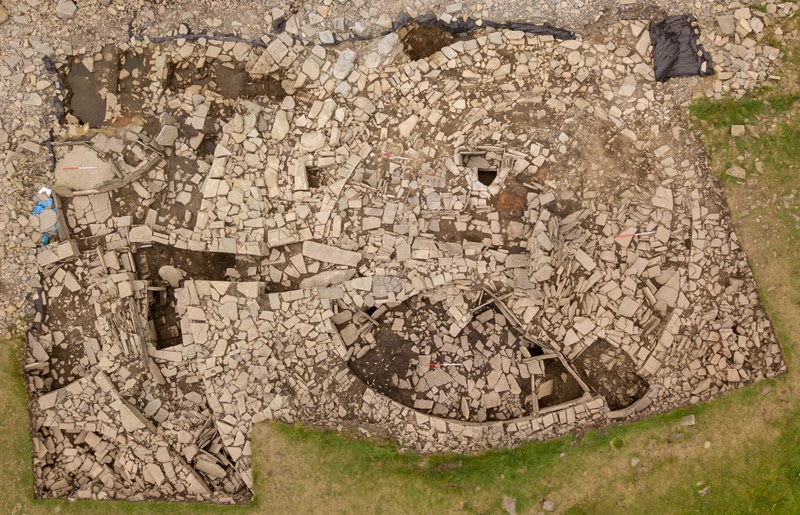
The Ness of Brodgar excavation in Orkney has been named Research Project of the Year at the Current Archaeology Awards.

At the 2024 awards ceremony in London on Saturday, project director Nick Card was also awarded the title Archaeologist of the Year.
Both awards were collected on behalf of the Ness by Time Team stalwart and geophysicist John Gater.
John was responsible for the initial phase of the geophysical surveys which detected the presence of the large Neolithic complex on the Ness of Brodgar – a discovery he hailed “the main highlight of his career” in 2023.
The Ness of Brodgar excavation is located between the Standing Stones of Stenness and the Ring of Brodgar in the Heart of Neolithic Orkney’s UNESCO World Heritage site. The excavation has uncovered a complex of monumental Neolithic buildings, dating from around 3300BC to 2400BC, flanked by a pair of massive stone walls. The size, quality, and architecture of the structures, together with evidence for tiled roofs, coloured walls, decorated stone and stunning artefacts have seen the Ness hit headlines across the world regularly over the past two decades

2024 marks a major milestone in the history of the multi-award-winning project, which is managed by the Ness of Brodgar Trust in partnership with UHI Archaeology Institute.
Commenting on the awards for the Ness of Brodgar Nick Card said:
“We were up against extremely fine archaeologists and projects, so are both delighted and humbled by this recognition.
“To receive two awards is a great accolade to all the hard work that the Ness team has put into the project over the past 20 years and a fitting celebration to mark the end of two decades of excavation. Both, I feel, are for the whole team and thank you to everyone who voted and deemed us worthy of these awards.”
Excavations at the Knowe of Swandro, in Rousay, Orkney, were also recognised at the awards, named Rescue Project of the Year 2024.

The Swandro dig is run by the Swandro-Orkney Coastal Archaeology Trust and the University of Bradford with additional research support from Historic Environment Scotland.
Dr Julie Bond, from Bradford’s School of Archaeology and Forensic Sciences, said:
“This is a national award voted for by the public and so it’s fantastic because it demonstrates universities have a role to play in field archaeology and in making a major contribution to the subject, especially as it relates to rising sea levels, coastal erosion and climate change.”
The Knowe of Swandro was once a large settlement occupied from around 1000BC to AD1200 and consists of Iron Age roundhouses, Pictish buildings, a Viking settlement and a Norse Long Hall, and is considered an area of extreme importance due to the insight the dig can provide on the use of existing sites by Scandinavian settlers.

Dr Stephen Dockrill added:
“This award is both a recognition for the work we are doing and the fact we are losing knowledge to the sea through coastal erosion, and once it’s gone, it’s gone.
“This project is also being used as a test-bed for cutting edge technology, such as 3D imaging, and of course, it is fantastic for our students, who get the chance to work on a real archaeological excavation.”
The prestigious Queen’s Anniversary Prize was awarded to the University of Bradford in 2021 for their world-leading work in developing archaeological technology and techniques, and its influence on practice, policy and society.
Between them, the two Orkney projects took three of the four Current Archaeology awards.


Leave a Reply