
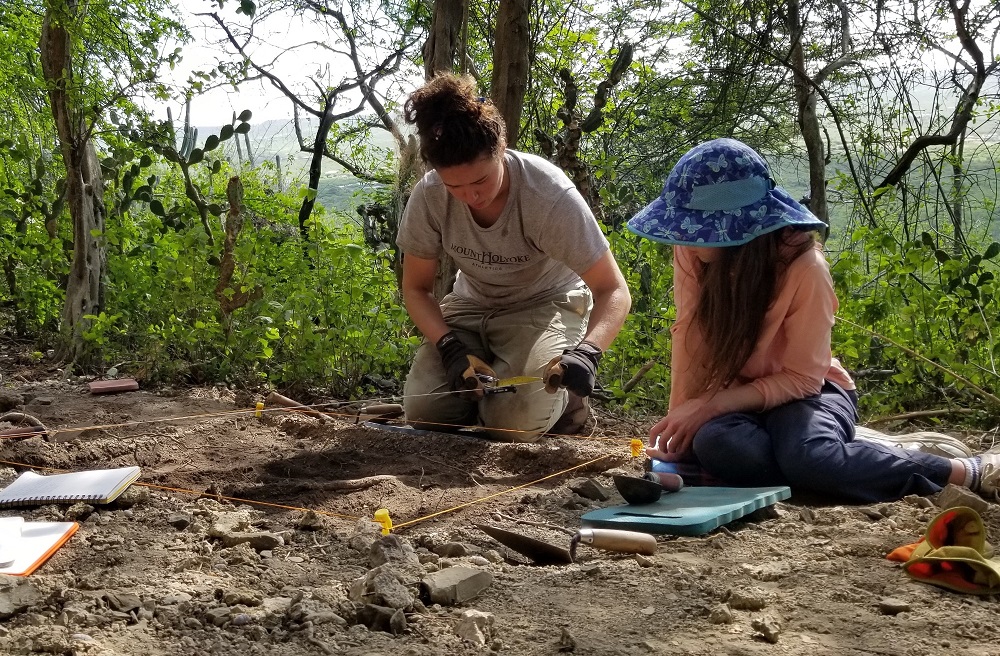
People have been living on the island of Curaçao for thousands of years and new archaeological research indicates that the exploration of the islands off the western Venezuelan coast began earlier than previously known.

Curaçao is an island in the Caribbean Sea and a country within the Kingdom of the Netherlands. The Empire builders of Western Europe still have these remnants dotted around the world. Curaçao is situated off the Venezuelan coast and was first settled by white Europeans in 1499, firstly by the Spanish and then by the Dutch as part of the Dutch East India Company.
The new research co-led by Simon Fraser University (Canada) and the National Archaeological Anthropological Memory Management (NAAM Foundation) in Curaçao, tells the story of human occupation of the islands well before the white Europeans took it over .
It’s part of the Curaçao Cultural Landscape Project which has been researching since 2018 to understand the long-term biodiversity change of the island, and its relationship to human activity. The project also works to increase local capacity for archaeology on the island, create opportunities for the sharing of knowledge and bring awareness to the depth of history of the area.
The date of human activity can be traced as far back as 5735 – 5600 cal BP ( The term cal BP means the number of years before 1950) . The date pushes back human occupation up to 850 years earlier than previously thought.
Christina Giovas, an associate professor in SFU’s Department of Archaeology and co-lead on the study, explained that the settlement of the Caribbean and the origin of its peoples is still highly debated.
“What this new information does is push the initial exploration in this region back to a time where other islands to the north of Curaçao are also being settled. This suggests that the movement of people from the continental mainland into those more northern islands might have entangled with some of the movement of the people into Curaçao.”
This indicates that the exploration of the islands off the western Venezuelan coast began earlier than previously known and provides a baseline for studying human-environment interactions in the area.
According to NAAM Deputy Director, Claudia Kraan, who also led the study, the finding demonstrates to the local public that further research can unveil new insights into the people who once inhabited the island. She said: “archaeological information is dynamic, continually evolving with ongoing exploration and analysis.”
The updated timeline was determined by radiocarbon dating charcoal collected from an Archaic period site at Saliña Sint Marie, what is now the earliest known archaeological site on the island, using accelerated mass spectrometry.
The team plans to return to Curaçao again in 2025 as part of another SFU international field school to dive deeper into how humans have transformed the island throughout time, and the lessons we can learn for future conservation efforts.
The use of Curcao by the Dutch East India Company was as a base for trade. The island developed a major sugarcane-plantation economy under Dutch colonial rule. As the slave trade boomed the islands were opened up for all countries to bring in products for the South American plantations. Britain was interested in acquiring Curcao as it continued its expansion of Empire and exploitation, resulting in military conflict between the two western powers. Since 1816 it has remained under Dutch control.
In 1845 Curaçao was one of the six Dutch dependencies in the West Indies that were brought under collective administration. Those dependencies were reorganized as the Netherlands Antilles in 1954 and granted autonomy in internal affairs. In 2006 the people of Curaçao, along with those of the other islands and the Dutch government, agreed to dissolve the Netherlands Antilles. On October 10, 2010, Curaçao and Sint Maarten became—like Aruba, which had separated from the Netherlands Antilles in 1986—countries within the Kingdom of the Netherlands. Britannica
Click on this link to access, Radiocarbon dates from Curaçao’s oldest Archaic site extend earliest island settlement to ca. 5700 cal BP, published in The Journal of Island and Coastal Archaeology
Along with SFU and the NAAM Foundation, the team includes partners from Max Planck Institute of Geoanthropology, University of Queensland, and InTerris Registries. The research was supported by Social Science and Humanities Research Council of Canada (Insight Development grant #430-2020-00177) and National Geographic Society (NGS-75166R-21) funding awarded to CMG.


Leave a Reply