
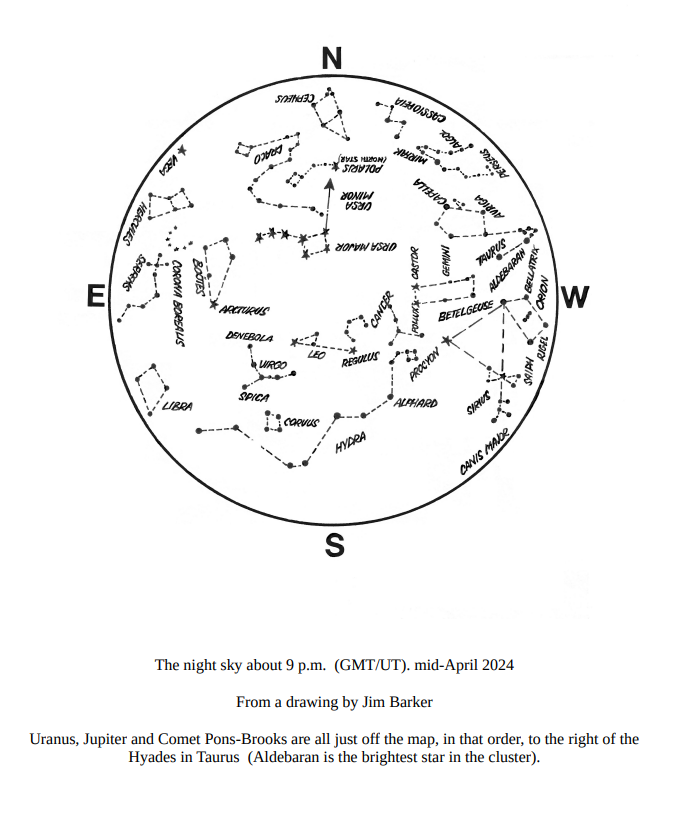

The Moon will be New on April 8th, and Full on April 23rd. The Moon passes Jupiter on the early evening of the 10th, and no other visible planets. Next month, unusually, there will be no planets visible in the morning and evening sky. The April issue of Astronomy Now urges us to take the opportunity to spot the crescent Moon as soon as possible after the 8th, because soon after the spring equinox the Moon’s orbit makes a large angle with the horizon, and the Moon will be much lower in the sky around the Autumn equinox in September.
On April 8th there will be a total eclipse of the Sun on a track crossing North America, and if they don’t check for updates, some people who expect to see it may miss it. According to an article in EarthSky on April 2nd (Dave Adalian, ‘April 8th Eclipse Maps Are Wrong Along the Edges’, quoting one by James Carter on Forbes.com (‘Why Your Total Eclipse Map Is Now Wrong (and Where to Find the New One)’, March 30th), the apparent diameter of the Sun has been remeasured and found to be greater than previously measured, by 0.02 arc seconds. It narrows the eclipse track by approximately 2000 feet (Fig. 1), very little when the track is 115 miles wide, but enough to make a big difference in the Cité Jardin of Montreal, for example, where the park—where many people may go to watch from the Olympic Village and the Olympic Stadium – will now lie outside the track (Fig. 2). I’m giving the full references for this story because the revised map was issued on April 1st, and if the articles it accompanies hadn’t been published on March 30th and April 2nd, one might have one’s doubts.


There’s growing excitement about whether Venus, Jupiter and Comet Pons-Brooks will be visible during it, all of them near the Sun (Fig. 3).

Images of the comet near the M31 galaxy in Andromeda, which is visible to the naked eye in good conditions, suggest that it might be (Fig. 4).

The comet has had outbursts, on July 20th (Fig. 5), October 5th, November 1st and 14th, December 14th and January 18th, bringing it to near naked-eye brightness. It may be visible from here at predicted maximum brightness, in Taurus, low down in the west on April 21st, after passing below Jupiter on April 12th,and I’ve heard from a friend in Australia who has high hopes, literally. Closest approach to Earth will be on June 2nd, when it will no longer be visible from here.

The planet Mercury is invisible this month, as are Venus and Mars, still out of sight beyond the Sun, and as all the planets will be by the end of next month. Mercury reaches inferior conjunction on this side of the Sun on April 11th, and although the April edition of Astronomy Now suggests that it might be visible at the beginning of the month, as usual serious caution is needed if searching for it so near sunset.
Jupiter, in Taurus, is moving towards the Hyades cluster, setting at 10.00 p.m., and the Moon passes Jupiter on March 10th, when Uranus will be 2 degrees above the Moon to the left. On March 14, Jupiter and Uranus were at heliocentric conjunction – in the same direction as seen from the Sun – for the first time since April 21, 1941, just under 83 years ago. On April 20th they reach conjunction as seen from here, separated by the diameter of the Full Moon.
There’s an argument going on about the composition of the seafloor on the ‘water moon’ Europa. The James Webb Space Telescope has confirmed the existence of oxygen, emanating from water deposits on the surface, but there’s not as much of it as expected. It suggests that the ocean floor, up to 200 miles below Europa’s ice crust, may be a solid plate without the volcanic vents which might support the evolution of life, and there may be fewer outbreaks to the surface than anticipated, with less possible evidence of life for NASA’s Europa Clipper probe and ESA’s Jupiter Ice Moons Explorer (JUICE, now en route) to find when they get there. But outbreaks do occur: they’ve been detected from here, and the Galileo spacecraft flew through one of them in 2014. But for them, Europa would be covered in sulphur from the volcanoes on Io, the next large moon inward. Sulphur is found along the cracks in Europa’s ice, and it’s not clear whether those are recent deposits or whether it migrates towards the cracks and into the interior, again possibly forming an energy source for life. The argument continues.
Saturn, in Aquarius, is already no longer visible. It’s increasingly clear from the data compiled by the Cassini Saturn orbiter that there’s sub-surface water below the south pole of the icy moon Enceladus, erupting in geysers due to tidal forces and resurfacing the hemisphere of Enceladus nearest them. The difference between the two hemispheres was striking even in the images obtained by the Voyager spacecraft in 1980-1981, even though the closest images were lost due to a temporary jamming of Voyager 2’s camera platform. Cassini’s flybys through the plumes identified salt and organic compounds, though it wasn’t possible to identify them, but it could be done with the right instrumentation and calls for a follow-on mission are growing. (Matt Williams, ‘What Can We Learn Flying through the Plumes at Enceladus?’, Universe Today, March 13th 2024.)
Uranus, on the left side of Aries, sets at 10 p.m.. Uranus appears near the Moon on the 8th.
Neptune too has disappeared from the night sky for now.
The Lyrid meteors from Comet Thatcher (no relation) peak on the night of 22nd/23rd April, but will be spoiled by the Full Moon, (‘ruined’ according to Nigel Henbest’s Stargazing 2024).
Duncan Lunan’s recent books are available through Amazon. For more information see Duncan’s website, www.duncanlunan.com.
You can download a copy of the star map here:

Leave a Reply