
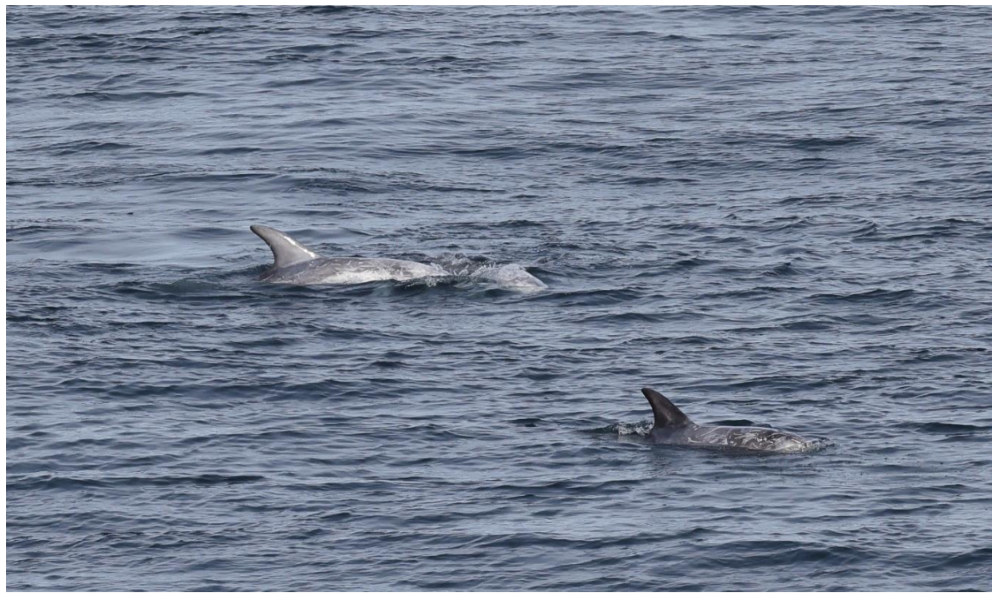

Sightings made of Risso’s dolphins off the coasts of North East Scotland, Orkney and Shetland by members of the public are adding valuable insights and contributing to new research being undertaken by marine charity, Whale and Dolphin Conservation (WDC).
The research, published in Frontiers in Conservation Science, found that whilst Risso’s are most likely to be seen in July, August and September, these visually striking dolphins are in fact present all year round in northeast Scotland, Orkney and Shetland.

Sightings of Risso’s dolphins have also increased significantly over time, particularly from 2020 onwards. For example, in 2011 there were 75 sightings reports, increasing to 525 sightings reports in 2021.
Following the publication of two Risso’s Dolphin Photo ID catalogues in 2022, this research has analysed 1,884 photographs and 1,867 historical sightings records, the earliest dating back to 1933.
The publication combined and analysed sightings made by members of the public to many different organisations and programmes, including: WDC, Sea Watch Foundation, Shetland Cetacean Group, the Cetacean Research and Rescue Unit (CRRU), ORCA, Orkney Marine Mammal Research Initiative (OMMRI) and NatureScot.
Recognising individual dolphins from photographs is possible because Risso’s have distinct scars and marks on their dorsal fins and bodies, allowing individuals to be identified and recognised again and again – some for well over a decade. Reviewing the photographs, the research found that individual dolphins return to the same areas time and time again and are often found hanging out with the same social group.

Additionally, some individuals had travelled long distances over the years, with one Risso’s dolphin photographed in Caithness in 2010, Sumburgh Head Lighthouse (Shetland) in 2014 and has since been photographed off Orkney in 2023. The data collected is already being used to better protect whales and dolphins – last month, Important Marine Mammal Areas (IMMAs) were created for Orkney and the Pentland Firth, Shetland and Fair Isle.
Emma Steel, Shorewatch Coordinator, explained:
‘Risso’s dolphins are incredible creatures and to protect their long-term future, we need to better understand where they go and how they use different habitats. This research wouldn’t have been possible without members of the public getting involved in citizen science projects like WDC Shorewatch, reporting their sightings and sending in photographs.’

Andy Knight, Shorewatch Volunteer, said:
‘Being a WDC Shorewatch volunteer has given me some unforgettable experiences with Risso’s dolphins. I’m proud to have supplied identification photos to help further our understanding of Risso’s distribution and contribute to greater protection for these unique, social dolphins’.
If you are lucky enough to take any pictures of Risso’s dolphins, please get in touch with WDC(northernisles@shorewatch.org) and your images might appear in future revisions of the catalogues.
It’s thanks to WDC supporters, WDC Shorewatch volunteers, fellow researchers and members of the public, that this research on Risso’s dolphins has been possible – and highlights how incredibly valuable community science can be to further our understanding of these species.
Click on this link to access Using citizen science to better understand Risso’s dolphin (Grampus griseus) presence in northeast Scotland and the Northern Isles




Leave a Reply