By Bernie Bell.

There’s presently a lot of discussion about visitors to the Neolithic Heart of Orkney pooing and peeing around and in what is a very special place. 

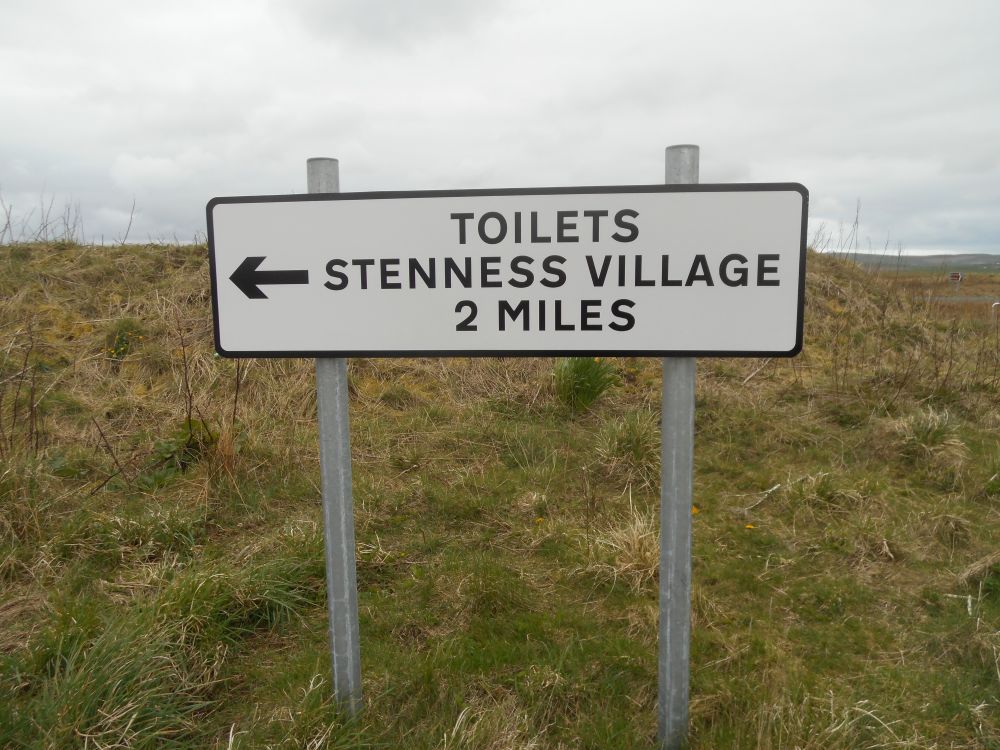
When visitors to the Ring of Brodgar park in the car park they’re shown that they can use the facilities in Stenness Village (Paddington Bear reference)

the toilet sign at the Ring of Brodgar

But that is 2 miles away, and it’s just one public toilet, next to the Maes Howe Visitor Centre.

It would be impossible to actually  build a public toilet in the Brodgar car park as it’s a very sensitive area archaeologically and the necessary connection to mains drainage/electricity is out of the question. 

A ‘Portaloo’ as used at music festivals might be a possibility, but if there isn’t a company in Orkney which could supply that facility, getting one in and maintaining it could be costly.

I don’t have a solution – the best I can think of is a ‘Portaloo’.

But…this got me thinking about what happened in the Neolithic at certain times of year when hundreds of people converged on the area on pilgrimage? 

At Skara Brae, there are rudimentary toilets in some of the structures,  connected to drains.  Drains have been found at the Ness – but no sign of what might have been toilets.  And, to cope with the numbers they would need to be sizeable, public toilets.

There was too much going on and there were too many people there for it to be possible to nip into a field to relieve yourself!

So…..I’m wondering what happened back then?  How did the Neolithic Heart of Orkney cope with a lot of visitors, needing facilities?  Could this be a possible subject for an archaeology student’s Dissertation?

It’s  another example of when it would be good to be able to talk with someone who had been at the Ness when it was functioning as a pilgrimage centre

though it might be in indelicate subject to mention at a dinner party!

The one-off dig at the Ness this summer is because  geo-physics for something unusual has been found.  I’m playing with the idea that it might be a structure which could have answered this need?

To get down to the nitty-gritties….if such a structure is found, with accompanying coprolites – think of what that might tell us about  the life of the people back then!  As I’ve said previously, it’s not all about the glamorous finds

Thoughts about the drain, discovered at the Ness

   Bernie Bell August 2015

5 responses to “‘Facilities’ At The Ness Of Brodgar?”

  1. Come on. There is absolutely no need for waste and electrical connections. The ‘waste’ can be stored and then taken away by tanker. Plenty of tankers in Orkney. Electricity is minimal and can be provided with micro-generation and batteries. The electrical requirements would be very little if optimised. Skylights can provide most of any illumination needed during the day. And the batteries at night with low energy fittings. There is no need for potable water and fairly clean water can be provided by rain harvesting and tanker deliveries during the busier parts of the season (from other harvest locations). Using filters and UV filtration. Although not drinkable, it is good enough for flushing and hand washing. And to reduce the visible impact, the whole building can be set into the ground, or there are plenty of self-hiding toilets in the world which would work very well in this setup. Is there no one with a decent brain in the ‘system’? You are going to have to spend money on the issue, accept that. Just get down and solve it. You need a couple of real engineers on the project team, not a bunch of Nimby’s, pen pushers and do gooders that have got nowhere in 5yrs.

    1. berniebell1955 Avatar
      berniebell1955

      I have absolutely no say in the matter apart from voting for Councillors who I think might help HES to take sensible action, and being a member of HES – tho’ I don’t see how I can influence their actions as they appear to mostly go their own sweet way. I realise that you’re not directing your impatience at me, personally – but it kind-of reads as though you are!

      I was with you until your last couple of sentences – but never agree with gratuitously calling names.

      Good to have got some discussion going though.

      Re. your suggested solutions – many years ago I visited the Centre for Alternative Technology near Machynlleth in Wales, where their toilets were much as you describe and worked just fine, even coping with a lot of visitors…..

      https://cat.org.uk/

      1. I’m not targeting you and I apologise for any offence caused. It is just the frustration of this issue going around and around. The name calling is indistinct and not aimed at anyone specifically, but a ‘committee’ that has stagnated for whatever reason – and this is what it looks like from the outside. Really if you have a ‘committee’ that has failed to produce anything better than a sign in 5ys of meetings, it should be disbanded and a new more focused, targeted and applicable group selected. This now requires specialist assistance, it has floundered for long enough now.

        The ideas at CAT are really good, although I have not visited for many years and (sadly), no longer open to the public, except by visiting an internal course at the site.

  2. berniebell1955 Avatar
    berniebell1955

    Fair enough.

    Re. the sign…..it’s a bit farcical – but I thought – at least it’s letting folk know where there IS a toilet!

    I didn’t know that CAT is no longer open to the public, it’s a long time since I was there, when I lived near-by. It was fantastic. I went to a music event in the geodesic dome…imagine…

  3. A composting toilet facility could be a good solution. Very little water and electricity required and no collection tanks to drain. But they would need to be emptied now and then. The contents would eventually be useable as compost however. Maybe not in a vegetable garden, but certainly in a field, the way animal compost is used. Something along the lines of what A. Sharp mentioned above.

Leave a Reply

Trending

Discover more from The Orkney News

Subscribe now to keep reading and get access to the full archive.

Continue reading