
The changing climate means that conditions are now more favourable in Scotland for various species that may prove to be harmful to native and well established ones.
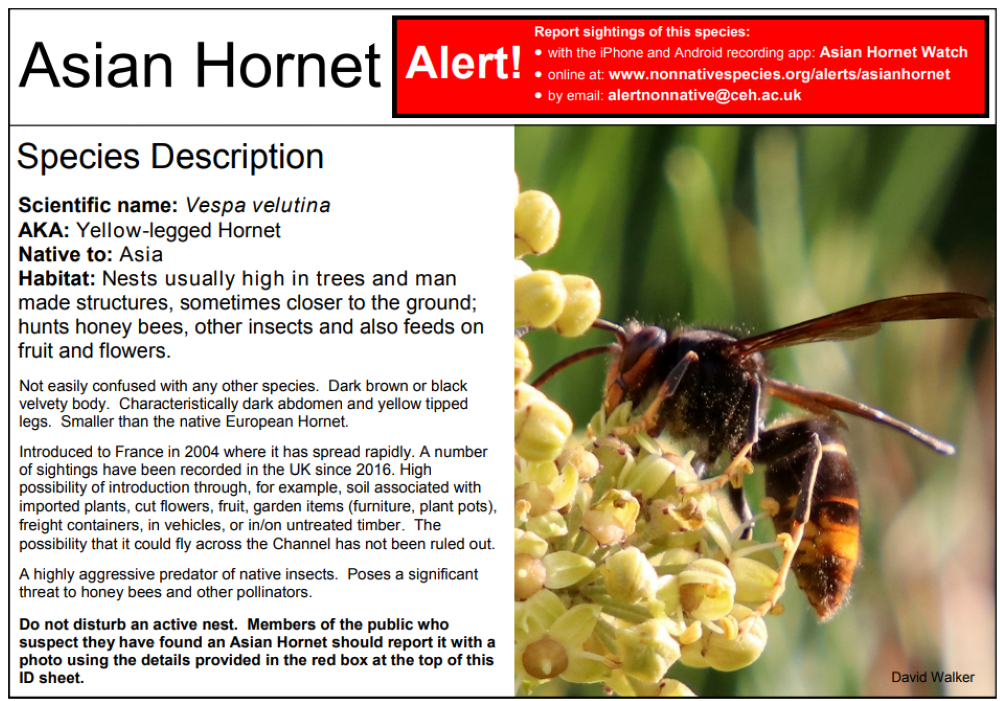
Yellow-legged Asian hornet
Bee keepers and members of the public are being asked to report sightings of the non-native Yellow-legged Asian hornet (Vespa velutina nigrithorax). These hornets are aggressive predators of several species, including honey bees and other pollinators.

Members of the public can report suspect sightings of Asian hornets to the Great British Non-Native Species Secretariat (NNSS), which has responsibility for helping to coordinate the approach to invasive non-native species in Great Britain. Sightings should be reported through the free Asian Hornet Watch App, available for Android and iPhone.
Other methods of reporting the hornet also include using the NNSS online notification form or emailing alertnonnative@ceh.ac.uk with the location of the sighting and a description of the insect seen and a photograph if it is safe to take.
Click on this link for more information: Asian hornet: pest-specific contingency plan

Agriculture Minister in the Scottish Government Jim Fairlie said:
“I am delighted to see the progress made by the Bee Health Improvement Partnership to help deliver our second 10-year Scottish Government Honey Bee Health Strategy.
“By developing a Contingency Plan to address any Asian hornet incursion in Scotland, we are well prepared to tackle and eradicate the insect before it has an opportunity to establish.
“We cannot underestimate the devastating impact this non-native predator has on honey bees and other insects, including important pollinators, and I urge people to be aware of what to look for and report any potential sightings.”
Click on this link for: Bee Health Improvement Partnership: annual report 2022 to 2023
Varroa
Another threat to our honey bees are Varroa mites. Varroa continues to be one of the main causes of honey bee colony losses in Scotland and is considered endemic in the UK except for the islands of Colonsay and Oronsay , nature reserves for Apis mellifera mellifera (Amm, Black Bee) and where it is prohibited to keep any honey bee other than a black bee (Amm) in these islands.
2023 saw unprecedented levels of both American and European Foulbrood outbreaks in Scotland. BeeBase is the Animal and Plant Health Agency’s (APHA) National Bee Unit (NBU) website. The Scottish Government has a dedicated web page on honey bee health which contains guidance on policy, diseases and pests, legislation and inspections.



Leave a Reply