
By Kim Twatt
Exploring Cultures
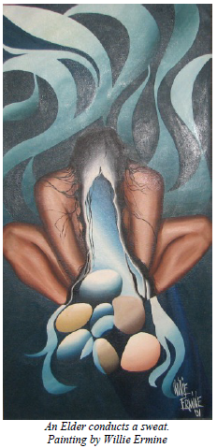
While visiting the youth camp at Sturgeon Lake, Robert Ermine had explained the sweat lodge to us and its role in the lives of the people. While we chatted I had noticed a pile of burnt stones close by the lodge. These stones had been blessed and used in the lodge as part of the ceremony. They reminded me of Orkney’s two hundred or so ancient burnt mounds. Back home in Orkney, as I spoke to Arlene Isbister about the Minehowe Knowehow Iron Age project she was organising, I wondered whether she might want someone from Canada to try to explain the possible origins of Orkney’s burnt mounds. The Chief at Sturgeon Lake put Arlene in touch with Professor Willie Ermine from the Saskatchewan Indian Federated College. With his son, Charles, Willie came to Orkney.

As I drove the jet-lagged Ermines out of Kirkwall to gather the materials for the building of a sweat lodge Willie asked if I knew the sort of trees he required. I reassured him best I could. A couple of miles further and he asked tentatively whether there were any trees on Orkney. I reassured him again and swung the car and rattling trailer into the beautiful terraced garden belonging to the late Mrs Daphne Lorimer in Orphir. Willie gasped, we can’t cut these. This is someone’s garden. I reassured him again and Mrs Lorimer waved enthusiastically from her window. A friend arrived with a chain saw and Willie selected the first tree. Peter swung the chain saw ready for action but noticed, just in time, that Willie was praying and making an offering of tobacco to the earth. The Ermines constructed the sweat lodge at Minehowe in Tankerness using willow from the garden in Orphir and stones from the beach at Inganess. Willie conducted a sweat which I was fortunate to be able to attend. With no idea of what to expect at all, I emerged very relaxed and any problems or anxieties now in perspective. In the lodge I had thought of the elders we had met at Sturgeon Lake, in particular, Harold Kingfisher and Robert Ermine. Imagine my surprise when I returned to the house, the phone rang, and it turned out to be those two gentlemen phoning from the Band Office at Sturgeon Lake. This was the one call I ever had from them.
Willie Ermine described his paper, written following his visit as:
a cursory idea in terms of attaching some significance to this convergence of world views. Broadly speaking, he continued, I want to say that the mission to uncover the unknowns of our human existence is consistent with our personal need to search for soul and spirit. The experience of the sweat lodge teaches that uncovering our sacred resources and giftedness we each possess may be the way to our knowing. The forces of heat, steam, the rocks, the air, all encapsulated in the utter darkness of the lodge recreates that moment of the great potential, the primordial moment within each of us. They are the same forces that take us to the access routes to our inner landscapes of the soul. The events of that week at Minehowe, he stated, seemed to speak of much more than just a scientific glimpse at the past.”
Willie Ermine’s paper, The Cree First Nation’s Sweat-lodge appears in Sea Change, a collection of papers published by The Pinkfoot Press following the Iron Age Conference held in Orkney in 2002.

Coming next in Part 12 Pilgrimage to Orkney
In case you missed it: Full Circle:An Orkney family reunited after 200 years separated by distance and culture (Part 10)

Leave a Reply