
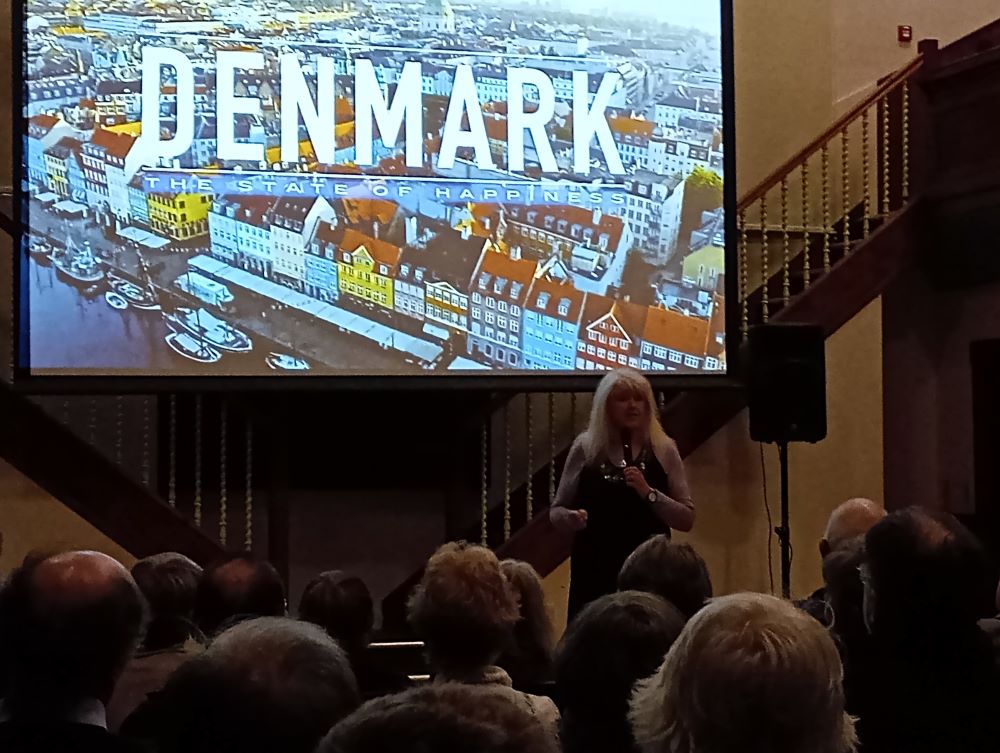
It was a Full House on Monday 27th May in Stromness Town Hall, where folk gathered for the Orkney showing of ‘Denmark: The State of Happiness’, a film by Lesley Riddoch.

The film is a positive documentary-style presentation with Lesley Riddoch exploring parts of Denmark including the capital Copenhagen and the island of Samsø, interviewing various individuals on the way.
The northern European nation of Denmark has a population of 5,935,619. A mostly flat and fertile landscape it consists of many islands, some of which are connected via fixed links, others by ferry.
Denmark has a written constitution and a constitutional monarchy. It is a member of the European Union. The film dealt a lot with the politics of Denmark with a government elected through proportional representation. The film stressed the consensual nature of politics and the importance of local decision making.
Education was also a main component of the film. Happy young children were seen playing at Kindergartens aimed at developing social skills and citizenship from an early age. Further education was also covered in residential schools and ones which focus on outdoor pursuits and the Arts.
The island of Samsø is a model renewable energy community with 100% of its electricity coming from wind power and biomass. It uses a District Heating Model to provide the homes on the island with their electricity needs and individuals are encouraged to take out shared ownership of wind turbines. It exports its excess energy to mainland Denmark generating extra income for the island.
Back in Copenhagen the film extolled the virtues of the city’s transport layout with dedicated lanes for cyclists and pedestrians. Many people cycle – 49% of Copenhageners commute to work or studies on a bike. No doubt the flatness of the landscape helps but the city has been designed with safety and cycling in mind so for those wishing to cycle they don’t even see the need to wear a helmet.
Of course, there were aspects of Danish society which the film did not cover, or which it skipped over. One of those issues was of Denmark’s attitude to refugees.
Denmark — under Social Democrat Prime Minister Mette Frederiksen and her center-right predecessor Lars Løkke Rasmussen — has pursued some of the toughest immigration policies in Europe over recent years.
In the last decade, Denmark has integrated an increasingly harsh stance on immigration. In 2023, Denmark revoked residency permits for Syria refugees, declaring some parts of the war-torn country safe for return, before backtracking after international backlash.
In 2021, the country passed a law that could allow refugees arriving in Denmark to be moved to asylum centers in partner countries, such as Rwanda, a proposal which the European Commission criticized. It also looked hard at detaining asylum seekers on a remote island.
After the film Lesley Riddoch conducted a Q&A where she suggested the way forward for Orkney, and for Scotland, to take lessons from how Denmark has developed in: Education; Governance; and Renewables.
Danes pay a high rate of personal tax for the services they receive and some of those, including in early education, are means tested. In Scotland funded early learning and childcare is free to parents, with the funding coming from the Scottish Government. Scots can get up to 1,140 hours of funded early learning and childcare a year (around 30 hours a week in term time) if the child is 3 or 4 years old. Some 2 year olds are also eligible.
In the Q&A the collaborative form of community decision making used by the Danes was seen as a way forward for Orkney and Scotland. In March The Orkney News reported on the Community Land Scotland event in Kirkwall Powering Change With Community Right to Buy At that meeting the excellent projects in several of Orkney’s islands through community led developments was covered. The rest of Orkney and Scotland – even perhaps Denmark – could learn a lot from the folks in Shapinsay, Rousay, and Westray. Islanders in Shapinsay are responding to needs in housing, for example, using the revenues from community owned wind turbines.
It’s important to look at how other nations, and in particular those of a similar size to Scotland, respond to the challenges they face. It is also important to look at what we are getting right, or where we are on the right track, and to discover what best suits our communities.
Those who know that the best are the people who live and work in them. For that to happen the decision making has to be localised and from the bottom up. Many of the issues Scotland is facing like the cost of living crisis and climate emergency are not able to be dealt with under the limitations of the devolved settlement. Yes we can achieve small scale successes, as shown in our islands of Rousay, Westray, and Shapinsay, but for the fundamental changes required to respond to Scotland’s needs, devolution hasn’t got the teeth to do it, and for the UK Government, issuing new licenses for extracting oil from Scotland’s waters, their direction of travel will add to the climate emergency.
Scotland’s government and local authorities, have policies which support refugees and those seeking asylum. Migration, however, is a power retained by the UK Government, still intent on pursuing its policy of deporting those seeking refuge here to internment camps in Rwanda. Scotland not only has supportive policies towards migrants, it needs them, as the results of the latest Census shows. So yes, we can learn from other countries, but acting on those lessons and being able to deliver the actions required for them to be successful is limited by the devolved nature of our government.
Fiona Grahame

Leave a Reply