
Edinburgh abounds with museums and places of attraction so that when you visit Scotland’s capital any visitor, or local, has a diverse range to choose from.

The Museum of Scottish Fire Heritage, Dryden Terrace, off Leith Walk, is fascinating, not just for those with a connection to our Fire Services but for the stories it tells about the development of this Emergency Service. So much has changed since the early days of responding to the deadly destructive force of Fires in our communities, in the appliances used, the funding of the service, the role of the firefighters, and the nature of the work.
The museum is funded by the Scottish Fire and Rescue Service (SFRS) and they have done an amazing job of presentation. It is connected to an active Fire Station.
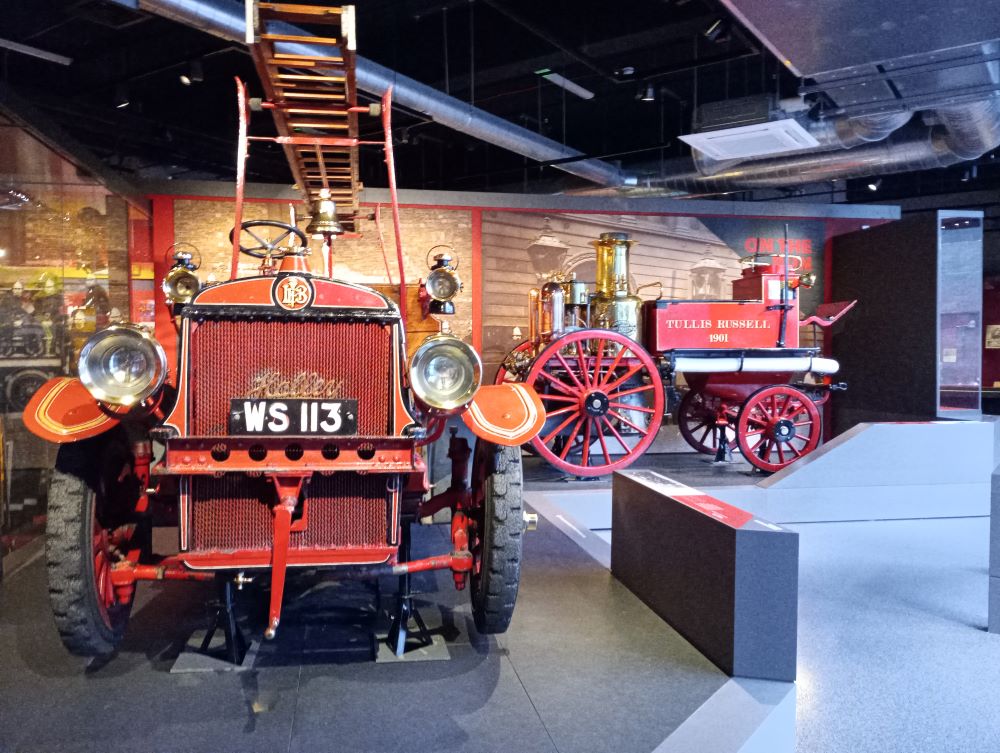
Dominating the displays are Fire Engines.
- Duns Fire Appliance 1806, initial cost £75 3s 3d
- Tullis Russell 1901, steam powered, horse drawn
- Leith Fire Appliance 1911, motorised

1806 Duns Fire Appliance. Cost £75 3s 3d 
Tullis Russell 1901, Steam powered and horse drawn 
Leith Fire Appliance 1911, motorised
The 1911 motorised fire appliances in Leith were used alongside the horse drawn ones. Leith Fire Brigade purchased two of the motorised engines in 1911 at a cost of £1000 each. Leith had these engines before the Edinburgh Fire Brigade. Leith was at that time independent of Edinburgh. An extremely busy port filled with crammed tenement buildings and bonded warehouses – a modern equipped Fire Service was essential.

The museum has an excellent display dedicated to James Braidwood.
James Braidwood (1800–1861) was a Scottish firefighter who was the first “Master of Engines”, in the world’s first municipal fire service in Edinburgh in 1824. The exhibit includes personal items of his work as a firefighter and an innovator of the service. He was the first director of the London Fire Engine Establishment (the brigade which was eventually to become the London Fire Brigade).

He died on 22 June 1861 in the Tooley Street fire at Cotton’s Wharf near London Bridge station when a falling wall crushed him, three hours after the fire began. It took two days to recover his body.
Another display cabinet recounts some of the other stories of firefighters who were injured or gave their lives in the course of their service.
The museum is a modern place of learning and there’s lots to keep all ages interested. The displays are well laid out with just the right amount of information to take in on a visit. For more information there are panels where you can select the items you would like to know more about. The Scottish Fire Service has an important archive of materials which it is hoping to fully digitise.
Getting around is excellent for anyone with mobility problems and at the visitor entrance helpful staff are on hand to answer any questions or assistance you may require.
This museum is FREE, however, you can make a donation. It is open Tuesday to Saturday. Check out the website and the Facebook page for events, including Bookbug for our youngest citizens.


Fiona Grahame





Leave a Reply