
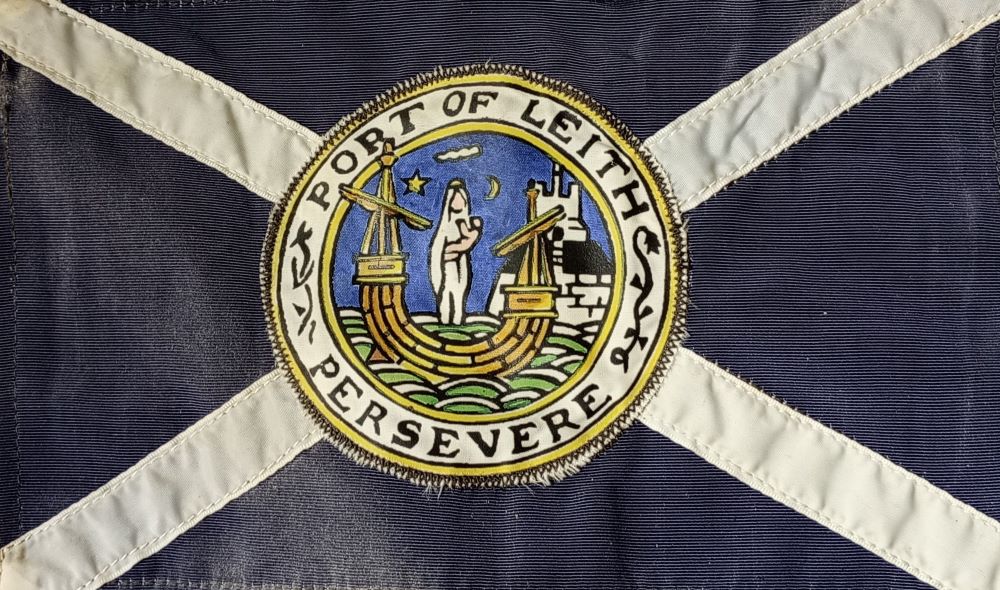
As the Scottish Boundaries Commission proposes to get rid of the Scottish Parliamentary Constituency of Leith, let’s take a brief look back at how this important port was once an independent burgh with strong and vital connections with Orkney.

Most Orcadians, and Shetlanders, will know of the Zetland Hall in Pilrig Street situated off Leith Walk where islanders and their descendants could meet up for functions and talks. The property bought in 1962 was eventually sold in 1983. The Edinburgh, Leith and District Orkney Association now holds occasional functions in the Thomas Morton Hall , Leith.
For trade, Leith was the port where regular sailings took place from Kirkwall and many Orcadians followed that same route travelling south for employment and some for education at Edinburgh University.

Sailing to Leith also took place from Stromness. In 1868 the cutter ‘Catherine’ under Captain James Miller, took passengers and goods to Leith.
With the arrival of Steamships there were even faster sailings.

The North of Scotland and Orkney and Shetland Steam Navigation Company had several steamships in the late 19th century: St Clair, St Giles, St Magnus, St Nicholas, St Rognvald, St Sunniva, Queen, St Ola and Earl of Zetland.

Leith was where Mary Queen of Scots landed in 1561 when she returned to Scotland. She stayed in Lamb’s House.
Lamb’s House is a merchant’s house of late 16th or early 17th century date (National Trust 1959). Both residence and ware-house were contained within this five-storey building of exceptional architectural quality. It was extensively remodelled internally and the windows enlarged in the 18th century; ruinous by 1937, restored in 1938 by the Marquis of Bute, whose son presented it to the National Trust in 1958, when further restoration took place.
Headland Archaeology was commissioned by Groves-Raines Architects to undertake a programme of recording at Lamb’s House, 19 Water Street, Leith. This report forms a basic written, metric and photographic record of the building. It is clear from the documentary work that the main structure of the building has stayed almost the same for the last 200 years. During this time the use of the property has changed and at times has been in a very poor state of repair. From being a rich merchant’s house from at least the 17th century by the turn of the 20th century it was occupied by a number of families and was derelict by the early 1930’s. Building repairs were then undertaken although still laid empty until it was converted into a day care centre in 1961. The work undertaken as part of the current project identified a number of features that had changed but found that the overall structure had not been altered from its original construction.
Tim Holden and Don Wilson (Headland Archaeology) August 2012. OASIS id: headland1-84347. Canmore
Between 1833 and 1920 Leith was an independent burgh when it thrived, and despite the objections from the people of Leith it was amalgamated into Edinburgh. What once had been a vibrant port and industrial centre went into decline which accelerated after World War 2.
In 1916 Leith was attacked by a Zeppelin raid on the night of the 2nd/3rd April. One of the bombs landed on a bonded warehouse. The resultant fire could be seen for miles around. Two people in Leith were killed. Bombs also fell on Edinburgh where there were more fatalities.
My own grandfather, Adam Grahame, served in the Leith Fire Brigade alongside many Orcadians, all ex-servicemen, who were ideal for the discipline needed to work in that service. My father was born in what was known as ‘Fire Brigade Street’ and grandad was called out to fight the fire in that Zeppelin bombed warehouse. His uniform was set ready to jump into even if he was roused from his bed. Houses and buildings in Leith were packed together. There were many warehouses that could easily go up in flames to the endangerment of lives and property. The Fire Brigade in Leith had the most modern equipment but very poor compared to today. The men who went in to tackle these fires were brave and selfless.
Leith suffered under plans to modernise housing and rid the area of some of its slums. Unfortunately many of those high rise buildings themselves became unpopular and unsightly. The heart was being torn out of the town. In 1983 the shipyard of Henry Robb Ltd closed. This brought an end to over 600 years of shipbuilding in Leith. Many parts of Leith have now become ‘gentrified’ , a fantasy of what they once never were. It seems that the great historical significance of Leith will witness the ultimate demise of its very name if the proposals by the Scottish Boundaries Commission sail through unopposed.

Want to find out more about Leith ? visit Leith Local History Society.
Fiona Grahame



Leave a Reply