
Review by Duncan Lunan

“Tell No Lies, Stories by John Grant”, The Alchemy Press, paperback, 343 pp., 2014.
First published in Interzone # 257, March-April 2015.
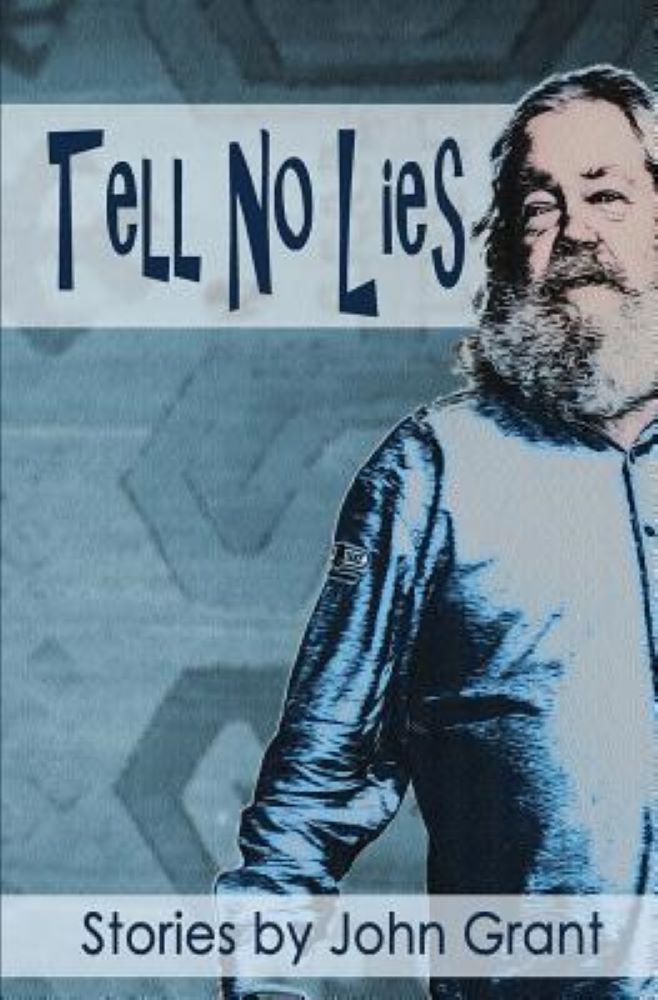
John Grant is the pen-name of Paul Barnett, whose portrait (unidentified) by Peter Coleborn forms the cover of this book, then his latest of over 70 (now over 80, in 2024). In 1978, when he was editing my New Worlds for Old for David & Charles Ltd, he was living in an 18th century house outside Newton Abbot in the village of Ashburton, which was memorable for bell-ringing and for its antiquarian bookshop. Neither of those feature in the similarly located ‘Tarburton’ of ‘Two-Stroke Toilets’, the story at the midpoint of this book, but the link to the past is real, a doorway to the 1958 of ten-shilling notes and amazingly cheap, leaded petrol. It echoes stories by Jack Finney, but with a much sadder ending. Three of these stories first appeared in Interzone, Black Static and The Third Alternative, which should let you know that nostalgia is not on the agenda,
Another story with a strong sense of place is ‘Has Anyone Here Seen Kristie?’, set at the Edinburgh Festival – as Ian Black says of that, “Imagine a whole city getting drunk and waking up with a Tattoo” (Who Wants to Be a Glaswegian?, 2002). The story ends on Arthur’s Seat in a manner reminiscent of Angus McAllister’s The Canongate Strangler, without the murders, but which will ring bells for anyone who’s gone through to the Festival and fallen into a temporary relationship.
The parallels with other writers are not here as put-downs: none of the stories is older than ten years, and though many of them begin with familiar situations, they take them in unexpected directions. The first, ‘All the Little Gods We Are’, begins à la Twilight Zone, with a man accidentally telephoning his own number and getting an answer. The next features an eponymous, second-rate superbeing called ‘Q’, but it’s set in our world; it provides what would be a rationale for a Prime Directive, in a more advanced civilisation, and it’s far bleaker than anything in Star Trek. ‘Baited Breath’ features miniature dragons, though in a suburban kitchen rather than on a distant volcanic world, and with a really good idea for how to ‘impress’ them. ‘Only One Ghost’ starts with a book signed by the central character, something he would never do, like a similar idea of Archie E. Roy’s about a letter he could never have written. ‘Lives’ begins with a boy miraculously surviving a car crash… but don’t let any of these openings fool you into thinking you know where the story is going, because the author has something new to say about each of them. There’s a common theme of relationships lost due to accident, murder, infidelity, time-slips and slides into alternative realities; one of those last ones, ‘Ghost Story’, was in Interzone # 251. The book’s overall title is a warning, and the message is ‘Be thankful for what you have’.
John Grant now lives in the USA, and many of the stories are set there or have US protagonists, convincingly rendered. ‘Commander Ginfalcio Beeswax and the Menace from Deneb’ is about the crushing of childhood imagination, and could be taken as a metaphor for how light pollution is cutting us all off from the wonder of the heavens. Otherwise I might be a little doubtful that even the negativity of “a successful Lutheran pastor before he lost his marbles and an even more successful one since” could convince both adults and children that there are no stars. The Bible to which he clings so tightly is full of astronomical references. The Victorian astronomer E.W. Maunder (best known for the sunspot minimum named after him) wrote a whole book called The Astronomy of the Bible, and not a few of the astronomy books that I bought in Ashburton were published by religious organisations.
‘Memoryville Blues’ is probably the most chilling story here, in which a failed musician turned serial killer gets his comeuppance in the afterlife. The central character of ‘His Artist Wife’ is also a murderer who wasn’t caught while he was alive, but he seems to get off lightly by comparison. For the biggest surprise of the book, though, the last story ‘Benjy’s Birthday’ comes close. The idea that our Universe is a classroom experiment has been done before, and this time it’s a home science kit – but the publishing credit is to Nature, no less.



Leave a Reply