
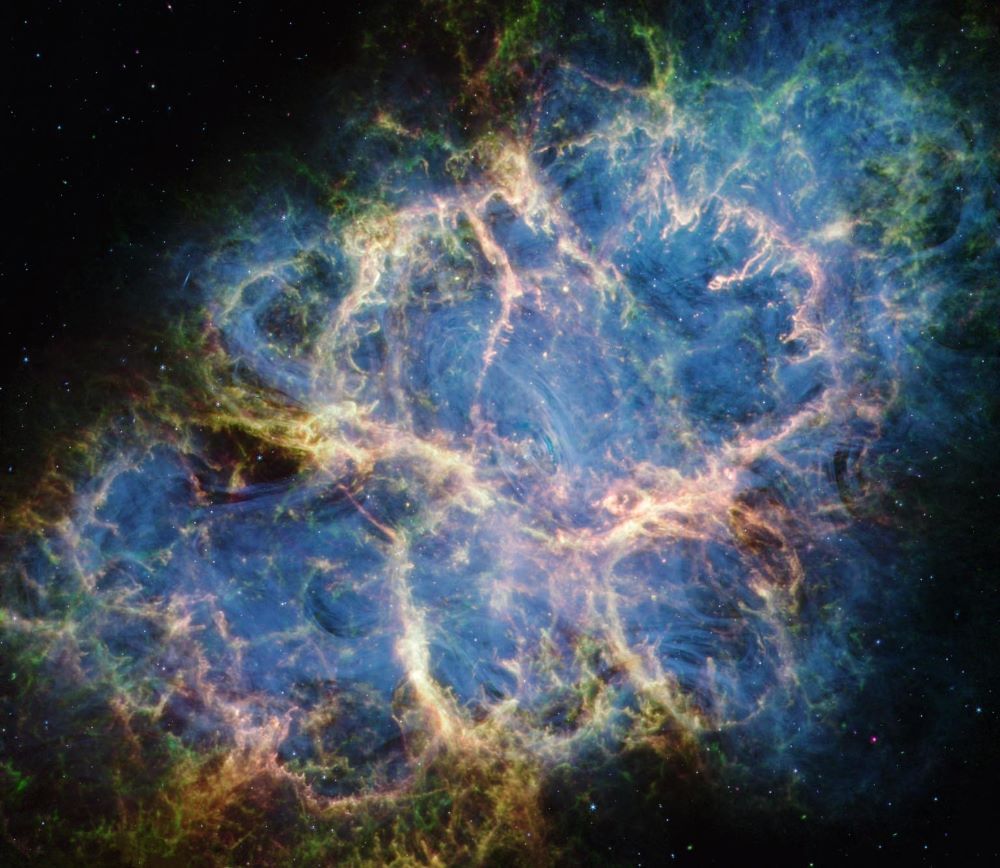

The Crab Nebula is the result of a core-collapse supernova from the death of a massive star. The supernova explosion itself was seen on Earth in 1054 CE and was bright enough to view during the daytime. The much fainter remnant observed today is an expanding shell of gas and dust, and outflowing wind powered by a pulsar, a rapidly spinning and highly magnetized neutron star.
The Crab Nebula is also highly unusual. Its atypical composition and very low explosion energy previously have been explained by an electron-capture supernova — a rare type of explosion that arises from a star with a less-evolved core made of oxygen, neon, and magnesium, rather than a more typical iron core.
A team of scientists used NASA’s James Webb Space Telescope to parse the composition of the Crab Nebula, a supernova remnant located 6,500 light-years away in the constellation Taurus.
“Now the Webb data widen the possible interpretations,” said Tea Temim, lead author of the study at Princeton University in New Jersey. “The composition of the gas no longer requires an electron-capture explosion, but could also be explained by a weak iron core-collapse supernova.”
The Webb telescope, with its sensitive infrared capabilities, is now advancing Crab Nebula research. The team used MIRI’s spectroscopic abilities to measure the nickel and iron emission lines, resulting in a more reliable estimate of the Ni/Fe abundance ratio. They found that the ratio was still elevated compared to the Sun, but only modestly and much lower in comparison to prior estimates.
Besides pulling spectral data from two small regions of the Crab Nebula’s interior to measure the abundance ratio, the telescope also observed the remnant’s broader environment to understand details of the synchrotron emission and the dust distribution.
The images and data collected by MIRI enabled the team to isolate the dust emission within the Crab and map it in high resolution for the first time. By mapping the warm dust emission with Webb, and even combining it with the Herschel Space Observatory’s data on cooler dust grains, the team created a well-rounded picture of the dust distribution: The outermost filaments contain relatively warmer dust, while cooler grains are prevalent near the center.
“Where dust is seen in the Crab is interesting because it differs from other supernova remnants, like Cassiopeia A and Supernova 1987A,” said Nathan Smith of the Steward Observatory at the University of Arizona and a co-author of the paper.
“In those objects, the dust is in the very center. In the Crab, the dust is found in the dense filaments of the outer shell. The Crab Nebula lives up to a tradition in astronomy: The nearest, brightest, and best-studied objects tend to be bizarre.”
Click on this link to access, Dissecting the Crab Nebula with JWST: Pulsar Wind, Dusty Filaments, and Ni/Fe Abundance Constraints on the Explosion Mechanism, published in The Astrophysical Journal Letters.


Leave a Reply