
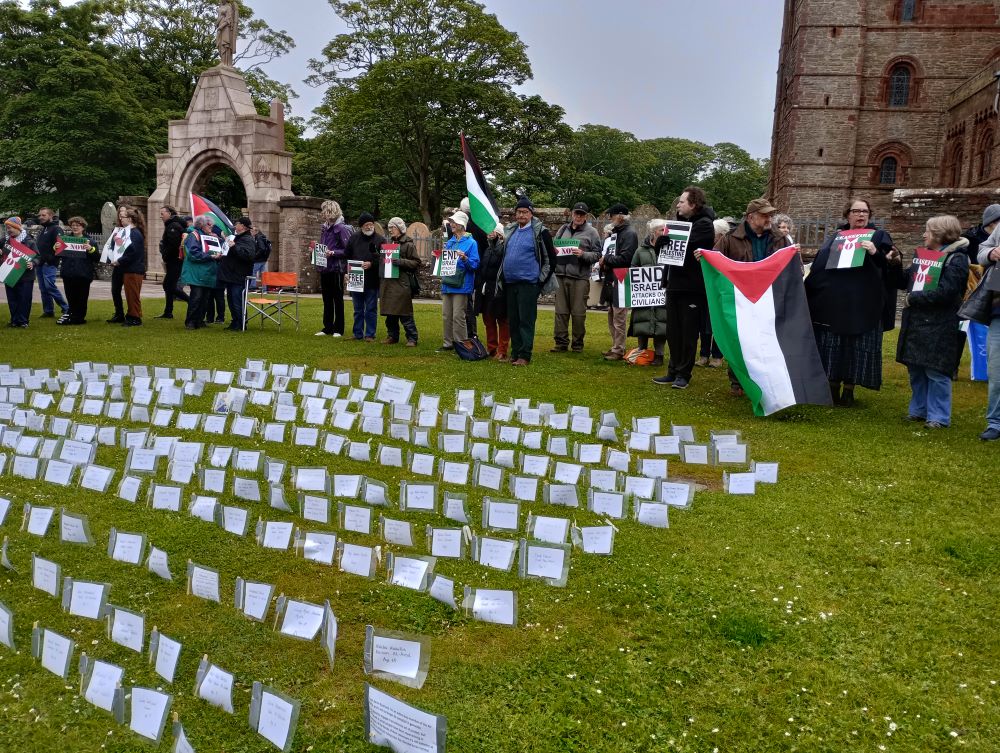

Islanders in Orkney will again be holding their vigil for Gaza on the Kirk Green, Saturday 22nd June, between 1 and 2pm, and invite anyone who shares their hopes for an end to the genocide, a return of all hostages, and for humanitarian aid to get through, to join them.
The Orkney folks have stood in vigil every Saturday throughout the Winter months, Spring and now into Summer.
In Gaza the Summer is bringing scorching temperatures. The UN aid coordination office, OCHA, has highlighted a lack of milk and formula for babies, along with nutritional supplements for children and pregnant and breastfeeding women.
There are visible signs of wasting among children.
Rafah where there were 1.4million people 4 weeks ago, now contains an estimate of 65,000.
For 2000 years, Gaza, situated as it is on the Mediterranean Sea, was an international location for traders and travellers. Its soils and climate produced exquisite wine. As part of international trade ‘The Silk Route’ – goods could be bought and sold in Gaza of the finest quality, including silks and fine spices.
In the 20th Century after Palestine was carved up the new state of Israel successfully took over other areas. Hundreds of thousands of Palestinians fled or were forced out of their homes in what they call Al Nakba, or the “Catastrophe”
Israel occupied Gaza in the 1967 war and stayed until 2005, during that time building illegal Jewish settlements. The United Nations considers the territory to be occupied by Israel. It is a narrow strip of land sandwiched between Israel and the Mediterranean Sea, but with a short southern border with Egypt. Just 41km (25 miles) long and 10km wide, it has more than two million inhabitants and is one of the most densely populated places on Earth.
This year the harvest in Gaza has been decimated by the Israeli bombardments and the manoeuvres of heavy military machinery. As of May this year, about 57 per cent of Gaza’s cropland is estimated to have been damaged, compared to more than 40 per cent in mid-February, according to FAO (the UN Food and Agriculture Organization) and UNOSAT (the UN Satellite Centre).
Hundreds of agricultural structures have also been damaged, FAO said, including 537 home barns, 484 broiler farms, 397 sheep farms and 256 agricultural warehouses, in addition to almost half of Gaza’s agricultural wells (1,049 out of 2,261) as of 20 May.
As of May 2024, crop health and density across the Gaza Strip appears to have substantially declined compared to the average of the past seven years. This deterioration is attributed to conflict-related operations, including razing, heavy vehicle movement, bombing, and shelling. The assessment, which evaluates damage to permanent field crops, vegetables and orchards and other trees, offers an insight into the relationship between conflict-related destruction and the state of the agricultural sector. The extent and severity of the damages highlighted in this assessment underscore the urgent need to provide emergency support to restart local production of fresh and perishable food. UNOSAT and FAO remain committed to providing accurate and timely information to support humanitarian efforts in conflict-affected areas. This satellite imagery-based analysis will serve as a crucial tool for assessing the implications of the damage and guiding emergency relief efforts. UNOSAT
Latest data from the Gazan health authorities indicates that at least 37,396 Palestinians have been killed and 85,523 injured in the enclave. No one knows how many bodies lay buried beneath the rubble of once heavily populated communities.
According to Israeli military figures, at least 664 soldiers have been killed and 3,871 others injured in Gaza since 7th October 2023.
The number of hostages still remaining alive in Gaza is unclear. Many will have died due to Israeli actions to rescue them.
The attack by Hamas on October 7th 2023 killed 1,200 people with 240 taken as hostages. A temporary ceasefire which ended on 1st December saw the release of 100 hostages. Israel has also taken hundreds of Palestinians hostage, including medical personnel, some of whom have died whilst in detention.
Fiona Grahame




Leave a Reply to JohnCancel reply