
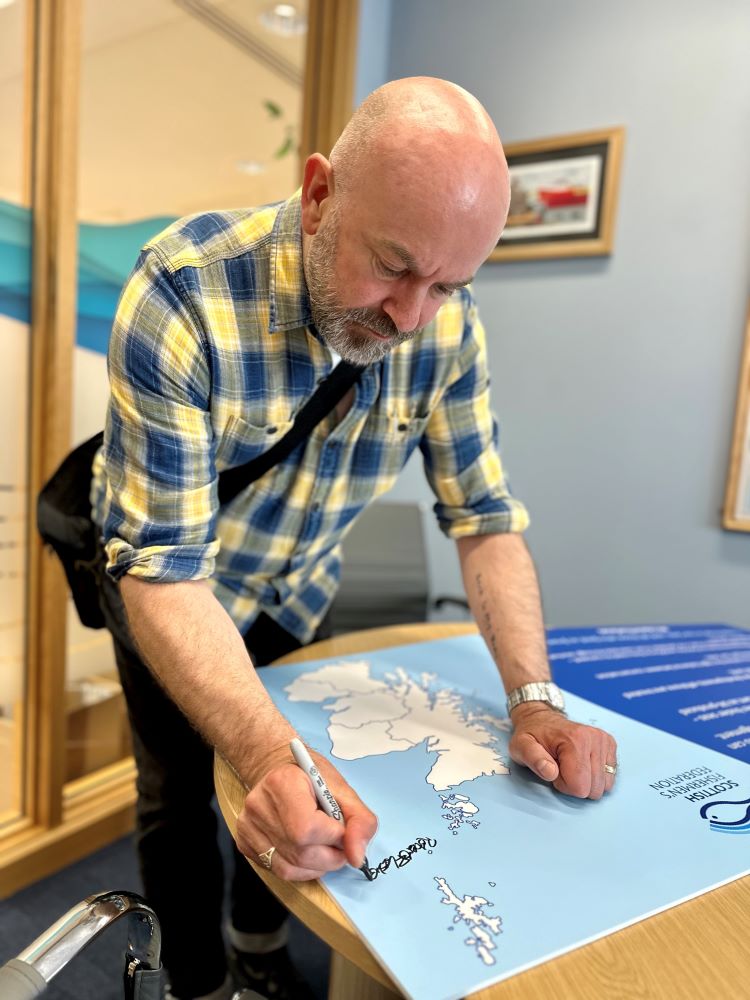
Most of the candidates contesting the Orkney and Shetland Constituency at the General Election on 4th of July have pledged to stand up for Scotland’s fishing sector and the communities it supports.
Organised by the Scottish Fishermen’s Federation (SFF) and hosted by the Shetland Fisherman’s Association alongside the Orkney Fisheries Association, the pledge reflects the growing pressures faced by the sector, which forms a large part of the islands’ economy and cultural heritage.
All but one of the candidates have either signed or vowed to sign the pledge, with only the Reform candidate Robert Smith having made no commitment.
The other candidates are Alex Armitage (Greens), Alistair Carmichael (Lib Dem), Robert Leslie (SNP), Shane Painter (Tories) and Conor Savage (Labour).
Recent polling commissioned by SFF and conducted by Opinion Matters showed that 19 in 20 (95.7%) of Scots believe it is important for the UK to retain control over its fisheries and nine in 10 (89.7%) agree that UK-produced food is just as important as UK-produced energy.

Elspeth Macdonald, Chief Executive of the Scottish Fishermen’s Federation, said:
“We need politicians across Scotland that respect and understand how essential this sector is for the economic and social fabric of constituencies like Orkney and Shetland and for the supply of sustainable, homegrown and healthy protein as part of wider food security.
“So it is hugely encouraging that so many candidates from across the political spectrum in Orkney and Shetland have signed or promised to sign our pledge, reflecting that this is both a local and national issue that should unite us all regardless of party allegiances.”
Shetland is one of six coastal locations that the SFF is highlighting prior to the general election, reflecting the region’s importance as a hub for the sector.
The pledge is:
I pledge to champion Scotland’s vital fishing communities and the sustainable, low-carbon food they provide by:
• Improving the UK’s position as an independent coastal State – deciding who can fish in our waters and making our own decisions about fisheries management.
• Making sure our fishing fleet can continue to thrive in our ever-busier seas – ensuring that UK-produced renewable food as is important as UK-produced renewable energy
• Ensuring that those impacted by renewable developments offshore are treated as they would be for developments on land.
• Using science and evidence to strike the right balance between conservation and sustainable harvesting of our seas.
• Supporting fishing businesses to find the workforce they need to succeed – whether at home or where that’s not possible, from overseas through workable immigration policies.
I have pride in our seas and all those who feed us from them.
Scotland’s fishing fleet is facing increasing pressures from vast offshore renewable projects, which will encroach on traditional fishing grounds.
The Scottish Government decided in the summer of 2023 to shelve its plans to ban fishing in up to 10% of Scottish waters. However, the impact of almost 40% of Scotland’s seas already designated as Marine Protected Areas combined with the industrialisation of our seas through colossal offshore windfarms, fishermen are being squeezed out of traditional fishing grounds.
This “spatial squeeze” has been identified by independent research as having the potential to close more than half of Scottish waters to trawling by 2050. Even if the worst-case assumptions are not realised, an area of 213,000 km² (46% of Scottish waters) is likely to be lost by then, threatening the very existence of fishing businesses and causing severe harm to coastal communities. Most of this area is likely already to have been lost to fishing by 2030.
With the upcoming election, the Scottish Fishermen’s Federation urges politicians to demonstrate their support for the fishing industry and coastal communities. The SFF calls for candidates to prioritise policies that protect fishing and ensures Scotland can continue to produce healthy, sustainable fish and shellfish.
The Scottish Fishermen’s Federation is calling for a re-evaluation of current policies to ensure that the fishing industry is not harmed in the race to expand renewable energy. The industry’s low-carbon footprint, commitment to sustainability and socio-economic importance must be factored into any future decisions.
Opinion Matters surveyed 1005 Scottish adults between 03-07 June 2024.
To find out more about the Scottish Fishermen’s Federation, please visit: https://sff.co.uk/
The candidates standing in the Orkney and Shetland constituency in the General Election on 4th of July are as follows:


Leave a Reply