
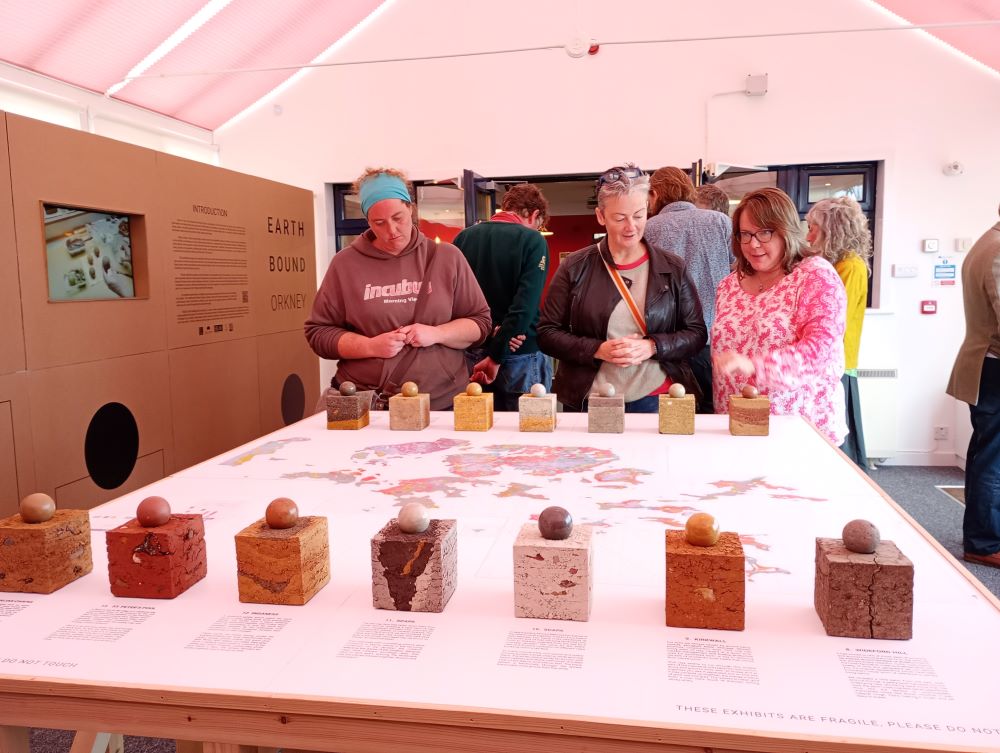
For farmers and keen gardeners the soil beneath our feet is a material they know extremely well. For the rest of us – possibly not so – we mostly take it for granted. A new exhibition showing now at the Maeshowe Visitor Centre not only explores the soils and their structures found in Orkney but leaves us in awe at the beauty of them.

Tom Morton of Arc Architects and Becky Little of Rebearth, specialists in the heritage of natural materials, have been studying Orkney’s clay subsoils for the last three years, funded by Historic Environment Scotland, The National Heritage Lottery and others.
The book which accompanies the exhibition states:
“The things we find and the things we make are part of what defines who we are as humans, and they become what we lay down as cultural markers along the paths we choose, both individually and collectively”
Some of the ‘finds’ in the exhibition are of small clay balls unearthed in the earliest homes constructed in Orkney, and on loan from Orkney Museum.

” More than 62 whole and fragments of near spherical clay objects have been found on eight, mostly domestic, Neolithic archaeological sites on Orkney” – Earthbound Orkney.
The cubes represent layers from the different places they have been collected from and under each one is an explanation. Resting on top of each cube is a sphere made from the same earth as the cubes. The spheres are between 4 and 5 cm in diameter, perfectly palm sized, where they have been rolled and moulded into shape.


In the centre is a map showing the soil and rock content of each part of Orkney. Linked to the places they were collected from are the cubes and spheres.
The accompanying book goes into more detail about the cubes, spheres and where they were collected from. It also points towards the future. For millennia Orkney and Scotland used clays, soils and stone to build with. Natural construction materials.
Tom Morton explained:
‘‘Many people will know that traditional buildings used clay mortar in the walls, but these local natural materials are now enjoying a comeback as sustainable, low carbon construction materials that can contribute to resilient and circular economies of the future, especially for island communities.’’
The Exhibition, Free to Visit
- Maeshowe Visitor Centre, Stenness 27th June – 31st August 2024
- Ship O’Fools Gallery, Kirkwall 5th – 12th September 2024
There will also be a series of workshops during the Orkney International Science Festival linked to the work of this fascinating project.


Fiona Grahame



Leave a Reply to Earthbound Orkney: Training Workshops #OISF24 – The Orkney NewsCancel reply